
The first thing that hits you when you walk through the gate isn’t the size. It’s the silence. A 200,000-square-meter manufacturing complex should rattle, hum, and grind—but ZHHIMG®’s precision granite facility in Jinan operates with the measured calm of a cathedral. The reason becomes clear about three steps inside the main workshop: you’re standing on concrete that weighs more than most buildings, surrounded by trenches designed to isolate every vibration before it reaches a machine bed that might take six months to grind to specification.
This is the largest precision granite manufacturing facility I’ve seen in twenty years of visiting factories across three continents. And if you’re sourcing machine bases, surface plates, or precision platforms longer than four meters, what happens inside these walls matters directly to your procurement decision.
TL;DR
ZHHIMG® operates 200,000m² of manufacturing space (two plants plus a 20,000m² stone yard) near Qingdao Port, with four Taiwan Nantex grinders capable of processing 6-meter platforms. Their 10,000m² constant-temperature workshop maintains ±0.5°C stability over 24 hours. Thirty-year grinding masters achieve micron-level flatness through hand-feel technique that no automated system has replicated. Every measurement is traceable to national metrology institutes through German, Japanese, American, and Swiss calibration equipment.
Why Factory Scale Matters When You’re Buying a 20-Meter Machine Base
Here’s a procurement problem nobody talks about: most granite suppliers can quote you a 3-meter surface plate without hesitation. Push that to 6 meters, and the list shrinks dramatically. Ask for 12 meters, and you’re negotiating with maybe three facilities in the world.
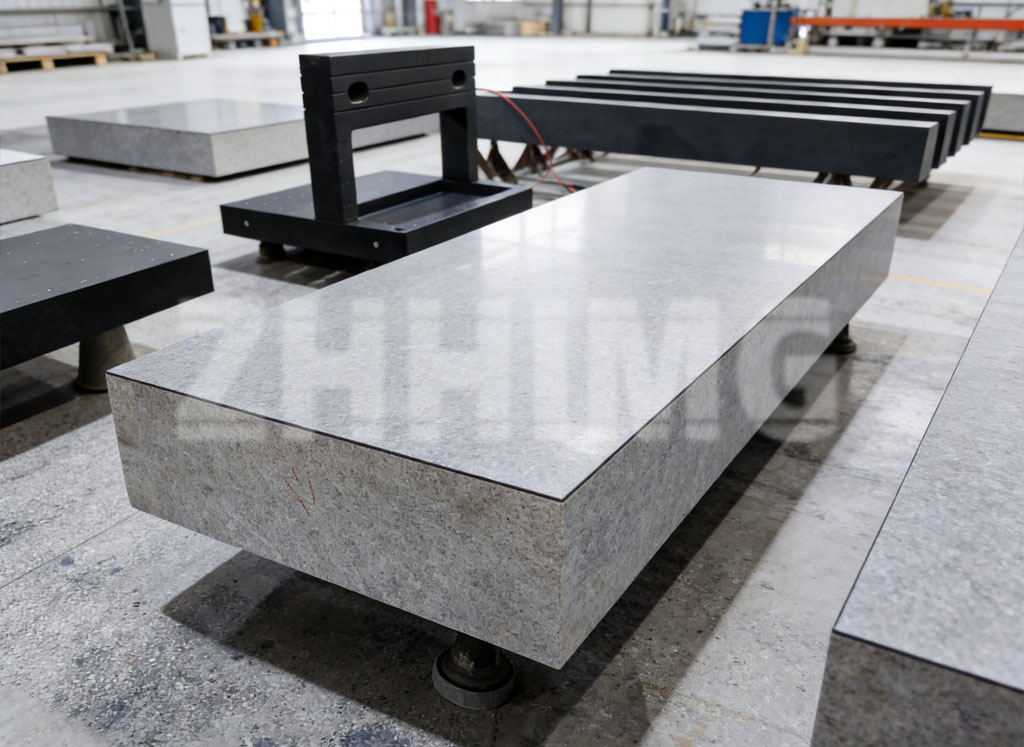
ZHHIMG®’s maximum processing dimensions—20 meters length × 4,000mm width × 1,000mm thickness—exist because scale requires infrastructure that most manufacturers simply don’t invest in. You can’t move a 15-meter granite slab through a doorway designed for standard equipment. You can’t grind a 6-meter surface plate on a machine built for 2-meter parts. And you can’t achieve sub-micron flatness on a 20-meter base if your workshop floor flexes under the vibration of a nearby forklift.
The facility spans 200,000 square meters across two production plants. One of those plants houses a dedicated cleanroom for granite component assembly—the environmental controls mimic semiconductor equipment standards because that’s the level of contamination control precision assembly now requires. This isn’t marketing speak. I watched a technician reject a finished component because a single human hair had landed on the bearing surface during final inspection. That’s the standard.
Monthly capacity sits at 20,000 sets of 5,000mm granite precision machine beds. Let that number sink in: 20,000 precision machine beds per month isn’t just volume. It’s repeatability. It means the processes are locked, the technicians are trained on identical procedures thousands of times over, and the measurement systems have been validated against production volumes that would overwhelm a smaller facility.
The Four Nantex Grinders That Changed How We Think About Precision
Four Taiwan Nantex precision surface grinders sit in the primary production hall. Each unit cost more than $500,000 USD. Most precision machine manufacturers would call one of these the centerpiece of their operation. ZHHIMG® has four.
The Nantex grinders can process 6,000mm precision platforms for both metal and non-metal materials. When you’re sourcing a 5-meter granite machine base, this capability isn’t theoretical—it means ZHHIMG® can machine your platform in fewer operations, with less repositioning, and therefore less accumulated error. A platform ground on a machine designed for 2-meter parts requires multiple setups. Each setup introduces positioning uncertainty. Fewer setups mean tighter tolerances.
Single-piece crane capacity reaches 100 tons. I watched a 40-ton granite slab moved across the factory floor on silent steel wheels, the operator guiding it with a pendant control while the load barely swayed. That’s not an accident—that’s engineering. The crane system runs silent because loud machinery vibrates the floor, and a vibrating floor means your freshly ground surface plate is already degrading before it leaves the machine.
What 10,000m² of Constant Temperature and Humidity Actually Looks Like
“Constant temperature workshop” is a phrase that appears in dozens of precision manufacturing brochures. What does it actually mean inside ZHHIMG®?
The temperature-controlled production area spans 10,000 square meters. The floor isn’t standard concrete—it’s ultra-hard concrete with a minimum thickness of 1,000mm. That’s roughly three feet of solid foundation under every grinding operation. The purpose isn’t structural stability in the traditional sense—it’s vibration isolation. Heavy machinery vibrates. Vibration transmits through floors into machine tool foundations. Even sub-millimeter vibration during a micron-level grinding operation creates surface errors you can measure.
But the floor isn’t enough. Around every major machine, 500mm-wide vibration-damping trenches cut 2,000mm deep into the foundation. The trenches create isolation barriers between the grinder’s operational vibration and the granite being machined. This is the detail most buyers miss when evaluating suppliers—until they’ve received surface plates that pass initial inspection but drift out of tolerance after three months in their own temperature-controlled inspection rooms. The root cause often traces back to residual stress in the stone from uneven thermal expansion during manufacturing, created by temperature gradients that no one controlled.
ZHHIMG® maintains ±0.5°C temperature stability over 24 hours across the entire controlled production zone. Humidity follows similarly tight parameters. These numbers matter because granite expands approximately 5-8 microns per meter per degree Celsius. A 6-meter platform experiencing 2°C temperature variation during grinding will grow or shrink by 60-96 microns during manufacturing—before it ever reaches your facility. That’s the difference between a Grade 00 plate and scrap.
The Vibration-Damping Design Detail Most Buyers Miss — Until It Costs Them
I want to dwell on the vibration isolation system because this is where I’ve seen the most buyer regret. A purchasing manager once told me about a $180,000 granite surface plate that measured perfectly at the supplier’s facility, arrived at his plant, and immediately showed 4 microns of flatness deviation on a 1,200mm plate. His first instinct was that the shipping company had damaged it. The investigation revealed something more subtle: his supplier’s factory floor sat on standard industrial concrete. The grinding operation had created surface stress in the granite that only manifested after temperature equilibration in a different environment.
ZHHIMG®’s approach eliminates this problem at the source. The 2,000mm-deep isolation trenches around each grinder create what amounts to floating foundations. The grinding forces transmit into isolated mass rather than shared floor structure. The granite being machined sits on a platform that isn’t coupling vibration from adjacent equipment, forklifts, or HVAC systems. When your 5-meter machine base leaves ZHHIMG®’s facility, it’s stable. It won’t surprise you three months later.
Meet the Grinding Masters: 30 Years of Hand-Feel at Micron-Level Precision
In the center of the main production hall, I watched a man in his late fifties run his hand across a freshly ground 3-meter granite surface plate. He paused at one section, made a mark with a grease pencil, and nodded to the machine operator. The operator adjusted the grinder’s downfeed by what looked like nothing—maybe 2 microns. They ran another pass. The old man checked again, ran his hand across the surface once more, and stepped back.
“That’s within spec,” he said.
I asked how he knew. He looked at me like I’d asked how he knew his coffee was hot.
“You feel it. A skilled hand reads stone the way a machinist reads a dial indicator. The resistance changes when you’ve removed exactly the right amount. Too little, and the surface feels sticky. Too much, and it goes dull. When it feels right, you know.”
ZHHIMG® employs 30+ grinding masters with this level of experience. Some have been with the company for decades. Their hand-feel technique represents accumulated knowledge that no automated CNC system has successfully replicated. Customers call these masters ”walking electronic levels” because their tactile assessment of a surface often agrees with instrument measurement within half a micron.
This isn’t mysticism. The technique involves consistent hand speed, consistent pressure, and thousands of hours of calibration against known standards. When you combine this human skill with machine precision—four Nantex grinders that position to within microns—you get surfaces that achieve Grade 00 flatness (≤0.5μm/m) consistently, not just occasionally.
Why “If You Can’t Measure It, You Can’t Make It” Is Our Factory Mantra
Precision manufacturing lives or dies by measurement. You can grind the finest surface in the world, but if your measurement system is wrong, you’re shipping problems to your customers.
ZHHIMG®’s metrology lab reads like an international standards showcase: German Mahr 0.5μm micrometers, Mitutoyo equipment from Japan, Swiss WYLER electronic levels, UK Renishaw laser interferometers. Each instrument is calibrated traceable to national metrology institutes. When they measure your surface plate, the measurement is linked back to government-maintained reference standards through an unbroken chain of calibration—every instrument in the chain documented, every calibration certificate filed.
The Renishaw laser interferometer deserves special mention. It measures linear displacement to nanometer resolution across long distances. For a 6-meter granite platform, this system maps flatness deviations across the entire surface, creating a topology map that no hand-held instrument can match. The data doesn’t lie. Either the surface meets Grade 00 specification, or it doesn’t.
Grinding masters use these instruments to validate their hand-feel assessments. Over decades, their tactile technique has been repeatedly calibrated against machine measurement until the two align. This is how “walking electronic levels” get created—not through magic, but through continuous feedback between human skill and instrument validation.
The Calibration Chain That Connects Your Surface Plate to the National Metrology Institute
Every surface plate that ships from ZHHIMG® carries documentation proving its measurement chain. This matters for quality assurance departments that must maintain ISO 17025 compliance or satisfy customer audit requirements. When your customer asks, “How do we know this 2-meter surface plate is actually flat to 1 micron?” you need documentation that traces every step.
ZHHIMG® provides calibration certificates documenting:
- Dimensional verification against traceable reference standards
- Flatness measurement using interferometric or autocollimator methods
- Thermal equilibrium confirmation at time of measurement
- Environmental conditions during final inspection
- Surface finish characterization
The company holds ISO 9001:2015, ISO 45001, and ISO 14001 certifications, plus CE marking for European market access. They’re the only company in this industry segment holding all four major certifications. Additionally, ZHHIMG® has registered over 20 international trademarks and patents across the EU, US, and Southeast Asia through CCPIT.
This certification portfolio isn’t decorative. It means your quality team can audit ZHHIMG®’s processes and find documented procedures at every step. It means when you need to source granite machine bases for GE, Oracle, Samsung, or Apple supply chains, ZHHIMG® already has the documented quality system those enterprises require.
Factory Stats at a Glance
|
Specification |
Detail |
| Total facility area | 200,000m² (2 plants + 20,000m² stone yard) |
| Constant-temperature workshop | 10,000m² |
| Floor thickness | ≥1,000mm ultra-hard concrete |
| Vibration-damping trenches | 500mm wide × 2,000mm deep |
| Max processing dimensions | 20m × 4,000mm × 1,000mm |
| Grinders | 4× Taiwan Nantex (>$500K each) |
| Max single-piece crane capacity | 100 tons |
| Monthly capacity | 20,000 sets of 5,000mm precision machine beds |
| Grinding masters | 30+ years experience |
| Flatness grades available | Grade 00 (≤0.5μm/m), Grade 0 (≤1μm/m), Grade 1 (≤2μm/m) |
| Standards compliance | DIN876, DIN875, DIN650 (Germany); ASME B89 (USA); JIS (Japan); GB (China); BS817-1983 (UK); GOST 10905-1975 (Russia); EIE101-77 (France) |
| Port proximity | Near Qingdao Port |
Frequently Asked Questions
How long does it take to grind a 6-meter granite platform?
Production time varies by flatness specification and surface condition of the raw stone. A Grade 0 (≤1μm/m) surface plate typically requires 2-4 weeks of grinding time. Grade 00 (≤0.5μm/m) platforms may require 6-10 weeks due to the number of measurement-verification cycles involved. The process cannot be rushed—granite must rest between grinding passes to allow internal stress to equilibrate before the next measurement cycle.
What makes ZHHIMG® grinding masters different from automated CNC grinding?
CNC grinding excels at repeatability and speed for standardized geometries. ZHHIMG®’s grinding masters bring adaptive judgment that no current CNC system replicates. They feel thermal drift in the stone, detect stress patterns invisible to instruments, and adjust technique in real-time. For surfaces requiring Grade 00 flatness on non-standard dimensions, this human expertise achieves results that purely automated approaches struggle to match consistently.
How does the constant temperature workshop maintain ±0.5°C stability?
The 10,000m² controlled environment uses precision HVAC systems with redundant sensors throughout the space. Temperature mapping surveys identify hotspots and cold zones, with supplementary conditioning in problem areas. The massive thermal mass of the 1,000mm concrete floor acts as a heat sink that dampens short-term temperature fluctuations. Humidity follows similar control logic. Environmental monitoring logs are available for quality documentation upon request.
Why is vibration damping critical for sub-micron flatness?
Sub-micron grinding operates at the physical limits of precision manufacturing. Even micro-vibrations from adjacent equipment, foot traffic, or HVAC systems can introduce surface errors during the material removal process. ZHHIMG®’s 2,000mm-deep isolation trenches create mechanical isolation between grinding operations and environmental vibration sources. Without this isolation, a 6-meter platform might meet specification when measured in the factory but develop flatness drift during thermal cycling in your facility.
What quality documentation do you provide with each shipment?
Every shipment includes dimensional inspection reports, flatness measurement data, surface finish characterization, thermal equilibrium certificates, and environmental condition logs from final inspection. Calibration certificates for all measurement equipment used during production are available upon request or as standard documentation for OEM orders. ZHHIMG® maintains ISO 9001:2015 documented procedures for all quality processes.
Can overseas buyers visit the factory before placing orders?
Yes. ZHHIMG® regularly hosts international buyers, quality engineers, and OEM procurement teams for facility tours. Factory visits are coordinated through sales representatives and typically include the main production halls, metrology laboratory, cleanroom assembly area, and stone yard. Advance scheduling is required. For buyers unable to visit in person, video documentation of production processes and live measurement demonstrations can be arranged.
Ready to Source Precision Granite at Scale?
ZHHIMG® combines factory scale, manufacturing precision, and quality documentation that satisfies the most demanding procurement specifications. Whether you need single-piece machine bases exceeding 10 meters, monthly volumes of 1,000+ surface plates, or OEM partners who understand the difference between Grade 0 and Grade 00 tolerance, the facility in Jinan is built for your requirements.
Contact the ZHHIMG® export team to discuss your precision granite specifications, request samples, or schedule a facility tour. All communications include direct access to technical sales engineers—not just sales representatives—who can walk you through the exact manufacturing process your order will follow.
Post time: Jun-24-2026