
1. Fatal Weakness of Metal Machine Beds: Continuous Accumulation of Thermal Expansion Errors and Yearly Accuracy Degradation
Conventional substrate materials for equipment such as steel, cast iron and aluminum alloy feature high thermal expansion coefficients and are extremely sensitive to temperature changes. Even a subtle temperature difference of 1–2℃ in the workshop, heat accumulation during continuous machining, and day-night ambient temperature alternation will cause measurable dimensional expansion, contraction and structural deformation of metal beds.
Such tiny deformation seems negligible for a single occurrence, yet precision equipment operates at micron and sub-micron accuracy levels. Frequent thermal expansion and contraction will continuously pull the equipment structure, leading to constant deviation in guide parallelism, worktable flatness and assembly benchmark positions. More importantly, metal materials retain residual thermal stress. Repeated thermal cycles will trigger structural fatigue deformation and permanent benchmark deviation. This is the core reason why most precision machine tools require overhaul and regrinding calibration after 2–3 years of service, which not only raises operation and maintenance costs but also affects the accuracy consistency of mass-produced products.
2. Core Advantage of Low Expansion in Granite: Hardly Any Dimensional Shift Under Minor Temperature Differences
ZHHIMG selects high-density black granite formed over hundreds of millions of years of geological processes. Its mineral structure is dense and uniform with an extremely low thermal expansion coefficient, only 1/3 of cast iron, 1/5 of steel and 1/8 of aluminum alloy. It is one of the best natural substrates for thermal stability in the field of precision equipment.
Unlike metals that deform immediately once temperature changes, granite boasts outstanding thermal inertia and low expansion properties. In the face of regular temperature fluctuations in industrial scenarios, dimensional variation is minimal. Whether it is local temperature rise generated by long-time equipment operation, seasonal temperature difference in workshops or day-night temperature variation, ZHHIMG granite mechanical systems will not show obvious expansion or contraction deformation. The geometric benchmarks, assembly spacing and motion trajectory benchmarks of the whole machine can remain in their initial state, completely eliminating error accumulation caused by temperature cycles.
This low-expansion advantage is greatly amplified in semi-constant-temperature workshops and conventional processing workshops with non-ideal working conditions. The accuracy of metal equipment drifts frequently with temperature fluctuation, while granite equipment can maintain stable benchmarks for a long time without frequent temperature compensation and parameter calibration.
3. Core Value of Low Expansion Property: Achieve a Closed Loop of “Long-Term Zero Drift” Accuracy
Short-term accuracy of precision equipment can be realized through commissioning, calibration and parameter compensation. However, long-term accuracy stability can only be backed by the physical properties of the substrate. The low expansion property of ZHHIMG granite mechanical systems not only solves the problem of instantaneous thermal deformation, but also achieves long-term closed-loop stability of the whole machine accuracy.
In scenarios such as high-speed CNC machining, semiconductor inspection, optical precision measurement and laser micromachining, equipment requires year-round continuous operation under alternating working conditions of dynamic temperature rise and ambient temperature change. Ordinary metal equipment will continuously accumulate thermal errors, leading to enlarged machining dimensional tolerances and poor repeatability of inspection data. In contrast, ZHHIMG granite bases and complete mechanical systems maintain no benchmark shift or geometric accuracy attenuation during long operation thanks to the ultra-low thermal deformation rate. The factory-calibrated precision accuracy of equipment can remain unchanged for years.
Meanwhile, the low expansion property perfectly matches high-precision assemblies including linear motors, air bearing guides and precision optical gratings. Temperature changes will not cause base deformation to squeeze motion pairs or shift sensing benchmarks, ensuring smooth high-speed movement and accurate inspection data. It eliminates systematic accuracy errors from the hardware substrate level. 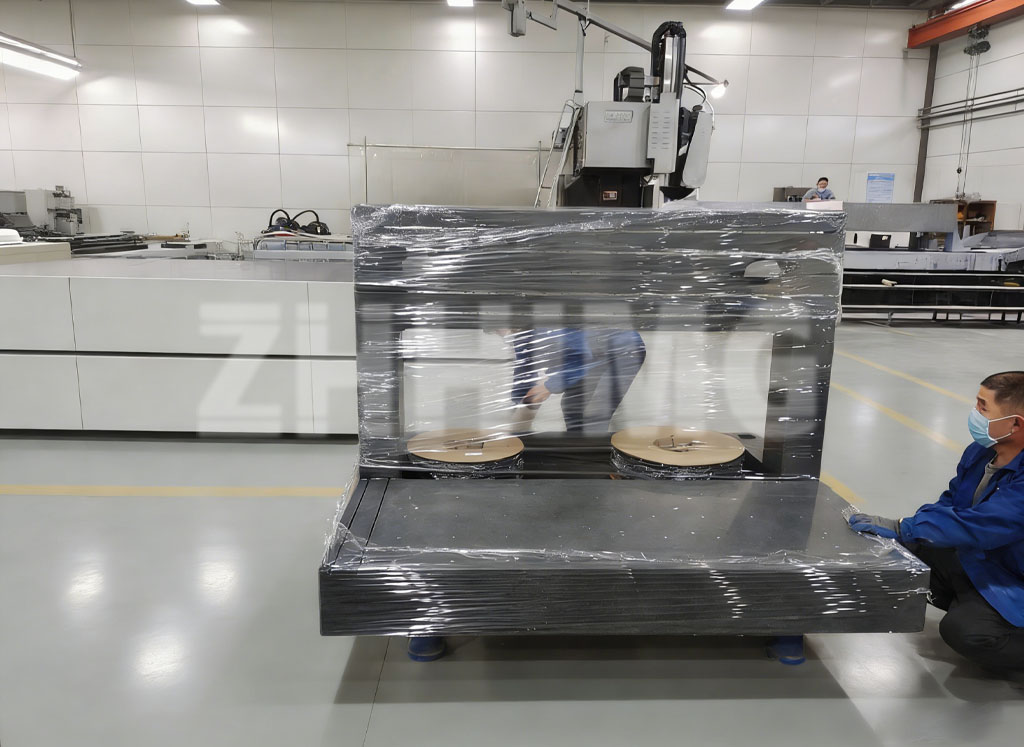
4. Process Enhancement to Amplify Long-Term Thermal Stability
Beyond the natural low-expansion property, ZHHIMG adopts a full set of precision processes to further consolidate the long-term accuracy stability of granite. All granite components undergo multiple rounds of natural aging and artificial stress relief to fully release potential internal stress of the stone and avoid secondary deformation caused by stress coupling during temperature changes.
All finishing and nano-level lapping processes are completed in a constant-temperature, vibration-isolated and dust-free workshop. The machining benchmarks are highly consistent with practical service benchmarks to avoid machining errors generated during production. The integrated monolithic forming structure has no splicing gaps or dissimilar material bonding. Structural dislocation caused by mismatched thermal expansion coefficients of different materials will not occur. The natural advantage of low expansion can be fully released to realize long-term accuracy stability for years or even decades.
5. Application Value: Reduce O&M Costs and Improve Core Competitiveness of Equipment
For precision equipment equipped with ZHHIMG low-expansion granite mechanical systems, the biggest advantage in practical application is no frequent calibration, no overhaul for stability maintenance and non-degrading long-term accuracy. Compared with metal-bed equipment that requires annual calibration compensation and disassembly overhaul every 3–5 years, granite equipment can greatly reduce after-sales maintenance costs and downtime losses.
For equipment manufacturers, stable long-term accuracy serves as a core differentiated advantage of products. It can be perfectly applied to high-end precision manufacturing, scientific research inspection, semiconductor mass production and other scenarios with strict requirements for long-term stability, helping end customers build a mass production system featuring high precision, high consistency and low operation and maintenance.
Conclusion
The accuracy ceiling of precision equipment depends on assembly and algorithms, while accuracy service life is entirely determined by substrate thermal stability. With the core characteristics of ultra-low thermal expansion coefficient, excellent thermal inertia and no thermal error accumulation, ZHHIMG granite mechanical systems tackle accuracy drift caused by temperature fluctuation and long-term working conditions from the source. Combining natural material advantages with precision process enhancement, it fully guarantees the long-term accuracy stability of complete precision CNC, inspection and optical equipment, enabling ultra-precision equipment to truly achieve “one-time calibration, long-term precision”.
Post time: Sep-18-2026