
Every frictionless precision stage is standing on two invisible things: an air film a few microns thick, and the quality of the surface underneath it. Air bearings have become the motion technology of choice for precision measurement, CMM, flatness and roundness inspection and ultra-precision positioning – not because they are simple, but because they remove the one thing no servo can compensate for: contact.
This article explains how air bearings work, why the granite underneath them is a precision component rather than a support block, and what to define before ordering a granite air-bearing platform.
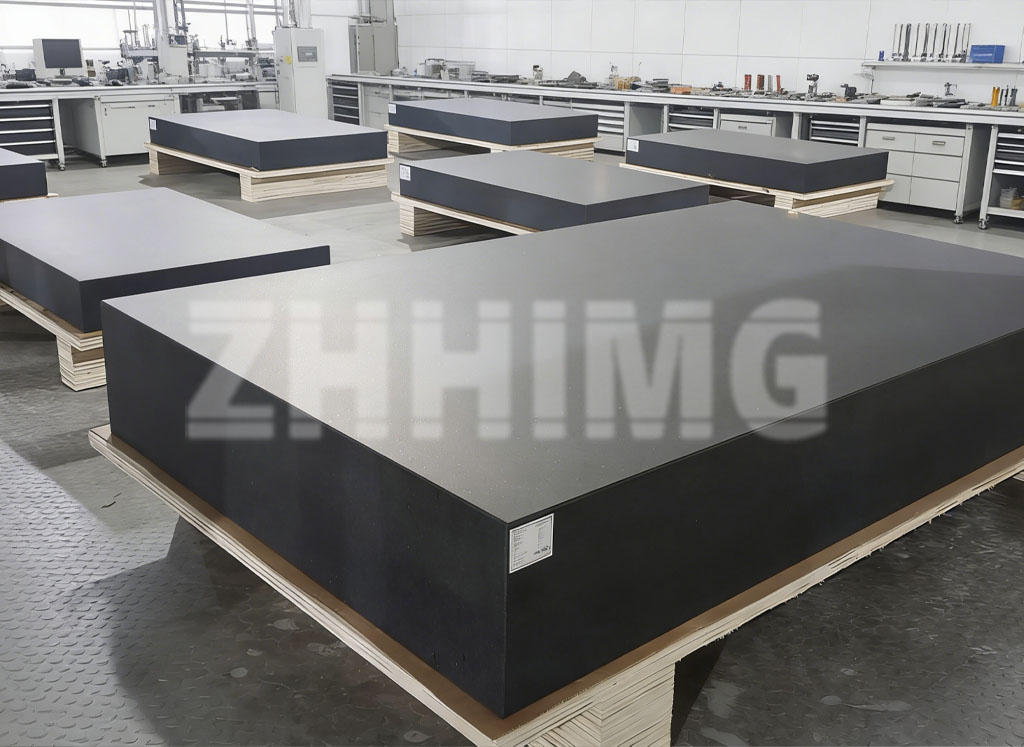
Large lapped granite surfaces at the ZHHIMG workshop – the finished face quality of these plates is what the air film rides on.
1. What Is an Air Bearing?
An air bearing supports and guides a moving part on a thin film of pressurized air instead of on rolling or sliding contact. Compressed air is fed through orifices and throttling restrictions into the gap between the bearing pad and the guide surface. The pressure in this film carries the load; the film itself separates the two surfaces completely.
The consequences follow directly from the physics. With no solid contact, there is no stick-slip at low speed, no lubrication to age or contaminate, and almost no wear – which is why an air bearing stage that is properly engineered can hold its performance for decades. Motion becomes smooth in the truest sense: the moving part never touches anything.
2. How Non-Contact Motion Is Achieved
The working principle is easiest to see in cross-section:
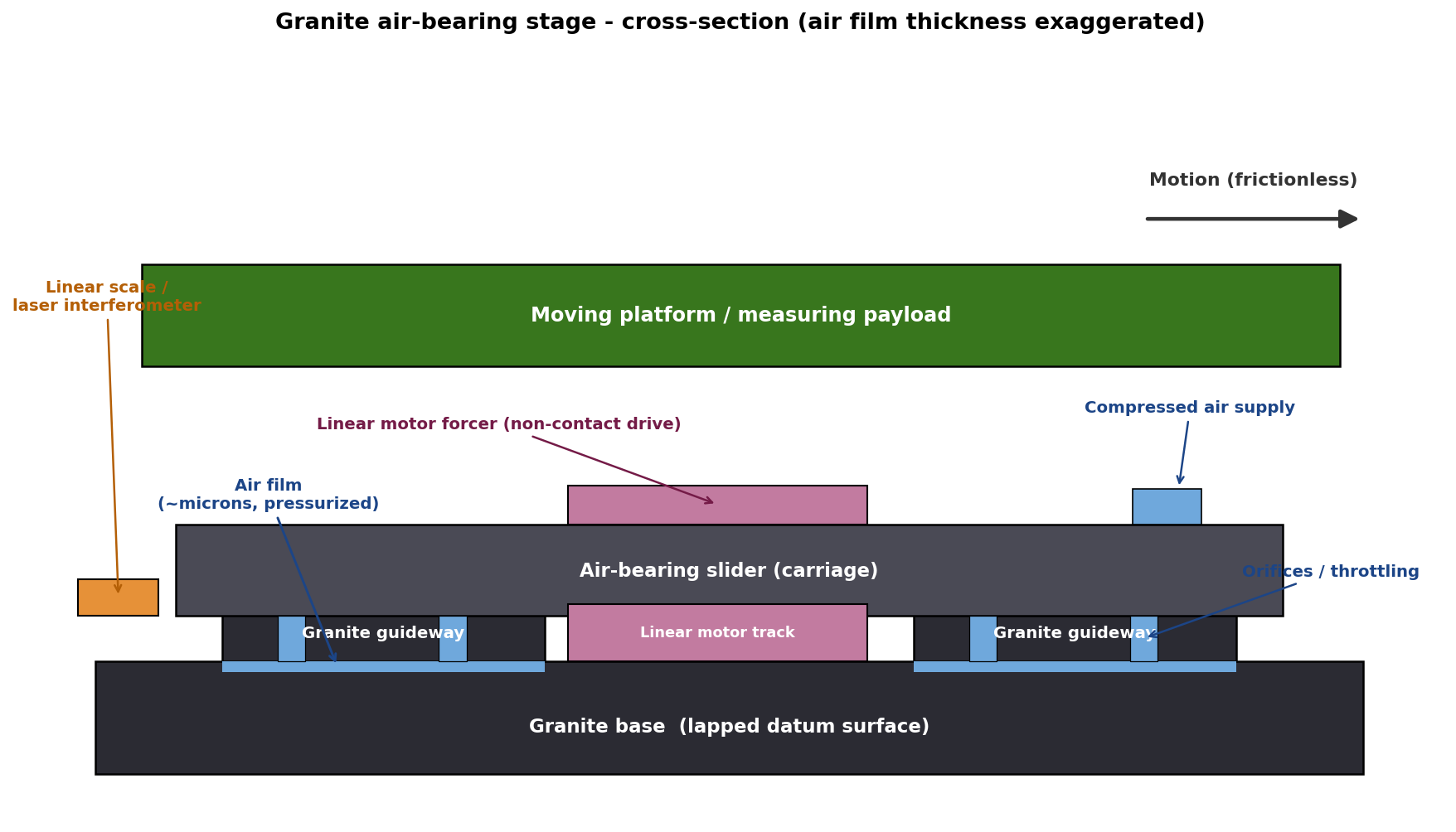
Cross-section of a granite air-bearing stage (air film thickness exaggerated for clarity).
- Granite base and guideways form the lapped datum surfaces of the system.
- Air-bearing sliders wrap the guideways; pressurized air enters through orifices and throttling structures and fills the gap as a continuous air film.
- A linear motor provides non-contact drive, so the force chain has no mechanical transmission either.
- A linear scale or laser interferometer closes the position loop directly on the moving platform.
- The payload – a measuring axis, an optical head, a workpiece – rides on the platform without ever touching the guide.
Every element in that list exists to protect one thing: the geometry of the air gap.
3. Why Air Bearing Systems Demand High-Precision Reference Surfaces
An air bearing has no mechanical compliance to hide behind. The film averages out micro-roughness to a degree, but over the bearing pad it faithfully follows the form error of the guide: if the granite guideway rises a tenth of a micron over the travel, the slider rises with it. Guide straightness and flatness translate almost directly into the motion error of the stage.
This is why surface quality has two jobs in an air bearing system. Form – flatness and straightness over the full travel – defines geometric accuracy. Texture – local finish, porosity and scratches – defines how uniformly the film maintains pressure. A scratch that is invisible to the eye can act as a pressure leak; a pore in the wrong place can cause local unload. Granite responds well to both demands because it can be lapped to sub-micron form with a fine, pore-free, wear-resistant surface that does not corrode in humid supply air.
4. The Role of Granite Guideways and Granite Bases
Within the system, granite typically takes four roles: the base that carries everything and provides the measurement datum, the guideways that define straightness of travel, bridges and columns that hold opposed bearing pads in preloaded designs, and reference faces for metrology. What granite contributes is stability: low thermal expansion, high vibration damping, no rust, and geometry that does not creep after years of load cycling.
The engineering point is that none of this is automatic. A granite machine bed for an air-bearing system must be designed against the whole structure, the load map, the thermal environment and the error budget of the machine – not selected from a catalog by size alone. Bearing preload, for example, is set by the geometry between opposing pads, which means the granite tolerances and the bearing design have to be developed together.
5. Typical Applications
Granite air-bearing systems appear wherever contact would corrupt the result:
- CMM and coordinate measuring systems – frictionless axes and stable datums for probing accuracy.
- Video measuring and optical inspection machines – smooth scanning motion for imaging systems.
- Roundness and flatness measurement equipment – spindles and stages where the reference motion must be purer than the part being measured.
- Semiconductor positioning platforms – clean, non-contact, non-particle-generating motion in controlled environments.
- Precision laser processing platforms – stable beam-to-workpiece geometry at speed.
- Linear motor stages and ultra-precision machine tools – where drive and guidance are both non-contact by design.
6. Parameters to Confirm Before Designing a Granite Air-Bearing Platform
Air-bearing platforms are system designs. Before requesting a proposal, define:
- Load and load map – mass, center of gravity position, and how both change during motion.
- Travel and axis configuration – stroke, single or stacked axes, carriage footprint.
- Motion accuracy targets – straightness, flatness of travel, pitch, roll, yaw, positioning and repeatability.
- Stiffness requirement – how much the stage may deflect under cutting, probing or acceleration forces.
- Air supply conditions – available pressure, dew point, filtration class.
- Drive and feedback – linear motor specification, scale or interferometer, and where they mount on the granite.
- Environment – temperature range and gradient, vibration floor, cleanliness class.
- Interfaces – inserts, dowel patterns, cable management, mounting frame, level adjustment.
Two of these deserve special emphasis: guide straightness and local surface quality are set by the granite workmanship, while stiffness and film behavior are set by the air circuit design – and the two are coupled. Supply them to your supplier as one consistent requirement set, and insist on measured results for both.
7. ZHHIMG® Custom Capabilities
ZHHIMG manufactures granite air bearing components and complete platforms as custom builds: lapped granite bases and guideways with certified geometry, matched bearing surface sets, machined inserts and interfaces, and integration with metal, ceramic and motion components in temperature-controlled assembly workshops. As part of its broader precision granite solutions portfolio, every critical air-bearing surface ships with measurement documentation – geometry values, instrument and conditions – so the film-critical quality is verifiable, not promised.
Conclusion: High-Accuracy Motion Starts From a Stable Reference
An air bearing eliminates friction. Everything else – the straightness of the travel, the purity of the scan, the repeatability a decade from now – comes from the quality of the reference the film rides on. That is why the granite is not the cheapest part of an air-bearing system, and also why it is the part that decides whether the system performs.
ZHHIMG® can customize granite air-bearing bases, guideways and integrated precision assemblies according to your load, travel, motion accuracy, environmental and interface requirements.
Post time: Sep-18-2026