
The CMM mainframe base serves as the geometric origin of the whole measuring machine. All three-axis geometric accuracy and repeatable measurement performance of the equipment are built upon the base benchmark. Many processors only focus on flatness indicators while ignoring raw material selection, multi-stage aging, low-stress cutting, constant-temperature machining environment and integrated control of embedded inserts. After assembly, finished products gradually suffer benchmark deformation with ambient temperature variation and continuous load, resulting in insufficient long-term stability of CMM. Machining of high-stability granite CMM bases is not simply grinding a flat tabletop. It forms a complete process chain covering raw material screening, stress relief, forming, precision lapping and multi-dimensional metrology verification, to minimize residual stress inside the material and guarantee long-term geometric stability of the benchmark.
Raw block screening acts as the first critical step for high-stability base machining. Ordinary granite has uneven crystal phases and hidden microcracks. Even if short-term precision meets requirements after machining, microcracks expand gradually under cold and hot cycles and continuous load, causing slow benchmark deformation. ZHHIMG® adopts high-density black granite raw blocks with density up to 3100kg/m³, featuring dense and uniform crystal phases and very few internal defects. After arrival, raw blocks go through ultrasonic flaw detection to inspect invisible internal microcracks and pores, followed by natural aging standing to release native stress generated during quarrying and cutting, avoiding benchmark rebound after precision finishing. This step lays the underlying foundation for long-term stability.
In rough machining and structural forming, the core principle is **low-stress material removal**. Conventional deep-cut and high-feed cutting introduces machining stress and microscopic damage on stone surfaces. ZHHIMG adopts progressive stock removal technology. Contours, weight-reduction cavities, mounting slots and holes are formed synchronously. R-fillet transitions are applied on all sharp corners to eliminate stress concentration points. When machining weight-reduction cavities, finite element mechanical simulation optimizes cavity layout instead of hollowing blindly, balancing dead weight, rigidity and thermal inertia to prevent elastic deformation under self-weight and workpiece load. Low-speed water-cooled diamond machining is adopted for holes and prefabricated slots of embedded sleeves. Dry drilling and impact drilling are forbidden to avoid edge chipping and internal microcracks of stone. After forming, the workpiece proceeds to secondary constant-temperature standing aging to release surface stress brought by rough cutting and prevent benchmark rebound after precision finishing.
Ultra-precision grinding and manual fine lapping must be carried out in constant-temperature & constant-humidity workshops. ZHHIMG’s 10,000 ㎡ constant-temperature workshop is built with thick superhard concrete floor and independent vibration isolation trenches to isolate external vibration disturbance and avoid uneven lapping texture induced by vibration during grinding. Large-stroke Taiwan Nantou ultra-large grinders are deployed for multi-stage grinding from rough grinding, semi-finish grinding to fine grinding, gradually changing abrasive grit without skipping grades to eliminate tool marks and grinding stress. After grinding, technicians with more than 30 years of experience perform nanometer-level manual fine lapping on guide rail mounting benchmarks and worktable surfaces, optimizing surface micro-morphology to guarantee uniform air-float bearing clearance and smooth three-axis motion. The texture direction of lapped surfaces is specially designed to reduce micro-wear during reciprocating movement of air bearings.
Assembly and sealing of embedded metal sleeves are easily overlooked but vital for high-stability base machining. Granite itself will not deform or corrode, yet improperly bonded and sealed threaded sleeves and locating pin seats may loosen or expand from corrosion under temperature and humidity variation, squeezing the granite substrate and causing local protrusion of benchmarks. Before press-fitting, ZHHIMG passivates and anti-corrosion treats metal inserts. Special high-stability adhesive is used to ensure void-free bonding between sleeves and stone, with controlled press-fitting pressure to prevent matrix extrusion from assembly stress. After all sleeves are fitted, the base stands in constant-temperature environment for full curing of adhesive. Hole coordinate, perpendicularity and flatness are re-tested to avoid position shift during curing.
Final inspection is not limited to static single-point testing. Multi-dimensional grid verification is required. Referring to DIN, ASME, GB and other international metrology standards, full sets of traceable measuring instruments including Germany Mahr dial gauges, Swiss WYLER electronic levels and laser interferometers are deployed. Besides flatness, straightness, perpendicularity and hole coordinate tolerance, grid scanning is performed to evaluate deformation distribution over the whole benchmark surface. Self-weight support simulation test is also carried out: simulating stress state under customer on-site support points, verifying deformation and rebound before and after unloading to confirm no irreversible deformation. Many manufacturers only sample a few points under ideal constant-temperature no-load conditions. Once delivered to customer sites, benchmark accuracy drifts due to changed support stress. 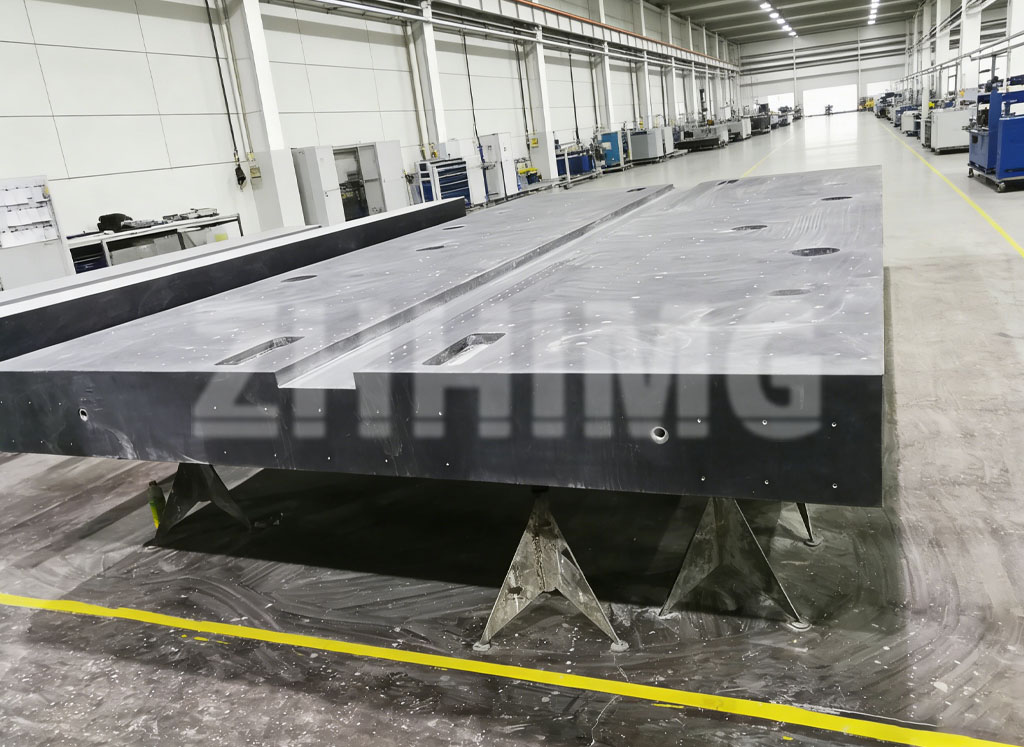
Finishing machining is not the end of the process. Constant-temperature standing before delivery is the final safeguard for stability. After precision lapping, granite bases continue to rest in constant-temperature workshops long enough for minor machining stress to fully release. All geometric indicators are rechecked. Products can only be packaged and shipped after stable indicators with no drift. ZHHIMG also provides technical guidance for hoisting, transportation and on-site leveling to prevent benchmark damage from improper force during transit and installation.
In short, the core logic for machining high-stability granite CMM mainframe bases is **stress control through the whole process**. From raw block flaw detection and aging, low-stress forming, constant-temperature multi-stage grinding, precision assembly of embedded sleeves, to grid-based simulated load inspection, every step reduces stress introduction and eliminates hidden deformation risks. Leveraging multi-material precision component manufacturing capability and joint R&D experience with domestic and overseas metrology institutes, ZHHIMG granite CMM bases maintain micron-level benchmarks steadily over long periods, supporting excellent repeatability of CMM during long batch measurement and lowering calibration and maintenance cost of complete machines.
Post time: Oct-14-2026