
Conventional granite CMMs are mostly deployed in clean metrology rooms. However, many production lines require measurement stations close to machining areas, where equipment is continuously exposed to metal dust, cutting fluid splashes and oil mist. Many users assume granite itself is immune to water and oil and only install simple outer protective covers, ignoring weak points such as granite micropores, air-float guideways and embedded metal inserts. Dust scratches nano-lapped benchmark surfaces, while cutting fluid seeping into stone micropores triggers local expansion. The combined effect gradually degrades repeatability. Under such harsh working conditions, protection is not limited to adding dust covers. It is a systematic protection solution integrating substrate micropore sealing, moving-part isolation, gas source purification, anti-corrosion for embedded components and environmental zoning.
The primary protection is micropore sealing for the granite body. Even premium black granite retains microscopic capillary gaps between mineral crystals. Suspended cutting fluid oil mist penetrates into these micropores and is hard to remove completely. Trapped liquid causes micro-expansion of local stone and impairs benchmark flatness. Dust trapped inside capillary gaps abrades air-float bearing surfaces during repeated movement. When manufacturing granite components for shop-floor measuring machines, ZHHIMG can apply penetrating sealing treatment at factory stage. The protective agent permeates surface micropores and blocks capillary channels without altering geometric precision or forming thick surface films, stopping penetration of cutting fluid and emulsion. This treatment only acts on the surface layer and keeps granite’s original low thermal expansion and high damping properties. Meanwhile, edges of the worktable are rounded to eliminate sharp gaps prone to dust accumulation and reduce jamming risks of hard metal chips. It should be noted that air-float working surfaces are only sealed at micropore level. Thick coatings are forbidden, otherwise air-float gaps will be changed and air bearings may jam.
The second protection category covers dust and liquid isolation for motion systems and air-float guideways. Air-float bearings maintain micron-level clearance against granite guideways. Once metal dust enters this gap, it easily scratches lapped surfaces and triggers motion jitter. Cutting fluid mist adhering to guideways contaminates air supply holes and blocks gas passages. The solution combines mechanical isolation and air source purification. Folding bellows shields fully enclose X/Y three-axis moving guideways to block splashing cutting fluid and large dust particles. The shields adopt cutting-fluid-resistant materials with reserved maintenance openings to avoid full disassembly during servicing. Multi-stage drying and precision filters are installed on the air supply pipeline to remove oil, moisture and solid particles from compressed air, preventing water vapor and oil contamination of granite air holes along gas circuits. This protection differentiates splashing droplets and suspended oil mist. Ordinary outer covers only block liquid splashes; oil mist requires additional local negative-pressure dust collection to reduce mist accumulation inside the measuring chamber.
Thirdly, anti-corrosion protection for embedded metal inserts and fasteners. Granite will not rust, yet threaded sleeves, locating pins and guide rail mounting bases embedded inside the worktable corrode gradually under cutting fluid mist and high humidity. Expanded rust squeezes adjacent granite, creating local protrusions on benchmarks and hidden measurement deviation. During machining, ZHHIMG applies passivation and anti-corrosion coatings on all metal embedded inserts, and optimizes sealant at joints between inserts and granite to stop cutting fluid penetrating along bonding gaps. After assembly, protective plugs are fitted on all counterbores and threaded holes to prevent dust and cutting fluid from accumulating inside cavities, fundamentally avoiding benchmark deformation induced by metal corrosion.
Fourth, zoning protection and flow-guiding design for workpiece loading zones. The workpiece loading area is the main entry point for dust and cutting fluid. Modular oil-resistant protective plates can be installed on non-guideway regions of the granite table. Workpieces carrying residual cutting fluid rest on these plates instead of directly contacting granite benchmark surfaces. Liquid guide grooves and drainage holes are built into the table to drain dripping cutting fluid outwards and prevent liquid overflow onto air-float guideways. Metal chips and leftover emulsion must be cleaned immediately after measurement and shall not stay on the table for extended periods. The plates are modular and replaceable. Worn plates can be changed separately without reworking the granite main body and greatly cut maintenance costs.
Fifth, auxiliary environmental isolation and foundation protection. If the measuring station sits next to milling or grinding machines, equipment-only protection is insufficient against persistent oil mist and dust. A simple independent dust-isolation booth with local air purification can be constructed to keep dust and oil mist concentration within acceptable limits. Waterproof and vibration-damping pads are added under the foundation and support points to stop spilled cutting fluid from seeping into ground, preventing foundation moisture and local settlement that distorts granite benchmarks. At the preliminary evaluation phase, ZHHIMG selects suitable protection grades according to on-site dust concentration and cutting fluid type (emulsion or neat cutting oil), distinguishing intermittent splashing conditions from continuous oil mist environments, to avoid over-simplified or redundant protection schemes. 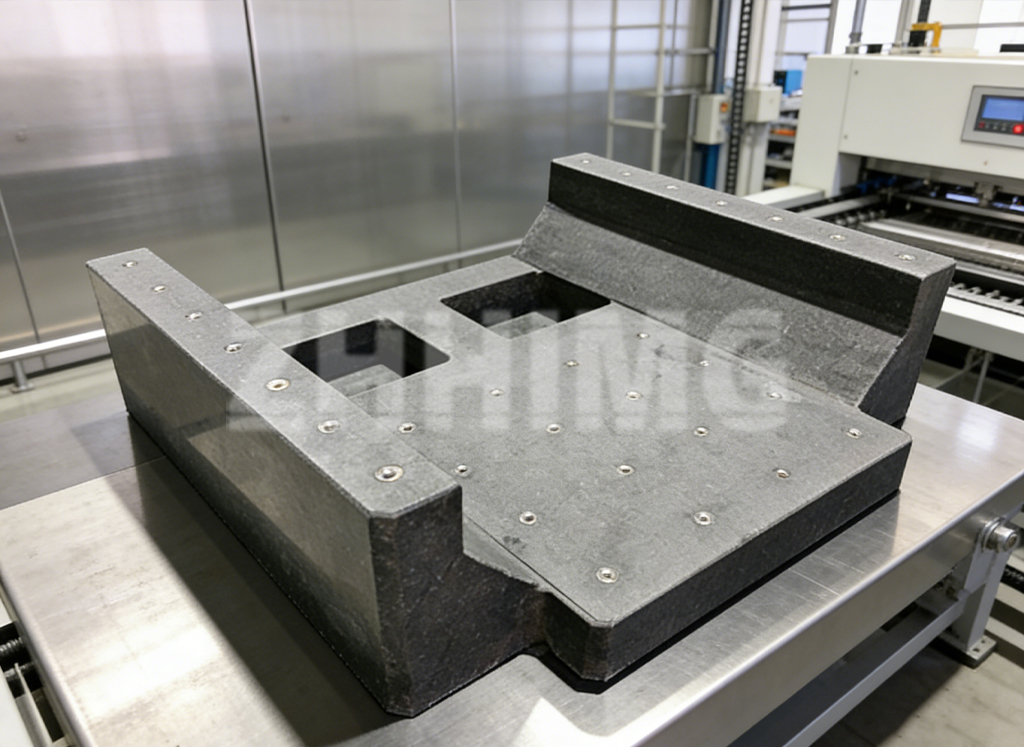
Finally, supporting inspection and maintenance standards. Protection treatment is not a one-time job. Periodic inspection routines must be established. Before delivery, benchmark precision is verified with Mahr dial gauges and WYLER electronic levels referring to DIN, ASME and GB metrology standards. Spray simulation tests are also carried out to validate benchmark stability under oil mist and dust conditions. In daily maintenance, dedicated neutral detergent and lint-free cloth are used for unidirectional cleaning of granite benchmarks. Strong acid or alkaline cleaners are prohibited, which would destroy the micropore sealing layer. Shield tightness, air filters and anti-corrosion state of inserts are checked regularly to detect hidden risks before precision drift occurs.
In short, the core principle of granite CMM protection under dust and cutting fluid conditions is blocking contaminants from contacting critical benchmarks. It adopts multi-dimensional protection including granite micropore sealing, 3-axis motion bellows shielding, air purification, anti-corrosion of embedded inserts and liquid diversion in workpiece zones. Leveraging experience in multi-material precision component machining and technical cooperation with metrology institutes, ZHHIMG Group customizes graded protection schemes for shop-floor granite measuring machines. It allows measuring equipment to be placed close to machining stations, maintaining nano and micron benchmark stability in oil mist and dust environments for long-term operation, reducing downtime and balancing on-line inspection efficiency and reliable measurement data.
Post time: Oct-14-2026