
How proper maintenance transforms your granite measuring tools from precision instruments into long-term assets
Introduction: When Precision Slips Away
In a precision machining facility in Michigan, a quality control team discovered a disturbing trend: their granite surface plates, once capable of measuring tolerances within ±0.0002 inches, were now producing inconsistent readings that varied by as much as ±0.001 inches. After weeks of investigation, the root cause emerged—not equipment failure or operator error, but improper maintenance practices that had gradually degraded the surface integrity over several years.
This scenario plays out across manufacturing facilities worldwide. Granite measuring tools—surface plates, parallel gauges, angle plates, and inspection tables—represent significant capital investments, yet many organizations fail to implement systematic maintenance protocols. The result? Premature equipment degradation, measurement inaccuracies that compromise product quality, and costly replacements that could have been avoided.
Granite’s inherent durability creates a paradox: its toughness leads organizations to assume it requires minimal care, yet precision applications demand meticulous attention. A granite surface plate may retain its structural integrity for decades while gradually losing the dimensional accuracy essential for precision measurement.
This guide presents four essential maintenance steps that extend equipment lifespan, maintain measurement accuracy, and protect your investment. Whether you’re managing a metrology laboratory, operating CNC machining centers, or overseeing quality control operations, these practices will transform maintenance from a necessary expense into a strategic investment.
Step 1: Cleaning and Protection — The Foundation of Precision
Understanding the Enemy: Contaminants That Compromise Accuracy
Every measurement performed on a granite surface introduces potential contaminants—metal shavings, cutting fluids, oils, dust, and microscopic particles that accumulate in the stone’s micropores. These contaminants act as abrasives, gradually wearing the precision-ground surface with each use.
The impact is measurable: Studies show that poorly maintained granite surface plates can lose accuracy at rates 3-5 times faster than properly cleaned surfaces, with wear spots developing in high-traffic areas within 12-18 months of heavy use.
Professional Cleaning Protocol
Selecting the Right Cleaning Agent
The choice of cleaning solution directly affects surface integrity:
-
Avoid water-based cleaners: Granite’s porosity means water absorption can cause localized expansion, affecting dimensional stability. In humid environments, absorbed moisture creates breeding grounds for mold and mildew that further degrade the surface.
-
Recommended solutions: Professional-grade granite cleaners, isopropyl alcohol (91% or higher), or acetone-based cleaners effectively remove oils and contaminants without leaving residues. These solutions evaporate quickly, minimizing thermal shock effects.
-
Application technique: Use two dedicated soft cloths—one for application, one for drying. Apply cleaning solution with the first cloth in a systematic pattern (e.g., left-to-right, top-to-bottom), then immediately dry with the second cloth using circular motions. This two-cloth method prevents contaminant redistribution.
Cleaning Frequency Guidelines:
| Usage Pattern | Cleaning Frequency |
|---|---|
| Light use (< 4 hours/day) | Weekly |
| Moderate use (4-8 hours/day) | Daily after each shift |
| Heavy use (> 8 hours/day) | Before and after each use |
| High-precision applications | Before every measurement |
Protection Strategies
Dust Covers: Your First Line of Defense
When not in active use, granite measuring tools should be protected with fitted covers. Dust particles—though seemingly harmless—act as microscopic abrasives that accelerate surface wear. In facilities with airborne metal particles or machining debris, covers become critical.
Best practices:
- Use breathable fabric covers that prevent condensation buildup
- Ensure covers fit snugly without dragging across the surface
- Clean covers regularly to prevent accumulated debris from transferring to the granite
Collision Prevention
Granite’s hardness (Mohs 6-7) exceeds most metals, but chipping and cracking occur through impacts, not scratches. Implement protocols that prevent:
- Dropping heavy workpieces onto surfaces
- Sliding metal fixtures without protective pads
- Using granite surfaces as temporary storage for tools or components
A telling statistic: Analysis of damaged granite surface plates reveals that over 60% of significant damage (chips, cracks) originates from impact events, not gradual wear.
Step 2: Temperature and Humidity Control — Environmental Mastery
Why Environment Matters for Granite
While granite exhibits excellent thermal stability compared to metals, it’s not immune to environmental influences. The thermal expansion coefficient of granite (approximately 4-6 × 10⁻⁶/°C) means a 1-meter surface plate can expand or contract by 4-6 microns with a 1°C temperature change. For applications tolerating ±1-2 microns, uncontrolled environments introduce significant uncertainty.
Humidity presents different challenges. Granite’s microporous structure absorbs moisture in high-humidity conditions, potentially causing:
- Localized expansion affecting flatness
- Surface staining from absorbed contaminants
- Accelerated wear in moist conditions
Optimal Environmental Parameters
Temperature Standards:
The metrology industry standard specifies 20°C ± 2°C (68°F ± 3.6°F) as the reference temperature for precision measurement. This range balances:
- Human comfort for operators
- Equipment thermal stability
- Cost-effective environmental control
For ultra-high-precision applications (tolerances < 1 micron), tighter control (20°C ± 0.5°C) may be required.
Humidity Guidelines:
Maintain 40-60% relative humidity to prevent:
- Moisture absorption at higher humidity levels
- Static electricity buildup at lower humidity levels
- Operator discomfort that affects measurement consistency
Practical Implementation
HVAC System Requirements:
For facilities housing precision granite equipment:
- Install dedicated air conditioning systems sized for continuous operation
- Position vents to avoid direct airflow onto granite surfaces (prevents localized cooling)
- Implement temperature monitoring with data logging for quality audit trails
Dehumidification Solutions:
In humid climates or environments with moisture-generating processes:
- Industrial dehumidifiers rated for facility size
- Desiccant-based systems for precise humidity control
- Regular monitoring with calibrated hygrometers
Environmental Isolation:
Where possible, locate precision measurement areas:
- Away from exterior walls (thermal bridging effects)
- Separated from heat-generating equipment
- Protected from direct sunlight through windows
Real-world example: A semiconductor equipment manufacturer implemented environmental controls for their granite surface plates and documented a 40% reduction in measurement variability, translating to improved process capability indices (Cpk values) for their critical dimensions.
Step 3: Regular Calibration — Detecting Drift Before It Matters
The Calibration Imperative
Calibration serves two critical functions:
- Verification: Confirming the granite surface meets specified accuracy grades
- Trending: Tracking gradual degradation to predict maintenance needs
Without regular calibration, organizations operate with hidden uncertainty—measurement results appear normal while accuracy silently degrades.
Understanding Accuracy Grades
Granite surface plates are classified by flatness tolerance:
| Grade | Maximum Deviation | Typical Applications |
|---|---|---|
| Laboratory (Grade AA) | 0.00005″ × diagonal length | Calibration laboratories, semiconductor inspection |
| Inspection (Grade A) | 0.0001″ × diagonal length | Quality control, precision machining |
| Toolroom (Grade B) | 0.0002″ × diagonal length | General manufacturing, fabrication |
| Workshop (Grade C) | 0.0004″ × diagonal length | Non-critical applications, training |
Each grade represents maximum allowable deviation. Regular calibration verifies your equipment maintains its certified grade.
Calibration Frequency: A Risk-Based Approach
Standard Intervals:
- Heavy use (daily measurement operations): 6-12 months
- Moderate use (weekly operations): 12-24 months
- Light use (monthly or less): 24-36 months
Factors requiring more frequent calibration:
- High-precision applications (tolerances < 5 microns)
- Harsh environments (temperature swings, contaminants)
- Regulatory requirements (ISO 17025, AS9100)
- History of out-of-tolerance findings
Immediate calibration triggers:
- Suspected impact or damage
- Significant environmental events (flooding, extreme temperature)
- Out-of-specification measurement results
- Before critical measurement campaigns
Calibration Methods and Equipment
Professional Calibration Services:
Third-party calibration laboratories employ sophisticated methods:
- Electronic levels: Measure angular deviations across the surface with resolution to 0.1 arc seconds
- Autocollimators: Optical measurement of surface flatness with micron-level precision
- Laser interferometers: Non-contact measurement providing comprehensive surface mapping
- Repeat reading gauges: Portable devices for interim checks between formal calibrations
Selecting a Calibration Provider:
Evaluate potential calibration partners on:
- Accreditation: ISO 17025 accreditation ensures traceable measurements
- Experience: Track record with similar equipment and industries
- Capabilities: On-site calibration minimizes equipment downtime
- Reporting: Comprehensive certificates with uncertainty analysis
Documentation Requirements:
Calibration certificates should include:
- Measurement results and comparison to specifications
- Uncertainty analysis (critical for ISO 17025 compliance)
- Traceability information to national standards
- Next calibration due date
- Environmental conditions during calibration
Quality system integration: Maintain calibration records for audit compliance. ISO 9001 and AS9100 require documented evidence of equipment calibration and suitability for intended use.
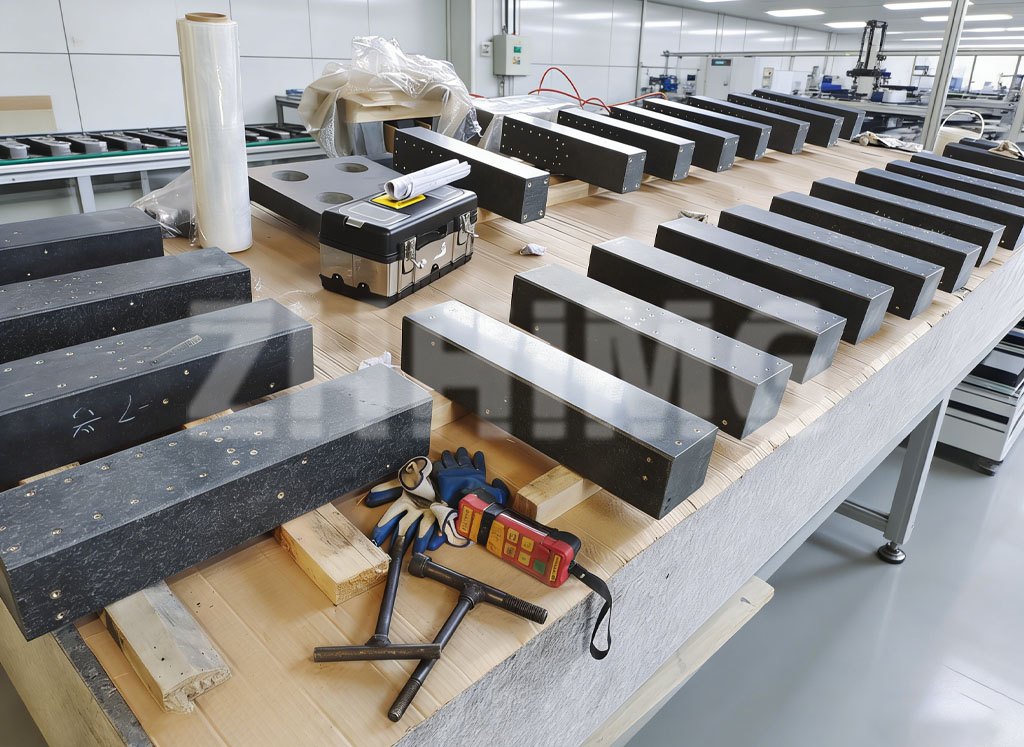
Step 4: Surface Restoration — Breathing New Life into Worn Surfaces
Recognizing When Restoration Is Needed
Calibration may reveal surface degradation requiring restoration. Key indicators:
- Flatness deviation exceeding grade specification
- Visible wear patterns or “shiny spots” indicating localized wear
- Surface scratches or nicks that affect measurement contact
- Contamination that cannot be removed through cleaning
Restoration Options
Minor Repairs (In-House):
For superficial damage:
-
Scratch removal: Use silicon carbide stones (400-600 grit) to gently remove raised burrs around scratches. Work in circular motions with light pressure, then blend the area with finer grits.
-
Chip repair: Small chips (< 3mm) can be filled with color-matched epoxy resin. Clean the area thoroughly, apply epoxy, allow curing, then sand flush with the surface using progressively finer grits.
-
Surface polishing: For dull areas, apply granite polishing compound with a felt pad, working in circular motions until the finish matches the surrounding surface.
Professional Resurfacing:
For significant degradation:
Professional restoration services employ precision lapping and grinding techniques:
-
Assessment: Detailed surface mapping identifies wear patterns and determines material removal requirements.
-
Lapping: Progressive grinding with diamond abrasives removes surface material uniformly, restoring flatness. Starting with coarse grits (typically 200-400) and progressing through finer grits (up to 3000 or higher).
-
Precision grinding: For severe wear, precision grinding machines restore flatness to original specifications.
-
Certification: Post-restoration calibration verifies the surface meets specified accuracy grade.
The economics of restoration: Professional resurfacing typically costs 30-50% of replacement cost while extending equipment life by 5-10 years. For large surface plates or custom configurations, restoration becomes even more economically attractive.
Restoration Timing
Proactive restoration: Address degradation early, before accuracy falls below critical thresholds. This approach:
- Minimizes material removal required
- Maintains continuous equipment availability
- Reduces risk of catastrophic failure
Reactive restoration: Waiting until accuracy is compromised results in:
- Greater material removal (shorter remaining lifespan)
- Extended equipment downtime
- Potential production impacts during restoration
Maintenance Checklist Template: Your Systematic Approach
Implementing a structured maintenance program requires documentation. Use this checklist template to ensure consistent practices:
Daily Tasks
- Clean surface before first use
- Clean surface after final use
- Inspect for visible damage or contamination
- Apply protective cover when not in use
- Record environmental conditions (temperature, humidity)
Weekly Tasks
- Thorough surface cleaning with appropriate solutions
- Inspect for wear patterns or surface degradation
- Verify protective equipment (covers, supports) condition
- Check environmental control systems operation
- Review measurement logs for anomalies
Monthly Tasks
- Detailed visual inspection with magnification
- Check for loose supports or mounting hardware
- Verify environmental monitoring equipment calibration
- Review calibration schedule and plan upcoming needs
- Update maintenance logs and documentation
Annual Tasks
- Professional calibration by accredited laboratory
- Comprehensive surface assessment
- Environmental control system maintenance
- Calibration certificate filing and quality system updates
- Training refresh for operators on proper procedures
Common Maintenance Mistakes to Avoid
Learning from others’ errors prevents costly lessons:
Mistake 1: Using Metal Scrapers or Blades
The error: Attempting to remove stuck-on debris with metal scrapers, razor blades, or putty knives.
The consequence: Microscopic scratches that accumulate into surface degradation. Even hardened steel (Mohs 5-5.5) can scratch granite under concentrated pressure.
The solution: Use plastic scrapers or wooden tools for debris removal, followed by appropriate cleaning solutions.
Mistake 2: Ignoring Environmental Factors
The error: Assuming granite’s stability means it’s immune to environmental conditions.
The consequence: Gradual accuracy drift that goes undetected until critical measurements fail.
The solution: Implement continuous environmental monitoring and maintain stable conditions.
Mistake 3: Infrequent Calibration
The error: Extending calibration intervals based on equipment appearance rather than measurement data.
The consequence: Operating with degraded accuracy until detection, potentially compromising product quality.
The solution: Follow risk-based calibration schedules and investigate any measurement anomalies.
Mistake 4: Using Abrasive Cleaners
The error: Applying household abrasive cleaners, steel wool, or scouring pads.
The consequence: Surface degradation that accelerates wear and reduces measurement accuracy.
The solution: Use only cleaners specifically formulated for granite surfaces with soft cloths or applicators.
Mistake 5: Treating Surface Plates as Workbenches
The error: Using granite surface plates for assembly, storage, or general workspace.
The consequence: Accelerated wear from unintended contact, contamination, and potential damage from dropped items.
The solution: Reserve granite surfaces exclusively for measurement activities with clear signage and training.
The ZHHIMG Advantage: Professional Support for Your Precision Equipment
At ZHHIMG Group, we understand that precision granite measuring tools represent significant investments that protect your product quality and manufacturing reputation. With over 30 years of expertise in precision granite manufacturing and 23 years of specialized mineral casting experience, we’ve developed comprehensive support programs that extend equipment life and maintain measurement accuracy.
Our maintenance and support services include:
- On-site calibration: ISO 17025-accredited technicians using traceable measurement standards
- Environmental assessments: Expert evaluation of facility conditions affecting precision equipment
- Restoration services: Professional resurfacing that returns equipment to original specifications
- Training programs: Operator certification in proper maintenance procedures
- Preventive maintenance contracts: Scheduled service programs that prevent unexpected failures
Global reach, local support: With manufacturing facilities in China and service partners worldwide, we provide responsive support wherever precision measurement is critical. Our ISO 9001, ISO 14001, ISO 45001, and CE certifications demonstrate our commitment to quality, environmental responsibility, and operational excellence.
Custom solutions: Every facility presents unique challenges. Our engineering team develops tailored maintenance protocols addressing your specific applications, environmental conditions, and quality requirements.
Conclusion: Maintenance as Investment, Not Expense
Precision granite measuring tools serve as the foundation for dimensional accuracy across manufacturing industries. When maintained properly, these instruments deliver reliable performance for decades. When neglected, they become sources of measurement uncertainty that compromise product quality and customer confidence.
The four maintenance steps outlined—cleaning and protection, environmental control, regular calibration, and surface restoration—form a comprehensive approach that transforms maintenance from reactive expense into proactive investment. Organizations that implement systematic maintenance programs consistently report:
- Extended equipment lifespan: 30-50% longer service life compared to poorly maintained equipment
- Reduced measurement variability: Improved process capability and product consistency
- Lower total cost of ownership: Avoided replacement costs and production downtime
- Regulatory compliance: Documented maintenance records supporting quality audits
The economics are clear: proper maintenance costs a fraction of premature replacement while protecting the measurement accuracy that underpins manufacturing quality. In an era of increasing precision requirements and tighter tolerances, systematic maintenance isn’t optional—it’s essential.
Your granite measuring tools represent precision engineering at its finest. Honor that precision with the care it deserves, and it will serve your organization reliably for years to come.
Post time: Apr-16-2026