
In modern ultra-precision optics, laser processing (such as femtosecond and picosecond laser systems), optical inspection (AOI), and semiconductor equipment, optical bench bases play a crucial role akin to the “human skeleton and foundation.” An excellent optical bench base must not only support complex upper-layer precision optical or mechanical components, but also reduce external and internal micro-vibrations and thermal deformations to virtually zero.
As an industry benchmark deeply rooted in the ultra-precision manufacturing field, ZHHIMG Group (ZHHIMG®) has found through years of experience serving top global optics, semiconductor, and Fortune 500 companies that selecting materials for high-end optical bench bases requires a strong focus on the following core properties:
I. High Density and Superior Damping Characteristics (Eliminating the Source of Micro-Vibration)
The primary consideration for an optical bench base is its dynamic stiffness and vibration attenuation capacity. In femtosecond laser processing or high-resolution optical inspection, nanoscale micro-vibrations can lead to blurred imaging, optical path deviations, or failure in processing accuracy.
-
Core Consideration: The material must possess extremely high density and internal damping.
-
Industry Benchmark: Taking the premium black granite selected by ZHHIMG® as an example, its density is as high as approximately $3100\,\text{kg/m}^3$, far exceeding ordinary marble or other low-density stones. This high-density property endows the material with a natural “vibration-absorbing” gift, capable of rapidly attenuating high-frequency and low-frequency vibrations to provide the optical platform with absolute stability as if rooted deep in the earth.
II. Extremely Low Coefficient of Thermal Expansion and Thermal Stability (Resisting Environmental Thermal Drift)
Optical systems are extremely sensitive to temperature. Minor temperature differences in the workshop or heat generated by the equipment itself can cause the base to thermally expand or contract, thereby destroying the coaxiality of precision optical paths.
-
Core Consideration: The linear expansion coefficient of the material must be sufficiently small, and it must exhibit a high degree of predictability and uniformity when environmental temperatures fluctuate.
-
Practical Validation: Premium natural granite performs exceptionally well in thermal conduction and thermal expansion control. Combined with ZHHIMG®’s proprietary constant-temperature, constant-humidity, and dust-free workshop—built with ultra-hard concrete pouring and anti-vibration trench designs—the base can minimize thermal deformation risks to the extreme, ensuring drift-free accuracy during long-term continuous operation.
III. Micro-Geometric Accuracy Retention (Anti-Creep and Long-Term Stress Release)
An optical bench base not only needs to achieve nanoscale or micron-scale flatness upon leaving the factory, but it must also maintain its original geometric shape without “creep” after enduring years of heavy loads, transportation, and alternating temperature and humidity.
-
Core Consideration: The internal stress state, hardness, and long-term deformation resistance of the material.
-
Process Assurance: This relies not only on the physical crystalline compactness of the material itself, but also tests the manufacturer’s natural aging treatment processes and manual lapping expertise. Relying on ZHHIMG®’s veteran master craftsmen with over 30 years of experience performing nanoscale fine-finishing by hand, it ensures that the base will not experience accuracy “spring-back” or deformation due to internal stress release during long-term service.
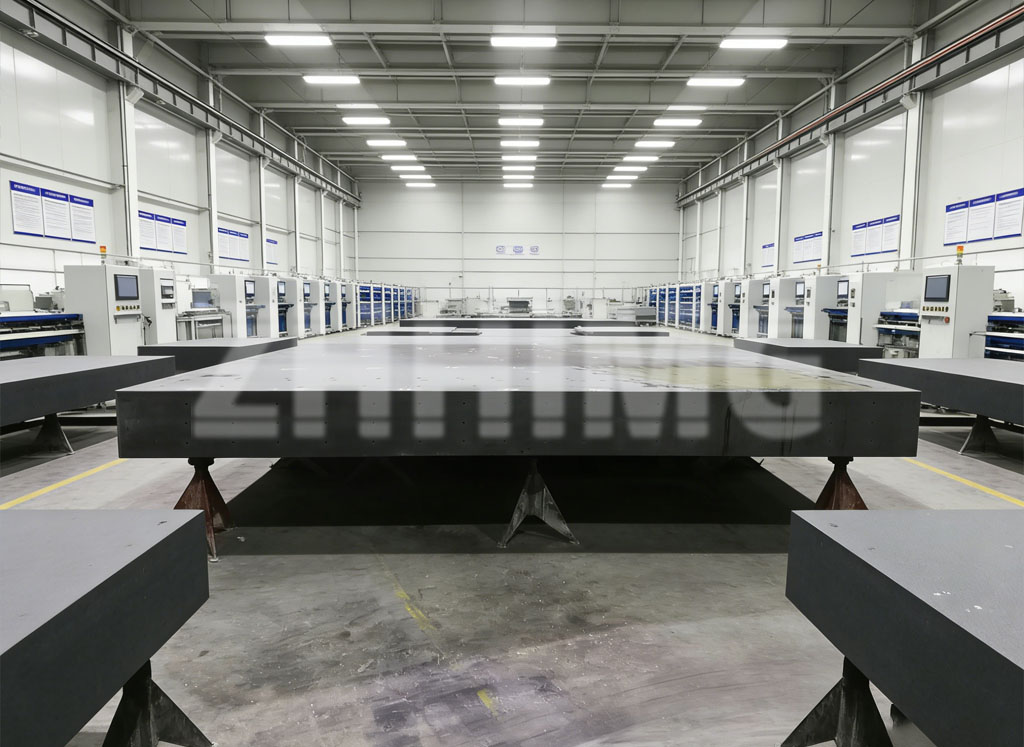
IV. Machinability and Multi-Dimensional Integration Capabilities (Adapting to Complex Optical Layouts)
Modern optical bench bases are often no longer simple flat plates, but comprehensive datum components integrating precision guide rail mounting surfaces, granite air bearings, T-slots, or complex hole patterns.
-
Core Consideration: Whether the material supports high-precision mechanical processing, grinding, and localized composite modification.
-
Technology Integration: Excellent material selection must cooperate with ZHHIMG®’s ultra-large CNC equipment and high-precision grinding machines (such as Taiwan Nantian grinders costing over $500,000 USD per unit), achieving efficient and precise machining of ultra-long single pieces with large strokes (such as up to 20m in length and hundreds of tons in weight), meeting the strict integration needs of modern large-scale optical and semiconductor equipment for integrated bases.
Conclusion
In summary, when selecting materials for ultra-precision optical bench bases, high-density vibration resistance, ultra-low thermal expansion rates, long-term creep resistance, and excellent machining integration constitute four unshakable core indicators. Adhering to the quality policy that “the precision business can’t be too demanding,” ZHHIMG® consistently selects materials with superior physical properties from the source, supplemented by rigorous international metrology standards and manufacturing processes, committed to building a solid foundation for the ultra-precision industry for global customers.
Post time: Sep-24-2026