
Ultra-precision equipment rarely depends on one material alone.
A semiconductor inspection machine may require a granite base for stable reference geometry, ceramic parts for electrical insulation, metal components for compact load-bearing interfaces, and mineral casting for a large damped structure with embedded cooling or cable channels. The same pattern appears in metrology, laser processing, optical inspection, industrial CT, high-end CNC, battery inspection, and scientific automation.
The challenge for engineering purchasers is not simply finding a supplier for granite, ceramic, metal, or mineral casting. It is selecting the right material for each function and managing the interfaces between them.
A one-stop ultra-precision solution brings these material options into one coordinated engineering and manufacturing process. The purpose is not to claim that one supplier can replace every specialist. It is to reduce interface risk when multiple precision components must fit, align, and perform together.
For projects with tight geometric tolerances, long lead times often come from repeated handoffs: one supplier makes the granite base, another produces ceramic parts, a third machines metal adapters, and the machine builder must solve tolerance stack-up during assembly. A coordinated multi-material approach can reduce that risk by reviewing the complete structure before production starts.
Materials Should Follow Function
Every material has strengths and limitations. The best ultra-precision structure uses them deliberately.
Precision Granite
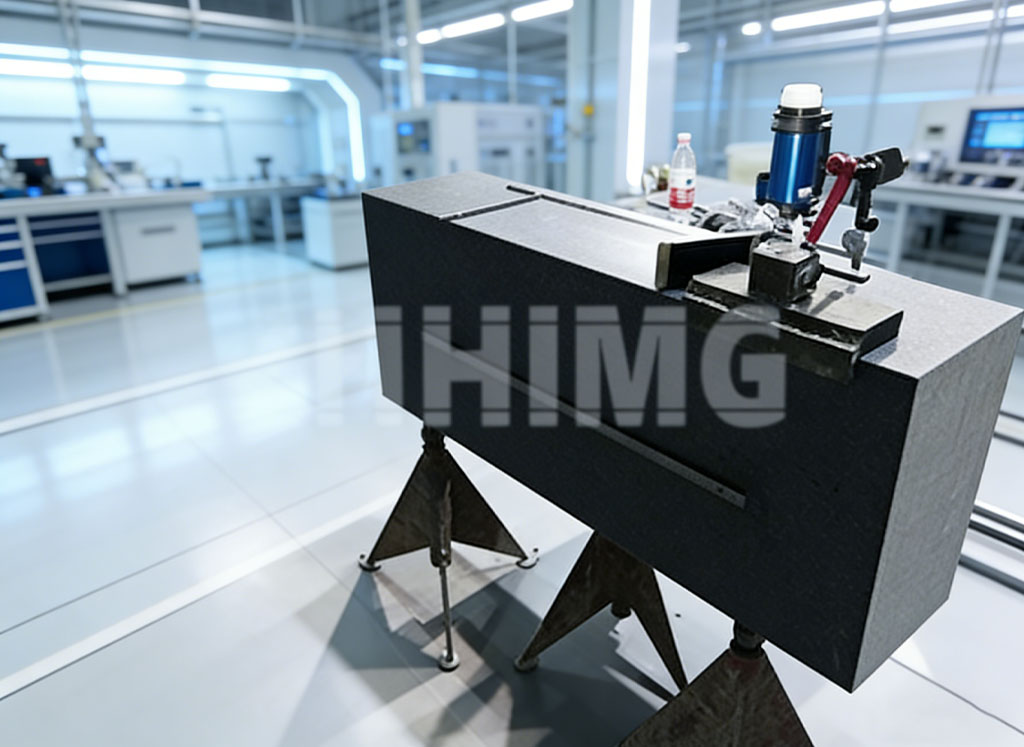
Natural granite is widely used for machine bases, CMM structures, granite surface plates, guideway supports, air-bearing components, bridges, columns, optical platforms, and semiconductor inspection frames.
Its practical advantages include stable geometry, low thermal conductivity, relatively low thermal expansion, useful vibration damping, corrosion resistance, non-magnetic behavior, and precision-ground or lapped reference surfaces.
Granite is especially effective for stationary structures where stable geometry matters more than low moving mass. It is commonly used in special measuring devices, semiconductor equipment, laser machines, machine-tool structures, and precision inspection systems.
A custom granite base can include rail seats, threaded inserts, dowel holes, pockets, cable channels, encoder interfaces, air-bearing surfaces, and mounting references. Its greatest value often comes from providing one common datum for the machine’s motion, measurement, optical, and fixture systems.
Precision Ceramics
Technical ceramics serve a different role.
Materials such as alumina, zirconia, silicon carbide, silicon nitride, aluminum nitride, and glass ceramic are selected where electrical insulation, wear resistance, chemical compatibility, thermal capability, low outgassing, or high hardness is required.
Ceramic components are common in semiconductor process equipment, vacuum-adjacent systems, precision fixtures, wear guides, electrical insulators, measurement structures, bearings, chucks, and thermal-control assemblies. Their properties vary significantly by material grade, purity, density, grain structure, and sintering process.
A ceramic part may be more suitable than granite when the component must withstand plasma exposure, high temperature, chemical cleaning, repeated wear, or strict electrical requirements. Granite may still provide the better stationary foundation beneath that ceramic component.
In semiconductor equipment, a practical pairing may use granite as the stable fixed reference and ceramic as an insulating or wear-resistant moving element.
Precision Metal Components
Metal remains essential in ultra-precision machines.
Stainless steel, aluminum, tool steel, titanium, copper alloys, and other metals are used for shafts, housings, brackets, adapters, motor mounts, vacuum interfaces, mechanical joints, heat-management parts, and compact load-bearing structures. Metal can provide strength, ductility, machinability, and complex detail that natural granite cannot always achieve economically.
The challenge is managing metal’s thermal behavior and structural stress. A metal component mounted on a granite structure can expand at a different rate when temperature changes. If the interface is poorly designed, thermal mismatch can introduce alignment error, preload change, or stress concentration.
For this reason, metal parts should be designed around functional datums and realistic operating temperatures. Locating pins, compliant interfaces, symmetric geometry, controlled bolt preload, and thermal isolation features may be required.
Mineral Casting
Mineral casting, sometimes called polymer concrete or epoxy granite, is an engineered mixture of mineral aggregates and resin binder. It is cast into a mold and cured at relatively low temperature.
Its main advantage is design integration. Inserts, steel plates, cooling circuits, cable passages, sensor mounts, service channels, and complex internal forms can often be incorporated during casting. This is useful for CNC machine beds, grinding machines, laser platforms, automation bases, dispensing equipment, and custom industrial structures.
Mineral casting also offers strong vibration damping. The aggregate-and-resin structure can dissipate vibration energy effectively, making it suitable for stationary machine bases exposed to dynamic loading. The exact result depends on the formulation, curing process, geometry, embedded features, and final machine design.
Comparing the Four Materials
| Material | Primary strengths | Typical ultra-precision role |
|---|---|---|
| Precision granite | Stable geometry, damping, low thermal response, non-magnetic, lapped datums | Machine bases, CMMs, guideways, metrology and optical structures |
| Precision ceramic | Insulation, hardness, chemical resistance, wear resistance, thermal capability | Semiconductor parts, insulators, guides, wear surfaces and specialized fixtures |
| Precision metal | Strength, ductility, complex machining, compact mechanical interfaces | Mounts, shafts, brackets, housings, adapters and motion components |
| Mineral casting | Damping, integrated geometry, embedded features, structural mass | Machine beds, automation bases, CNC structures and complex damped frames |
The table is only a starting point. Material choice should also consider operating temperature, heat sources, load path, motion profile, cleanroom conditions, chemical exposure, electrical requirements, production quantity, cost, delivery schedule, and inspection needs.
Why One-Stop Coordination Matters
A precision assembly can fail even when every individual part meets its own drawing.
Consider a granite machine base with steel rail inserts, ceramic isolation pads, and a mineral-cast support structure. If the component suppliers use different datums, different temperature references, different measurement methods, or uncoordinated tolerance assumptions, the final assembly may require rework before it can meet alignment requirements.
One-stop coordination addresses this problem during the engineering-review stage.
The supplier or project team should review:
- Overall datum scheme across all components
- Material compatibility and thermal expansion differences
- Critical interface tolerances and inspection responsibilities
- Insert locations, threaded holes, dowel holes, and locating features
- Assembly sequence and bolt-preload requirements
- Adhesive or bonding requirements where applicable
- Load distribution, support points, transport and lifting methods
- Cleanliness, cleanroom packaging, and corrosion protection
- Final assembly inspection and calibration requirements
Multi-material ultra-precision manufacturing requires dedicated process routes for each material category. Granite, ceramics, metals, and mineral casting cannot be processed or inspected using one generic method.
That is why coordination is valuable. It does not simplify the engineering; it makes the engineering visible before production begins.
From Customer Drawing to Assembly
A complete RFQ should include more than a 2D drawing.
Provide 3D models, critical tolerances, datum definitions, material preferences, operating environment, load information, motion-system details, electrical requirements, inspection documentation, quantity, packaging needs, destination country, and target delivery date.
At ZHHIMG®, one-stop ultra-precision solutions can combine precision granite, ceramic components, CNC-machined metal parts, mineral casting, precision glass, UHPC, carbon-fiber beams, and precision 3D-printing technologies. The goal is to help machine builders evaluate the best structural solution rather than force every component into a single material category.
Granite may establish the reference. Ceramic may provide insulation or wear resistance. Metal may carry local loads and moving mechanisms. Mineral casting may create a complex damped frame. The strongest design assigns each material a job it performs well.
A More Practical Precision Strategy
One-stop ultra-precision solutions are valuable because modern equipment is increasingly multi-material by design.
For global purchasers, the benefit is not only fewer purchase orders. It is earlier coordination of materials, interfaces, datums, inspection methods, and assembly requirements. That can reduce technical clarification, prevent late-stage fit problems, and support more reliable installation.
The best ultra-precision structure is not defined by whether it uses granite, ceramic, metal, or mineral casting. It is defined by whether each material helps the machine maintain the geometry, stability, and repeatability required by its real operating environment.
Post time: Aug-19-2026