
High-precision laser processing depends on a stable relationship between the laser head, beam path, workpiece, motion axes, and process focus. When that relationship changes—even by a small amount—the effect may appear in cut-edge quality, kerf consistency, hole position, engraving detail, weld geometry, scan overlap, or process repeatability.
The gantry structure plays a central role.
A laser machine may use a high-quality source, advanced galvo head, linear motor, encoder scale, and motion controller. Those components cannot fully compensate for a gantry that bends, vibrates, twists, or changes alignment as temperature varies. For demanding laser applications, the mechanical structure is part of the process-control system.
Granite gantries are becoming more common in high-precision laser processing machines because natural granite provides stable geometry, useful vibration damping, relatively low thermal expansion, corrosion resistance, and precision-machined reference surfaces. They are particularly relevant for femtosecond laser processing, picosecond laser systems, micromachining, wafer dicing, precision drilling, laser measurement, PCB processing, optical manufacturing, and fine-feature marking.
Granite is not automatically the correct material for every gantry. Its mass can limit acceleration when used as a moving beam. In many laser machines, the best design is hybrid: a granite base and stationary structural references provide stability, while lightweight metal or carbon-fiber members carry fast-moving axes. The choice depends on the required laser process, travel range, throughput, payload, and accuracy target.
Laser Accuracy Begins With Mechanical Geometry
A laser beam can be focused to a very small spot, but the machine must deliver that spot to the correct location.
For a gantry-style laser system, critical geometry includes the straightness of the X-axis, parallelism between dual guide rails, squareness between X and Y axes, flatness of the worktable, position of the laser head, and stability of the beam-delivery path. If the gantry racks during motion, or if one side warms more than the other, the focal position may shift.
High-precision gantry systems are especially sensitive to:
- Structural bending under gantry and carriage weight
- Torsional racking in dual-drive configurations
- Vibration after acceleration, deceleration, or direction reversal
- Thermal expansion across long travel lengths
- Cable drag and asymmetric hose forces
- Uneven rail mounting surfaces
- Motor heat close to guideways or beam supports
- Floor vibration and machine-support deflection
In dual-drive gantry systems, small structural asymmetries or timing differences between drives can cause racking: torsional rotation of the bridge around its vertical axis. Thermal growth and uneven loading can further change bearing preload and guideway alignment.
A granite gantry structure can help manage these risks when it is engineered around the actual motion system rather than treated as a simple heavy beam.
Granite Provides Damping and Thermal Stability
Natural granite is well suited to stationary precision structures because it combines mass with internal vibration damping.
When a laser head changes direction, reaction forces travel into the guide rails, carriage blocks, supports, and base. A poorly damped frame may continue to oscillate after the motion command ends. The laser process may then begin before the structure has fully settled, producing inconsistent feature location or quality.
Granite helps dissipate vibration energy through its dense mineral structure. Its damping performance is one reason granite is used for metrology systems, optical instruments, semiconductor equipment, CMM structures, and high-precision machine bases. Granite machine beds and structural components are described as vibration-damping, dimensionally stable, non-magnetic, and more temperature-stable than many metal structures.
Thermal behavior is equally important.
Laser sources, beam-delivery systems, linear motors, electronics, cooling circuits, fume extraction, and process illumination can all introduce heat into a machine. Granite has relatively low thermal conductivity, so local heat spreads through the structure more slowly than in steel or aluminum. Its coefficient of thermal expansion is also relatively low, although the exact value depends on the selected stone.
This does not mean a granite gantry is unaffected by heat. It means the structural response can be slower and more manageable. The machine designer still needs to control cooling routes, motor placement, cable routing, airflow, and heat sources near critical datums.
Precision laser systems can benefit from stable granite machine bases because differential thermal expansion along long-travel linear guide rails may affect laser focus and path repeatability over extended production runs.
Gantry Design Requires More Than Material Choice
Granite can improve structural stability, but the geometry and assembly strategy determine whether the benefit reaches the laser process.
A granite gantry or granite machine structure should be designed around the load path. The guide rails should be mounted on controlled reference surfaces. Motor forces should enter the structure symmetrically where possible. Cable carriers should not apply large varying side loads. The center of gravity of moving assemblies should be managed to reduce pitch, yaw, and roll.
Key design details include:
| Design feature | Importance for laser processing |
|---|---|
| Rail-seat straightness | Supports consistent axis travel and focal-position control |
| Dual-rail parallelism | Reduces carriage binding and gantry racking |
| Beam stiffness | Limits deflection under moving-head weight and cable loads |
| Structural damping | Reduces vibration after high-speed motion |
| Thermal symmetry | Minimizes one-sided expansion and alignment drift |
| Encoder-scale interface | Maintains feedback geometry relative to guideways |
| Cable routing | Reduces parasitic force and uneven heat input |
| Support points | Limits deflection of the base and gantry assembly |
| Insert and locating features | Enables repeatable assembly and service alignment |
For a large laser-processing platform, the stationary granite base is often the most valuable structural element. It can carry guide rails, linear motors, optical columns, worktables, vacuum fixtures, and motion-system references. The moving gantry may then use a lighter material where high acceleration is required.
This hybrid approach helps balance two competing requirements: high stability for the stationary reference and low inertia for moving components. Industry material-selection guidance for ultra-precision equipment similarly notes that laser-processing systems may combine stable damped beds with lightweight moving beams.
Granite Gantries for Different Laser Processes
The value of a granite gantry varies by application.
For high-power cutting of thick structural material, throughput, rigidity, fume management, and process robustness may matter more than sub-micron structural stability. A well-designed steel or cast structure may be appropriate.
For fine-feature laser processing, the structural requirements become more demanding. Granite gantries or granite-supported motion structures are more relevant in:
- Femtosecond and picosecond laser micromachining
- Semiconductor wafer processing and dicing
- Precision drilling of ceramic, glass, and metal components
- Laser texturing and surface functionalization
- PCB and flexible-circuit processing
- Medical-device laser machining
- Optical-component manufacturing
- Laser measurement and interferometric alignment
- Micro-marking and fine engraving
In these applications, small changes in focus height, stage position, beam overlap, or scan-path geometry can influence the final result. A stable granite structure helps preserve the mechanical reference while the laser system manages optical and process variables.
CNC-machined granite beams and bases are already used as structural substrates for femtosecond and picosecond laser systems, metrology equipment, and semiconductor-related precision devices.
Custom Granite Assembly Matters
A granite gantry is rarely a simple rectangular block.
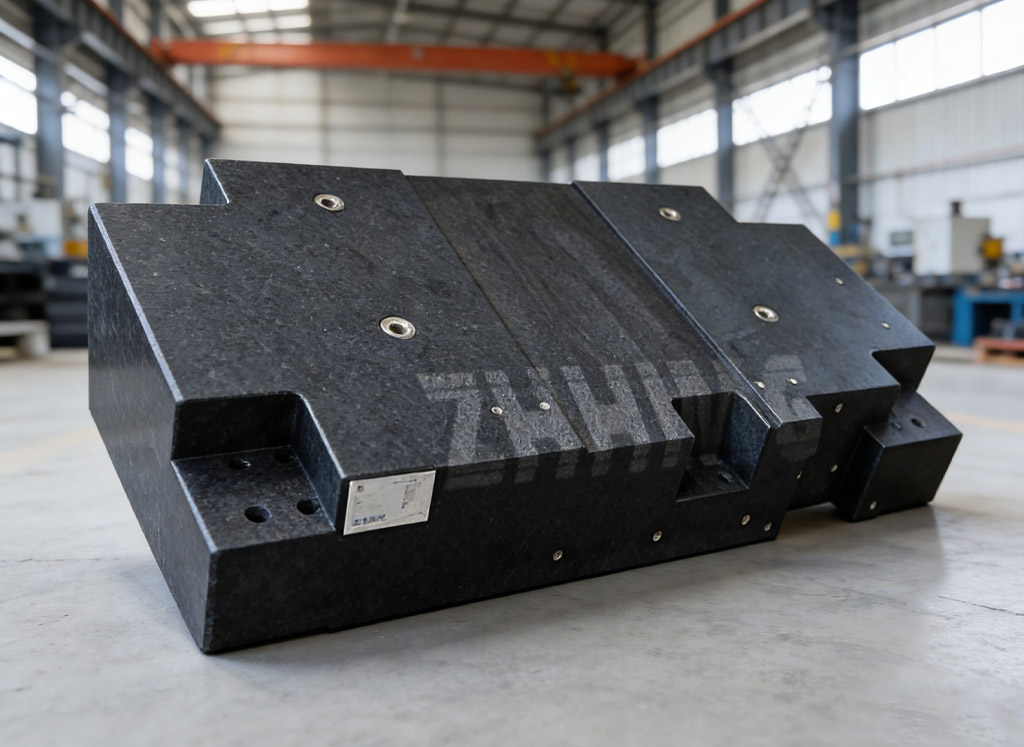
It may include guideway supports, lapped rail seats, threaded inserts, dowel holes, linear-motor interfaces, encoder mounts, cable channels, optical-column faces, air-bearing surfaces, lifting points, and precision assembly datums. The final structure may combine granite, stainless steel inserts, aluminum covers, ceramic components, and carbon-fiber moving elements.
At ZHHIMG®, custom granite components can be machined as bases, gantry beams, bridge structures, columns, guideway supports, air-bearing parts, and complete assemblies for precision laser equipment. The engineering review should cover:
- Laser process and required spot-position accuracy
- Travel length, acceleration, and moving mass
- Rail type, motor arrangement, encoder location, and cable carrier
- Worktable, fixture, vacuum, or chuck interface
- Heat sources, cooling circuits, and required operating environment
- Critical datums, rail-seat tolerances, and assembly features
- Support arrangement, handling method, inspection report, and export packing
A granite structure with excellent material properties can still underperform if its rail interfaces, support points, or thermal layout are poorly designed. The component must be treated as part of the machine’s motion, optical, and thermal system.
A Practical Structural Choice
Granite gantries are becoming a practical option for high-precision laser processing machines because they support stable geometry, vibration damping, controlled thermal response, and precision-machined interfaces.
They are most effective where structural movement can influence laser focus, beam path, positioning accuracy, or process repeatability. Granite is especially valuable for stationary machine bases and reference structures. Moving gantries require a careful trade-off between damping, stiffness, mass, and acceleration.
For equipment builders, the strongest solution is not a material claim. It is a complete structure designed around the laser process, motion profile, thermal environment, guideway geometry, and verification method. When those factors are managed together, custom granite components can provide a dependable foundation for repeatable high-precision laser processing.
Post time: Aug-19-2026