
In ultra-precision optical, laser processing, and high-resolution inspection systems, an optical bench base not only requires superior intrinsic material properties, but also relies heavily on rigorous on-site installation of vibration-damping supports and precision leveling processes. Serving as the core foundation carrying nanoscale optical paths and micro-structures, any minor support imbalance or isolation failure will be infinitely amplified during reflection or imaging. Therefore, in practical engineering operations, perfectly deploying and maintaining absolute stability for large-stroke precision datums is a system engineering project of extreme technical depth. As an industry benchmark deeply rooted in the ultra-precision manufacturing field, ZHHIMG Group (ZHHIMG®) has summarized a set of rigorous standards and practical key points through years of experience serving top global optics, semiconductor, and Fortune 500 companies.
The primary core link lies in the load-bearing capacity assessment of the foundation interface and pre-installation vibration isolation preparation. Because modern ultra-precision equipment is extremely sensitive to environmental disturbances, it is essential to ensure that the ground foundation has sufficient compressive strength and rigidity before installing vibration-damping supports. Taking ZHHIMG®’s construction experience in high-standard global workshops as an example, it typically requires constructing dedicated anti-vibration trenches or using ultra-hard concrete pouring layers to cut off low-frequency ground pulsation interference from external building structures. The selection and layout of vibration-damping supports must be mathematically modeled and calculated based on the center of mass distribution, external dimensions, and dynamic load of the entire bench base to ensure uniform stress at every support point, avoiding long-term structural micro-deformation induced by local stress concentration.
During the actual fixation and dynamic tuning stage of the vibration-damping supports, matching and fine-tuning damping characteristics are key to determining the system’s anti-disturbance capability. Whether using air-floating vibration isolation or high-damping composite supports, installation personnel must meticulously adjust the pressure balance of each support unit. By introducing high-precision electronic levels (such as metrology-grade instruments commonly used by ZHHIMG®, like Swiss WYLER) for multi-point real-time monitoring, step-by-step micron-level adjustments are made to the support heights. At this time, tuning personnel must not only focus on static levelness, but also observe the system’s natural frequency and damping decay rate through dynamic disturbance tests, ensuring that when facing external complex environmental impacts, the base can rapidly attenuate vibrations to zero, providing rock-solid dynamic balance for the upper optical system. 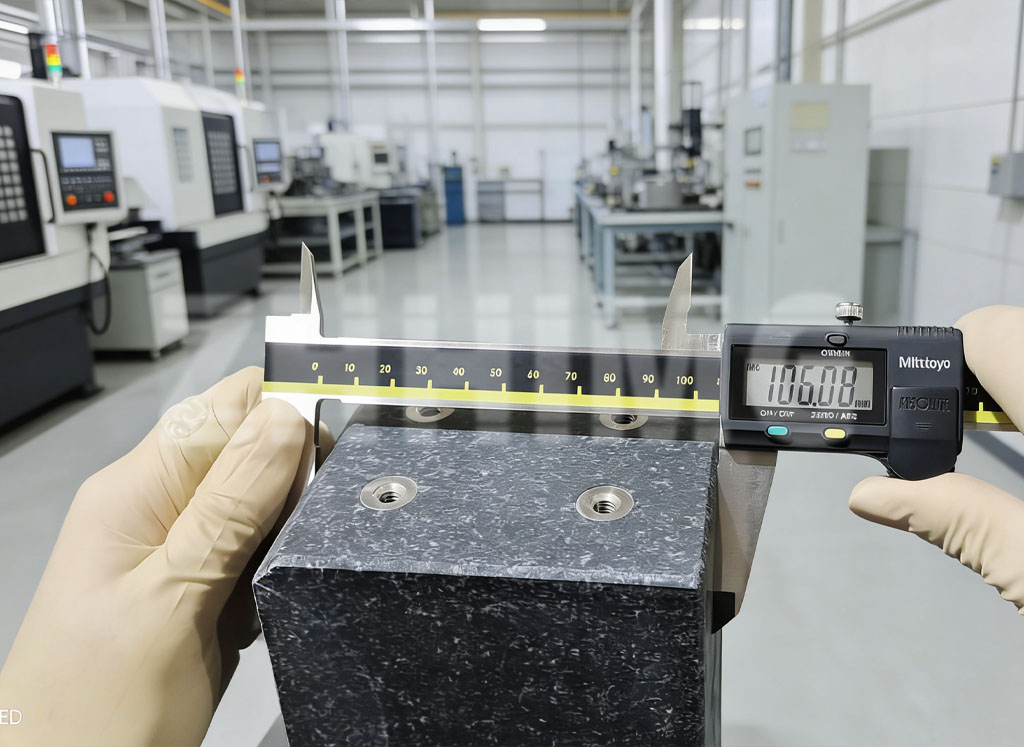
The final precision leveling and locking serve as the ultimate calibration of the whole system’s geometric accuracy. After initial adjustment, the system must undergo sufficient static settling and natural stress release, followed by global flatness and perpendicularity re-checks using laser interferometers or high-precision dial indicators. Leveling is never a one-time achievement, but a multi-iteration process of repeated correction and cross-validation; the tightening torque of every bolt and the minor displacement of every spacer must strictly adhere to international metrology standards (such as DIN, ASME, or ISO specifications). Upholding the quality policy that “the precision business can’t be too demanding,” ZHHIMG® deeply integrates the material’s physical advantages, the dynamic isolation of vibration-damping supports, and the ultimate manual and digitalized leveling craftsmanship, truly enabling optical bench bases to unleash nanoscale ultimate potential in rigorous industrial sites.
Post time: Sep-24-2026