
As semiconductor manufacturing, optical inspection and ultra-precision automation continue to advance, the demand for high-performance structural materials is increasing. Equipment manufacturers require components that combine dimensional stability, high stiffness, low thermal expansion, wear resistance and reliable long-term performance.
Precision ceramic components have become an important material solution for applications where conventional metals or other structural materials may not meet demanding engineering requirements.
From semiconductor processing equipment and wafer inspection systems to precision measuring instruments and advanced automation platforms, engineered ceramics offer a combination of physical, mechanical and thermal properties that make them suitable for specialized industrial applications.
ZHHIMG® (Zhonghui Group) specializes in the manufacturing of ultra-precision components using advanced materials, including precision ceramics, precision granite, precision metals, precision glass, mineral casting, UHPC and carbon fiber.
This article explores the materials, properties, manufacturing processes and industrial applications of precision ceramic components, helping engineers and equipment manufacturers understand how to select the right ceramic solutions for their projects.
1. What Are Precision Ceramic Components?
Precision ceramic components are engineered parts manufactured from advanced ceramic materials through specialized forming, sintering, machining, grinding and finishing processes.
Unlike ordinary ceramics used in household products, industrial precision ceramics are designed to meet specific mechanical, thermal, dimensional and functional requirements.
Depending on the material and application, precision ceramic components can provide:
- High hardness and excellent wear resistance.
- High stiffness and dimensional stability.
- Low thermal expansion.
- Excellent electrical insulation.
- Good corrosion and chemical resistance.
- High-temperature performance.
- Low density compared with many metallic materials.
- Excellent surface finishing capability.
These properties make precision ceramics particularly valuable in industries where component performance directly affects equipment accuracy, reliability and service life.
Common precision ceramic products include:
- Precision ceramic structural components.
- Ceramic machine components.
- Ceramic measuring instruments.
- Ceramic straight rulers and square rulers.
- Ceramic air bearing components.
- Ceramic positioning and support structures.
- Custom-machined ceramic parts.
Each component should be designed according to its actual working environment, mechanical loading, temperature conditions and dimensional tolerance requirements.
2. Common Materials Used in Precision Ceramic Manufacturing
Selecting the appropriate ceramic material is one of the most important steps in precision component manufacturing.
Different ceramic materials have different physical and mechanical characteristics. The correct choice depends on the intended application rather than simply selecting the hardest or most expensive material.
2.1 Alumina Ceramic (Aluminum Oxide, Al₂O₃)
Alumina is one of the most widely used advanced engineering ceramic materials.
It offers a combination of hardness, electrical insulation, wear resistance and chemical stability.
Key characteristics include:
- High hardness.
- Excellent electrical insulation.
- Good wear resistance.
- Good chemical stability.
- Good high-temperature performance.
- Relatively mature and economical manufacturing processes.
Typical applications include electrical insulation components, mechanical supports, semiconductor equipment parts and precision structural components.
Alumina is a practical choice for many industrial applications requiring reliable mechanical and electrical properties.
2.2 Zirconia Ceramic (ZrO₂)
Zirconia is known for its high fracture toughness compared with many conventional technical ceramics.
Depending on its composition and stabilization system, zirconia can provide:
- High mechanical strength.
- High fracture toughness.
- Excellent wear resistance.
- Good corrosion resistance.
- Good surface finishing characteristics.
Zirconia is frequently used in precision mechanical components, wear-resistant parts, shafts, bearings and specialized industrial structures.
It is particularly useful where mechanical strength and resistance to wear are important.
2.3 Silicon Carbide Ceramic (SiC)
Silicon carbide is an advanced ceramic material valued for its hardness, thermal conductivity and high-temperature performance.
Its important characteristics include:
- Very high hardness.
- Excellent wear resistance.
- High thermal conductivity.
- Low thermal expansion.
- Good chemical stability.
- Excellent performance in demanding thermal environments.
Silicon carbide is used in semiconductor processing equipment, high-temperature components, precision mechanical seals and specialized structural applications.
Its specific properties depend on the grade and manufacturing process.
2.4 Other Advanced Ceramic Materials
Depending on the engineering requirements, other materials may also be considered, including:
- Silicon Nitride (Si₃N₄).
- Aluminum Nitride (AlN).
- Cordierite.
- Technical ceramic composites.
For example, aluminum nitride offers high thermal conductivity and electrical insulation, making it useful in selected electronic and thermal management applications.
Silicon nitride is valued for its combination of strength, toughness and thermal shock resistance.
The material selection process should consider the complete operating environment, including temperature, load, chemical exposure, electrical requirements and required dimensional accuracy.
3. Key Properties of Precision Ceramic Components
The performance of precision ceramic components is determined by several important material characteristics.
3.1 High Hardness and Wear Resistance
Many advanced ceramics have significantly higher hardness than conventional engineering metals.
This makes them suitable for components exposed to friction, repeated contact and abrasive operating conditions.
In precision measuring equipment and semiconductor machinery, wear resistance can help maintain component geometry and functional performance over extended operating periods.
However, hardness alone does not determine component durability. Fracture toughness, surface defects, component geometry and installation conditions must also be considered.
3.2 Low Thermal Expansion and Dimensional Stability
Thermal expansion can affect the accuracy of precision equipment.
When a component experiences temperature changes, its dimensions may change accordingly. In high-precision applications, even small dimensional variations can influence equipment alignment and measurement results.
Certain ceramic materials have relatively low coefficients of thermal expansion, helping reduce dimensional changes under controlled temperature conditions.
This characteristic is important for:
- Precision measuring instruments.
- Semiconductor inspection equipment.
- Optical positioning systems.
- Precision automation structures.
- High-accuracy mechanical assemblies.
Actual thermal performance depends on the selected ceramic grade and operating temperature range.
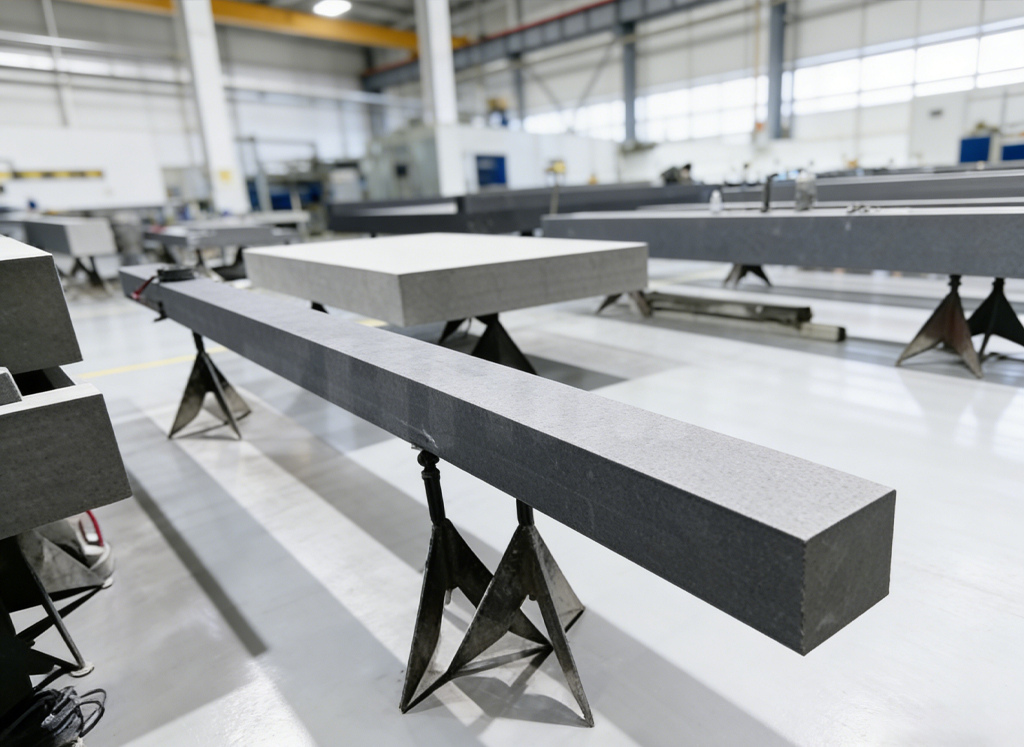
3.3 High Stiffness and Mechanical Performance
Advanced ceramics can provide high elastic modulus and excellent structural rigidity.
Their high stiffness can help reduce elastic deformation under mechanical loading.
This is particularly useful for precision structural components that require stable positioning and accurate geometric relationships.
However, ceramics are generally brittle compared with metals. Engineers must consider stress concentrations, impact loads, mounting methods and structural design to prevent cracking or failure.
3.4 Electrical Insulation
Many technical ceramics, particularly alumina, provide excellent electrical insulation.
This makes them useful in electrical systems, semiconductor equipment and specialized industrial assemblies where electrical isolation is required.
Electrical performance depends on material composition, temperature, moisture and surface conditions.
3.5 Chemical Resistance and Corrosion Resistance
Certain advanced ceramic materials offer excellent resistance to corrosion and chemical attack.
This property can be valuable in semiconductor manufacturing environments where equipment components may be exposed to cleaning agents, process chemicals or other demanding operating conditions.
Material compatibility should always be evaluated against the actual chemicals, concentrations and operating temperatures involved.
4. Precision Ceramic Manufacturing Process
Manufacturing precision ceramic components requires more than simply machining a ceramic block.
Unlike many metals, advanced ceramics are commonly formed and sintered before precision machining. Their high hardness and brittleness create specific manufacturing challenges.
A typical manufacturing process includes the following stages.
4.1 Engineering Design and Material Selection
The manufacturing process begins with a detailed review of customer drawings and technical requirements.
Important considerations include:
- Overall dimensions.
- Geometric tolerances.
- Flatness and parallelism.
- Surface roughness.
- Hole positions and mounting interfaces.
- Mechanical loading.
- Thermal operating conditions.
- Required material properties.
Selecting the correct ceramic material at the beginning helps optimize both component performance and manufacturing cost.
4.2 Ceramic Forming and Sintering
Ceramic raw materials are prepared and formed into the required initial shape.
Depending on the material and component design, manufacturing methods may include pressing, isostatic pressing, extrusion, injection molding or other specialized forming processes.
The formed ceramic body is then sintered under controlled conditions.
Sintering develops the required material structure and mechanical properties.
Because ceramic components may shrink during sintering, dimensional allowances and manufacturing process controls are essential.
4.3 Precision Grinding and Machining
After sintering, ceramic components may require precision grinding to achieve the specified dimensions and geometric accuracy.
Common processes include:
- Diamond grinding.
- Surface grinding.
- Cylindrical grinding.
- Precision drilling.
- CNC machining.
- Edge finishing.
Diamond tooling is frequently used because of the high hardness of advanced ceramic materials.
The machining strategy must account for the brittleness of ceramics to minimize chipping, cracking and subsurface damage.
4.4 Lapping and Surface Finishing
For applications requiring high surface quality, additional lapping and polishing processes may be necessary.
These processes can improve surface finish, flatness and contact characteristics.
The required finishing method depends on the intended application and the customer’s technical specifications.
For example, a ceramic measuring reference surface may require different finishing standards from a general mechanical support component.
4.5 Precision Inspection and Quality Control
Dimensional inspection is essential for ensuring that finished ceramic components meet customer requirements.
Depending on the tolerance and geometry, inspection may include:
- Dimensional measurement.
- Flatness measurement.
- Parallelism measurement.
- Perpendicularity measurement.
- Surface roughness measurement.
- Geometric position inspection.
For demanding precision applications, environmental conditions and measurement equipment calibration are also important factors.
At ZHHIMG, precision manufacturing is supported by professional metrology practices and inspection equipment from internationally recognized manufacturers, including Mahr, Mitutoyo, WYLER and Renishaw.
Measurement equipment used in the company’s inspection system is supported by calibration documentation, according to the applicable equipment and calibration requirements.
5. Applications of Precision Ceramic Components in Semiconductor Equipment
Semiconductor manufacturing is one of the most demanding industrial environments for precision components.
Equipment manufacturers require materials that can maintain reliable performance under specific thermal, mechanical, chemical and electrical conditions.
Precision ceramics are used in various semiconductor and related equipment applications.
5.1 Wafer Processing Equipment
Ceramic components may be used in selected wafer processing equipment because of their thermal stability, chemical resistance and electrical insulation properties.
Depending on the process, applications may include:
- Ceramic support structures.
- Wafer handling components.
- Insulating components.
- Precision mechanical supports.
- Specialized process equipment parts.
Material selection must consider process temperature, plasma exposure, chemical compatibility and contamination requirements.
5.2 Semiconductor Inspection and Metrology Equipment
Semiconductor inspection systems require highly stable mechanical structures and accurate positioning.
Precision ceramic components can be used in selected structural and mechanical applications where stiffness, wear resistance and thermal characteristics are important.
Examples include:
- Precision support structures.
- Mechanical positioning components.
- Measuring equipment components.
- Custom ceramic reference components.
The final performance of the complete equipment depends on the entire mechanical system, including mounting, thermal control, vibration isolation and measurement accuracy.
5.3 Optical Inspection Systems
Optical inspection equipment relies on stable mechanical structures to maintain the relative positioning of cameras, lenses, sensors and illumination systems.
Ceramic components can provide useful mechanical and thermal characteristics for selected applications.
They may be used in precision supports, positioning structures and other custom mechanical assemblies.
5.4 Precision Automation Equipment
Advanced automation systems increasingly require lightweight, rigid and wear-resistant components.
Depending on the application, ceramic materials can be used in:
- Mechanical guides.
- Wear-resistant contact components.
- Precision supports.
- Specialized bearing components.
- Custom structural parts.
The appropriate material should be selected according to the operating speed, loading conditions, friction characteristics and required service life.
6. Precision Ceramic Measuring Instruments
In addition to structural components, technical ceramics can also be used to manufacture precision measuring instruments.
Ceramic measuring tools are particularly interesting in applications where thermal stability, wear resistance, corrosion resistance or electrical insulation are important.
Common products include:
- Ceramic Straight Rulers.
- Ceramic Square Rulers.
- Ceramic Measuring Plates.
- Ceramic Reference Components.
- Custom Ceramic Measuring Tools.
Compared with conventional metal measuring tools, ceramic measuring instruments may offer advantages in specific environments.
For example, certain ceramic materials have low thermal expansion, helping reduce dimensional variation caused by temperature changes.
Their wear resistance can also contribute to long-term dimensional stability when used under appropriate operating conditions.
However, the achievable measuring accuracy depends on the material grade, manufacturing process, finishing quality, inspection method and environmental conditions.
At ZHHIMG, precision measuring products are developed around customer requirements, including dimensional tolerances, geometric accuracy and surface quality.
7. Precision Ceramic Components vs Metal Components
Engineers often need to decide whether a component should be manufactured from ceramic or metal.
Neither material is universally superior. The correct choice depends on the component’s operating environment and engineering requirements.
| Engineering Property | Advanced Ceramics | Metals |
|---|---|---|
| Hardness | Generally very high | Varies by alloy and treatment |
| Wear Resistance | Excellent for many grades | Depends on alloy and surface treatment |
| Elastic Modulus | High for many grades | Varies by metal |
| Thermal Expansion | Often relatively low | Varies by alloy |
| Electrical Insulation | Excellent for insulating ceramics | Generally conductive |
| Fracture Behavior | Generally brittle | Generally more ductile |
| Machining | Specialized grinding and machining | Established CNC machining |
| Corrosion Resistance | Excellent for selected grades | Depends on alloy and coating |
For semiconductor and precision equipment manufacturers, material selection should be based on a comprehensive evaluation of mechanical properties, thermal behavior, chemical compatibility, manufacturing feasibility and total component cost.
In some applications, ceramic and metal components can also be combined to achieve the required mechanical performance.
8. Why Choose ZHHIMG for Custom Precision Ceramic Components?
ZHHIMG® is a brand of Zhonghui Group, a professional manufacturer specializing in ultra-precision components and advanced engineering materials.
With manufacturing capabilities covering precision granite, precision ceramic, precision metal, precision glass, mineral casting, UHPC, carbon fiber precision beams and precision 3D printing, ZHHIMG provides customized manufacturing solutions for industrial equipment manufacturers worldwide.
8.1 Multi-Material Manufacturing Capabilities
ZHHIMG offers manufacturing solutions across multiple material categories.
This allows customers to explore different engineering materials and component structures according to their project requirements.
Our product categories include:
- Precision Ceramic Components.
- Ceramic Measuring Instruments.
- Ceramic Air Bearing Components.
- Precision Granite Components.
- Precision Metal Machining.
- Precision Glass Components.
- Mineral Casting Components.
- UHPC Precision Components.
- Carbon Fiber Precision Beams.
- Precision 3D Printed Components.
8.2 Professional Precision Manufacturing Facilities
ZHHIMG operates two manufacturing facilities with a combined site area of approximately 200,000 m², supported by a dedicated raw stone storage area of approximately 20,000 m².
The company has advanced manufacturing equipment and large-scale machining capabilities.
For applicable products and manufacturing processes, the company’s equipment can handle individual components weighing up to 100 tons, with maximum processing dimensions of approximately:
- Length: 20,000 mm.
- Width: 4,000 mm.
- Thickness: 1,000 mm.
These are facility-level manufacturing capabilities. Actual processing limits depend on material type, component geometry, equipment configuration and project requirements.
8.3 Advanced Metrology and Inspection Capabilities
At ZHHIMG, measurement is an essential part of precision manufacturing.
The company uses professional inspection equipment from internationally recognized manufacturers, including:
- German Mahr measuring instruments.
- Mitutoyo precision measuring instruments.
- Swiss WYLER electronic levels.
- Renishaw laser interferometry systems.
Measurement equipment is supported by relevant calibration documentation, with traceability according to applicable metrology requirements.
The company also maintains controlled temperature and humidity environments for precision manufacturing and inspection activities.
8.4 Experienced Technical Personnel
Precision manufacturing depends not only on machines but also on engineering knowledge and skilled personnel.
ZHHIMG places strong emphasis on professional training, manufacturing experience and metrology standards.
Its technical teams work with international measurement and engineering standards, including relevant DIN, ASME, JIS, GB and other applicable standards.
The objective is to ensure that each project is manufactured and inspected according to its specified technical requirements.
8.5 International Quality Management and Certifications
ZHHIMG has established a quality management and organizational certification framework that includes:
- ISO 9001 – Quality Management Systems.
- ISO 14001 – Environmental Management Systems.
- ISO 45001 – Occupational Health and Safety Management Systems.
- CE-related conformity documentation for applicable products.
These certifications and conformity documents should be considered according to their individual scopes and applicability.
ZHHIMG is committed to transparent communication, consistent quality control and responsible manufacturing.
Our customer commitment is:
No Cheating, No Concealment, No Misleading.
9. How to Order Custom Precision Ceramic Components from ZHHIMG
ZHHIMG provides customized manufacturing services according to customer drawings and project requirements.
Whether you need a single precision ceramic component, a batch of mechanical parts or a customized ceramic assembly, our team can review your requirements and evaluate manufacturing feasibility.
To help us understand your project, please provide:
- Technical Drawings: PDF, DWG, STEP or other available CAD files.
- Material Requirements: Alumina, zirconia, silicon carbide or other specified ceramic materials.
- Dimensional Requirements: Overall dimensions and critical tolerances.
- Surface Requirements: Surface roughness, flatness and finishing specifications.
- Application Information: Equipment type, operating temperature, mechanical loading and working environment.
- Order Quantity: Prototype, small batch or mass production requirements.
Our engineering team can review the drawings, discuss material selection and provide a manufacturing proposal based on your requirements.
10. Frequently Asked Questions About Precision Ceramic Components
Q1: What are the most commonly used materials for precision ceramic components?
Alumina, zirconia and silicon carbide are among the most commonly used advanced engineering ceramics. Other materials, such as silicon nitride and aluminum nitride, may be selected for specialized applications.
Q2: Are precision ceramic components suitable for semiconductor equipment?
Yes. Selected technical ceramics are widely used in semiconductor-related equipment because of their hardness, electrical insulation, thermal characteristics and chemical resistance. The appropriate material depends on the specific process and operating environment.
Q3: Can precision ceramic components be manufactured according to customer drawings?
Yes. Custom ceramic components can be manufactured according to engineering drawings and technical specifications. Manufacturing feasibility depends on material selection, component geometry, dimensions and tolerance requirements.
Q4: Are ceramic components more accurate than metal components?
Not automatically. Ceramic materials can provide useful thermal and mechanical properties, but final accuracy depends on the manufacturing process, machining quality, finishing methods and inspection capabilities.
Q5: Can ceramic components achieve micron-level tolerances?
Yes. Many precision ceramic components can be manufactured with micron-level dimensional tolerances. The achievable tolerance depends on material properties, component size, geometry, machining processes and inspection requirements.
Q6: What information is required to request a quotation?
Customers should provide technical drawings, material specifications, dimensions, tolerances, surface requirements and order quantities. Application details are also helpful for evaluating the best manufacturing solution.
Q7: Does ZHHIMG manufacture customized ceramic structural components?
ZHHIMG provides customized ultra-precision manufacturing solutions across multiple material categories. Please contact our team with your drawings and ceramic component requirements for a project-specific manufacturing assessment.
Conclusion: Your Partner for Custom Precision Ceramic Manufacturing
As semiconductor technology, optical inspection and precision automation continue to develop, the demand for reliable engineering materials and accurately manufactured components will continue to grow.
Precision ceramics provide valuable material solutions for applications requiring high hardness, wear resistance, thermal stability, electrical insulation and dimensional reliability.
However, achieving high-performance ceramic components requires the right material selection, appropriate manufacturing processes, experienced technical personnel and reliable measurement systems.
ZHHIMG® is committed to promoting the development of the ultra-precision industry through professional manufacturing, advanced materials and continuous innovation.
If you are looking for a reliable manufacturer of custom precision ceramic components, ceramic structural parts or ceramic measuring instruments, we welcome your inquiry.
Send your technical drawings to ZHHIMG and let our engineering team evaluate your project.
Website: https://www.zhhimg.com/
Contact ZHHIMG for customized precision ceramic manufacturing solutions.
Post time: Nov-19-2026