
In the relentless pursuit of miniaturization and performance that defines modern technology, structural materials are no longer secondary considerations. From semiconductor lithography systems capable of defining circuit features at nanometer scales to optical inspection platforms that verify dimensional accuracy at sub-micron levels, the foundation upon which these systems are built directly determines their ultimate capability.
Precision granite has emerged as the material of choice for the most demanding applications in semiconductor fabrication and optical systems. This natural material, refined over geological millennia, offers a unique combination of physical properties that engineered metals cannot match—thermal stability that resists dimensional drift, vibration damping that isolates sensitive processes from environmental noise, and chemical inertness that withstands the aggressive environments of modern manufacturing.
This article examines how custom-machined granite solutions address the critical challenges facing semiconductor and optical equipment manufacturers, providing engineers and procurement specialists with the technical foundation for optimal system design.
The Semiconductor Challenge: Precision at the Nanometer Scale
Understanding Semiconductor Manufacturing Requirements
Modern semiconductor fabrication represents the pinnacle of precision manufacturing. As chip geometries continue to shrink below 7nm process nodes, the equipment used to fabricate these devices must operate with unprecedented accuracy and stability.
Critical Precision Requirements:
| Process | Typical Tolerance | Impact on Yield |
|---|---|---|
| Lithography overlay | <3nm alignment accuracy | Direct defect rate correlation |
| Wafer inspection | <10nm feature detection | Quality assurance capability |
| CMP (Chemical Mechanical Polishing) | <50nm uniformity | Layer thickness control |
| Etch positioning | <5nm placement accuracy | Pattern fidelity |
| Thin film deposition | <1nm thickness control | Electrical performance |
At these precision levels, even minor structural instabilities in equipment bases and motion platforms can translate into costly defects and yield loss. The structural foundation of semiconductor equipment must therefore provide:
- Dimensional stability under varying thermal conditions
- Vibration isolation from manufacturing floor environments
- Chemical resistance to process gases and cleaning agents
- Long-term reliability with minimal maintenance requirements
Granite in Lithography Systems
Lithography machines represent the most demanding application for precision granite in semiconductor manufacturing. Extreme Ultraviolet (EUV) lithography systems, which pattern circuit features at nanometer scales, require structural platforms that maintain absolute stability throughout extended operation.
Lithography Component Applications:
Baseplates and Main Frames:
- Support entire optical column and wafer stage assemblies
- Maintain geometric accuracy under heavy loads (up to several tons)
- Provide vibration isolation from facility infrastructure
- Achieve flatness tolerances within 1-3 µm over large surfaces
Guide Rails and Motion Stages:
- Enable nanometer-level positioning accuracy
- Support air bearing or linear motor systems
- Maintain straightness and flatness under dynamic loads
- Provide stable reference surfaces for position feedback systems
Bridge and Gantry Structures:
- Span large working volumes without deflection
- Support scanning optics and exposure systems
- Maintain alignment between multiple motion axes
- Resist thermal gradients from exposure processes
Wafer Processing and Inspection Platforms
Wafer processing equipment demands granite platforms that can withstand aggressive chemical environments while maintaining sub-micron geometric accuracy:
Wafer Inspection Systems:
- Defect detection at nanometer resolution
- High-magnification optical and electron beam imaging
- Precision motion for wafer scanning and positioning
- Vibration isolation for image stability
Wafer Processing Tables:
- Dicing, etching, and deposition equipment bases
- Chemical resistance to acids, bases, and solvents
- Flatness retention for uniform process results
- Anti-static surface treatments to prevent particle contamination
Chemical Mechanical Polishing (CMP):
- High-load capacity for polishing heads
- Flatness stability under dynamic pressure
- Chemical resistance to slurries and cleaning agents
- Long-term wear resistance
The Semiconductor Granite Advantage
| Property | Value in Semiconductor Applications | Benefit |
|---|---|---|
| Low Thermal Expansion | ≈3×10⁻⁶/°C (1/3 that of steel) | Dimensional stability under temperature variation |
| High Rigidity & Damping | Damping ratio 0.012-0.015 | Suppresses vibrations, ensures nanoscale accuracy |
| Chemical Inertness | pH stability 1-14 | Resists corrosive process environments |
| High Hardness | Mohs 6-7 | Wear-resistant, extends equipment lifespan |
| Insulation Properties | Non-conductive, non-magnetic | Prevents electrostatic damage to sensitive components |
Optical Systems: Where Stability Enables Precision
The Optical Platform Challenge
Optical systems—whether used for inspection, measurement, or laser processing—operate at the intersection of light and precision mechanics. Any instability in the optical platform directly translates into measurement error, image degradation, or process variation.
Sources of Optical System Error:
- Thermal Drift: Dimensional changes in the platform alter optical path lengths and component alignment
- Vibration: Environmental vibrations cause relative motion between optical elements and samples
- Structural Creep: Long-term deformation compromises calibrated alignments
- Magnetic Interference: Affects precision sensors and actuators in optical systems
Granite Optical Platforms: Engineering Advantages
Superior Vibration Damping:
Optical systems are exceptionally sensitive to minute displacements. External vibrations from factory equipment, HVAC systems, or even distant traffic can cause relative motion that blurs images or invalidates measurements.
Premium black granite with density ≈3100 kg/m³ possesses a crystalline structure highly efficient at dissipating mechanical energy. Unlike metallic bases that transmit vibrations, granite absorbs energy within its crystalline matrix, creating a quiet mechanical floor for optical systems.
Vibration Damping Performance:
| Material | Damping Ratio | Vibration Attenuation (50-500Hz) |
|---|---|---|
| Granite | 0.012-0.015 | 95% |
| Cast Iron | 0.003-0.005 | 60-70% |
| Steel | 0.001-0.002 | 20-30% |
| Aluminum | 0.0001-0.0005 | <10% |
Extreme Thermal Stability:
Optical measurements often span extended periods—hours for complex interferometric scans or lengthy imaging sequences. During these periods, any dimensional change in the platform introduces systematic error.
Granite’s high mass and low coefficient of thermal expansion provide the thermal inertia necessary to resist minute expansions and contractions. This stability ensures that calibrated focus distances and optical alignments remain fixed throughout extended measurement sequences.
Achieving Nanometer-Level Flatness:
The most visible difference between industrial and optical-grade granite platforms lies in flatness requirements. While standard industrial bases may meet Grade 0 or Grade 00 specifications (measured in microns), optical systems demand flatness measurable in nanometers.
Flatness Grade Comparison:
| Application | Required Flatness | Typical Grade |
|---|---|---|
| Standard industrial | ±5-10 µm/m | Grade 0/1 |
| Precision metrology | ±1-3 µm/m | Grade 00 |
| Optical inspection | ±0.5-1 µm/m | Grade 000 |
| Advanced optics/lithography | <0.5 µm/m | Ultra-precision |
Optical Platform Applications
Laser Interferometer Bases:
- Measurement of displacement at micron and sub-micron scales
- Thermal stability for extended measurement sequences
- Vibration isolation for interferometric stability
- Precise mounting interfaces for optical components
Automated Optical Inspection (AOI):
- High-magnification imaging systems
- Precision motion for component scanning
- Image stability for defect detection algorithms
- Environmental isolation for consistent results
Optical Alignment Systems:
- Laser beam alignment and positioning
- Optical component mounting and adjustment
- Reference plane for multi-axis alignment
- Long-term stability for calibration retention
Optical Breadboard Applications:
- Modular optical setup flexibility
- Threaded mounting hole grids
- Vibration-damped platform for optics
- Thermal stability for experimental consistency
Custom Granite Machining: Engineered for Specific Requirements
Beyond Standard Configurations
Modern semiconductor and optical equipment rarely requires standard rectangular slabs. Instead, manufacturers demand customized granite structures engineered to match specific system configurations—integrating mounting features, cable routing, service passages, and complex geometries that optimize performance for each application.
Advanced Manufacturing Capabilities
5-Axis CNC Machining:
- Complex three-dimensional geometries
- Integrated mounting features and datum surfaces
- Precision inserts, threaded holes, and alignment grooves
- Positioning accuracy: ≤±0.01mm
Precision Grinding and Lapping:
- Diamond-wheel grinding for surface finishing
- Flatness achievement: <1 µm for standard precision
- Ultra-precision lapping for nanometer-level surfaces
- Surface roughness: Ra 0.1-0.4 µm
Integrated Features:
- Threaded bushings and steel inserts for fastening
- Cable and air routing channels
- Precision alignment datums
- Custom hole patterns for component mounting
Quality Verification:
- Laser interferometer measurement (Renishaw XL-80)
- Electronic level verification (Wyler systems)
- Coordinate measuring machine inspection
- Surface profiling and geometric analysis
Material Selection for High-Tech Applications
Premium Black Granite Specifications:
| Property | Specification | Importance |
|---|---|---|
| Density | >3,000 kg/m³ | Vibration damping and mass stability |
| Hardness | Mohs 6-7 | Wear resistance and durability |
| Water Absorption | <0.1% | Dimensional stability in humid environments |
| Compressive Strength | >200 MPa | Load capacity without deformation |
| Thermal Expansion | 4-9 ×10⁻⁶/°C | Dimensional stability under temperature variation |
Material Grades:
- G350 (Standard Grade): Suitable for general precision applications, flatness ±0.005mm/m²
- G650 (Ultra-Precision Grade): Designed for highest accuracy requirements, flatness ±0.0015mm/m²
Custom Engineering Process
Stage 1: Design Collaboration
- Engineering consultation during early project stages
- CAD modeling with manufacturing optimization
- Material and feature specification
- Load analysis and structural optimization
Stage 2: Material Selection and Processing
- Premium black granite selection
- Stress relieving through natural aging and thermal cycling
- Initial rough machining to near-final dimensions
- Intermediate dimensional verification
Stage 3: Precision Machining
- 5-axis CNC milling for complex features
- Precision grinding for surface accuracy
- Integration of mounting features and inserts
- Custom hole patterns and datum surfaces
Stage 4: Final Processing and Inspection
- Precision lapping for ultimate flatness
- Comprehensive dimensional verification
- Surface finish measurement
- Certification and documentation
Industry Applications: Real-World Implementation
Semiconductor Manufacturing Applications
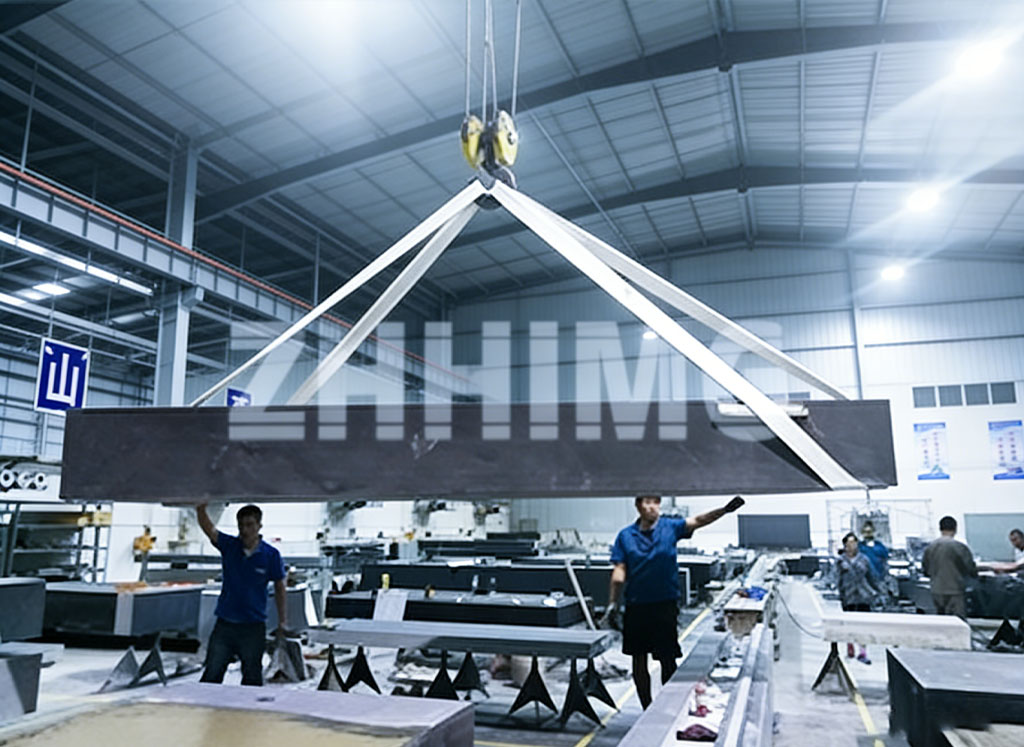
EUV Lithography Systems:
- Structural bases supporting exposure optics
- Motion stages for wafer positioning
- Guide rails for precision scanning
- Achieving 0.12nm vibration isolation
Wafer Inspection Equipment:
- Inspection platforms for defect detection
- Motion bases for wafer handling
- Reference surfaces for optical systems
- Chemical-resistant surfaces for process environments
CMP Equipment:
- Heavy-load capacity polishing platforms
- Flatness retention under dynamic pressure
- Chemical resistance to slurries
- Long-term wear resistance
Optical and Laser Applications
Laser Processing Systems:
- Beam delivery platforms
- Motion bases for laser cutting and marking
- Thermal stability for beam alignment
- Vibration damping for precision processing
Optical Metrology:
- Interferometer bases
- Coordinate measuring machine platforms
- Profilometer and surface measurement bases
- Calibration and reference standards
Scientific Instrumentation:
- X-ray diffraction (XRD) equipment bases
- Electron microscopy platforms
- Spectroscopy instrument foundations
- Research laboratory optical tables
Advanced Manufacturing Applications
Flat Panel Display Manufacturing:
- a-Si Array equipment platforms
- LTPS Array processing equipment
- Large-area substrate handling systems
- Uniform process control across large surfaces
Precision Automation:
- Semiconductor handling robots
- Automated inspection systems
- Precision assembly equipment
- Cleanroom-compatible platforms
Environmental and Operational Considerations
Cleanroom Compatibility
Semiconductor and optical manufacturing environments require equipment that meets stringent cleanliness standards:
Granite Advantages for Cleanroom Use:
- Non-shedding surface that does not generate particles
- Chemical stability compatible with cleaning protocols
- Non-magnetic properties prevent particle attraction
- Surface treatments available for ultra-clean applications
Chemical Resistance
Semiconductor processing involves exposure to aggressive chemicals:
| Chemical Environment | Granite Performance | Metal Performance |
|---|---|---|
| Acids (HCl, H₂SO₄, HF) | Excellent resistance | Requires protective coating |
| Bases (NH₄OH, KOH) | Excellent resistance | Susceptible to corrosion |
| Solvents | No degradation | May affect coatings |
| Process gases | Inert response | May require special materials |
Long-Term Reliability
The operational lifespan of semiconductor and optical equipment often spans decades. Structural foundations must maintain performance throughout this extended service life:
Granite Longevity Advantages:
- No internal stress relaxation (unlike metals)
- No corrosion or oxidation
- Stable geometry over 20+ year service life
- Minimal maintenance requirements
- Resistance to wear from component movement
Selection and Procurement Guidelines
Application Assessment
When specifying custom granite structures for semiconductor or optical applications, consider:
Precision Requirements:
- Required flatness and geometric accuracy
- Load capacity and distribution
- Integration with motion systems
- Thermal stability requirements
Environmental Factors:
- Temperature stability and variation
- Cleanroom classification requirements
- Chemical exposure potential
- Vibration environment characteristics
Operational Requirements:
- Service life expectations
- Maintenance accessibility
- Integration complexity
- Documentation and traceability needs
Supplier Qualification Criteria
Select granite machining partners with demonstrated capabilities:
- Experience: Minimum 10 years serving semiconductor/optical industries
- Certifications: ISO 9001 quality management, ISO 14001 environmental
- Capabilities: In-house 5-axis CNC, precision grinding, laser calibration
- Engineering Support: Design collaboration and optimization services
- Quality Systems: Full traceability and comprehensive documentation
- Reference Installations: Proven performance in similar applications
Quality Documentation Requirements
Comprehensive documentation supports quality management systems:
Standard Documentation:
- Material certificates and origin documentation
- Dimensional inspection reports
- Flatness and geometric verification
- Surface finish measurements
Advanced Documentation:
- Laser interferometer measurement data
- Thermal cycling certification
- Chemical resistance testing (when applicable)
- Cleanroom compatibility certification
Market Trends and Future Directions
Semiconductor Industry Growth
The global semiconductor industry continues to expand, driving demand for precision equipment:
- New fab construction: 78+ new 300mm fabs under construction globally
- Advanced process nodes: Increasing demand for EUV lithography systems
- Equipment investment: Rising capital expenditure for precision manufacturing tools
- Quality requirements: Tightening tolerances as chip geometries shrink
Optical Systems Evolution
Advanced optical systems are enabling new capabilities across industries:
- Autonomous vehicles: LIDAR and optical sensing systems
- Biomedical devices: High-precision optical imaging and measurement
- Quantum computing: Ultra-stable optical platforms for quantum systems
- Advanced manufacturing: Laser processing and optical inspection
Technology Integration Trends
Future granite solutions will integrate with emerging technologies:
- Hybrid structures: Combination with ceramics and composites for optimized performance
- Embedded sensors: Integration of temperature and vibration monitoring
- Smart features: Active compensation systems integrated with granite platforms
- Modular designs: Configurable systems for rapid equipment development
Conclusion
Precision granite has become the non-negotiable foundation for semiconductor manufacturing and optical systems operating at the limits of measurement and manufacturing capability. As chip geometries shrink below 7nm process nodes and optical systems demand sub-micron accuracy, the choice of structural material transitions from an engineering preference to a performance necessity.
The unique combination of thermal stability, vibration damping, chemical resistance, and long-term reliability offered by precision granite cannot be replicated by engineered metals or alternative materials. For semiconductor lithography systems achieving nanometer-level overlay accuracy, for wafer inspection equipment detecting defects at atomic scales, and for optical measurement systems requiring stability measured in nanometers, granite provides the only foundation capable of enabling these capabilities.
Custom granite machining solutions have evolved to meet the sophisticated requirements of modern high-tech equipment. Through advanced 5-axis CNC machining, precision grinding and lapping, and comprehensive quality verification, granite components are engineered to integrate seamlessly with complex semiconductor and optical systems.
For equipment manufacturers, research institutions, and production facilities operating at the forefront of technology, the selection of precision granite components is a strategic decision that defines achievable accuracy, long-term reliability, and competitive capability. In the pursuit of precision at the nanometer scale, stability is not optional—it is fundamental.
As semiconductor and optical technologies continue to advance, precision granite will remain at the core of the equipment that enables these capabilities. The material that has evolved over geological time scales now serves as the foundation for humanity’s most sophisticated manufacturing achievements.
Post time: Apr-17-2026