
hen a semiconductor manufacturer needed sub-micron positioning stability for their latest lithography machine, they didn’t reach for steel or cast iron. They specified natural granite. This choice—made by engineers who’ve spent careers chasing every micrometer of accuracy—reveals something important about granite machine bases.
These aren’t your grandfather’s optical table legs. Modern granite bases for machines are precision-engineered components that can fundamentally change how your equipment performs under thermal stress, vibration, and long-term dimensional drift. Whether you’re specifying a granite base for a CMM, a CNC machining center, or an optical inspection system, understanding why manufacturers consistently choose granite over conventional materials separates good designs from great ones.
What Is a Precision Granite Machine Base?
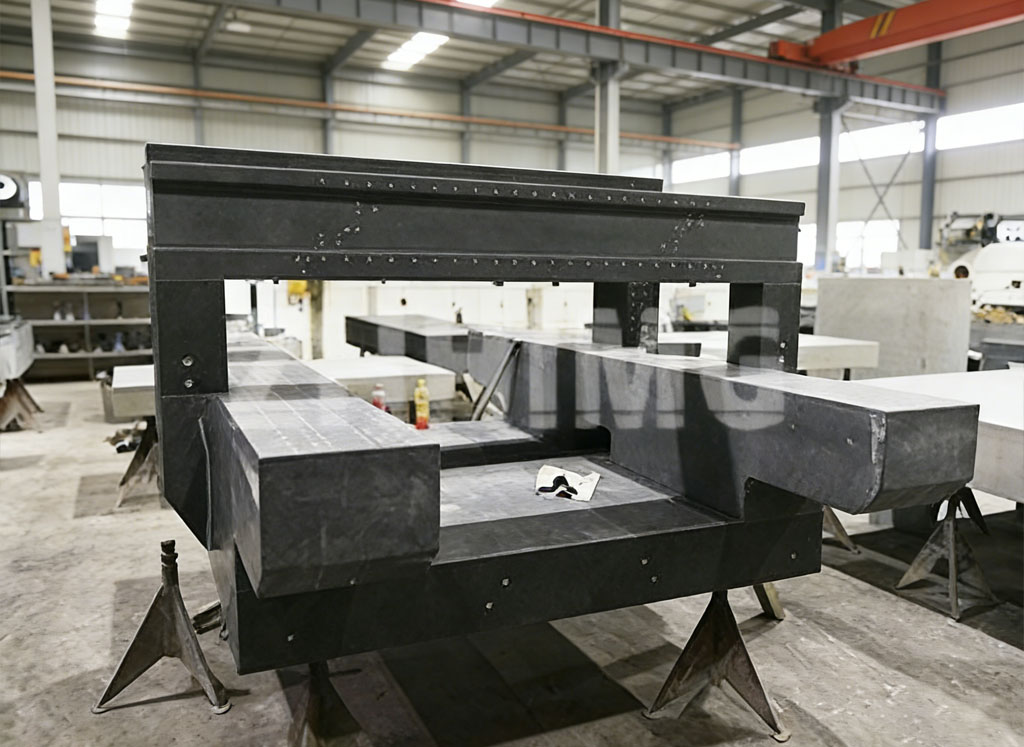
A precision granite machine base is a structural platform machined from natural stone—typically black diabase or anorthosite—serving as the foundation for equipment requiring exceptional stability. Unlike cast iron or welded steel, granite offers an intrinsic combination of properties that synthetic materials struggle to match simultaneously.
The material has been sitting underground for millions of years, naturally aged and stress-free. When extracted and precision-ground to micron-level flatness, it arrives at your facility with zero internal stress—a property that takes cast iron months or years to achieve through artificial aging. This geological maturity translates directly into manufacturing reality: a granite machine base won’t warp, twist, or develop dimensional drift as it ages.
CNC machining centers, coordinate measuring machines, laser systems, optical inspection platforms, and industrial CT scanners all depend on these foundations. The base does more than just support weight—it provides a thermally stable, vibration-damping, non-magnetic reference plane that other components build upon.
Core Advantages Over Cast Iron and Steel
The performance gap between granite and conventional materials isn’t marginal. It’s substantial across multiple critical parameters.
Thermal stability stands as granite’s most compelling advantage. With a thermal expansion coefficient of just 4.5×10⁻⁶/°C, granite responds to temperature changes approximately 40 times slower than cast iron. In absolute terms, this means granite expands 80% less than steel and 75% less than aluminum when exposed to identical temperature swings. For equipment operating in un climate-controlled environments, or machines that generate their own heat during operation, this thermal inertia can be the difference between maintaining tolerance and drifting out of spec.
Consider a typical machining center running a 4-hour cycle. Cast iron foundations absorb heat from the machine, coolant splashing, and ambient shifts, gradually expanding and distorting the spindle position. A granite base absorbs that same thermal energy but moves a fraction of the distance, keeping your tool path true.
Vibration damping follows as the second major differentiator. Granite exhibits a damping ratio between 0.012 and 0.015—roughly ten times better than cast iron’s 0.001. In practical terms, this means granite attenuates vibration energy across the critical 50-500 Hz range by approximately 95%. Machine tools cutting at high spindle speeds, coordinate measuring machines running probing cycles, and optical systems all benefit from reduced vibration transmission. The base acts as a natural shock absorber, isolating sensitive components from environmental vibration while preventing self-generated vibration from propagating through the structure.
Dimensional stability flows from granite’s geological history rather than manufacturing process. The material emerged from deep earth under extreme pressure and temperature, then cooled over geological timescales. No residual casting stresses lurk within the crystal structure waiting to release. A granite machine base arrives from the quarry essentially as stable as it will ever be—dimensional changes over decades are measured in nanometers, not microns.
Beyond these primary advantages, granite provides corrosion resistance (it won’t rust like cast iron or react with coolants), non-magnetic properties (critical for electron microscopy and magnetic resonance applications), and non-conductivity (providing a quiet electrical environment for sensitive sensors).
Material Properties and Technical Specifications
Understanding the numbers helps engineers make informed specification decisions.
The density of granite typically falls between 2970 and 3070 kg/m³, providing substantial mass without the reactivity of lead or the cost of tungsten. Compressive strength ranges from 245 to 254 N/mm², sufficient for supporting industrial equipment while remaining machinable with diamond tooling.
Hardness registers at Shore 70 or above on the durometer scale. This hardness means granite resists scratching and wear, maintaining surface integrity through years of component placement, fixture changes, and cleaning cycles. The Young’s modulus spans 60-100 GPa, giving granite a specific stiffness (elastic modulus divided by density) of approximately 28.3—significantly higher than cast iron’s 17.4. Put simply: for a given weight, granite deflects less under load.
Precision Grades and Tolerance Control
Granite bases are classified by flatness tolerance, measured in micrometers per meter. These grades directly correspond to application requirements:
Grade AA (000) represents the highest precision tier, with flatness tolerances of 4 μm/m or better. These bases belong in metrology laboratories, calibration facilities, and research institutions where sub-micrometer measurements are routine. Temperature control in these environments is typically ±1°C or tighter.
Grade A (0) tolerances reach 8 μm/m, suitable for precision manufacturing workshops, high-end CNC machining centers, and quality inspection areas. This grade balances manufacturing cost against performance requirements for most commercial precision applications.
Grade B (1) accommodates general industrial applications where absolute flatness matters less than consistency and durability. These bases serve as machine tool foundations, jigs and fixtures, and assembly platforms where tolerances are measured in tenths rather than hundredths.
International standards govern these classifications. ISO 8512-2 provides the European framework, while ASME B89.3.7-2013, DIN 876, and GB/T 25994-2010 address American, German, and Chinese markets respectively. ISO 10791-1 further specifies geometric accuracy requirements for machining centers.
Design Considerations for Your Application
Specifying a granite base involves more than selecting a size from a catalog. Thoughtful design considers the complete system rather than isolated component performance.
Dimensional layout must accommodate the equipment footprint plus adequate margin. The mounting surface should fully cover the equipment base, preventing localized stress concentrations at overhang edges. For larger installations, consider access paths for cables, coolant lines, and maintenance activities.
Hole patterns and features require careful coordination with equipment manufacturers. Threaded mounting holes must align with the machine’s mounting provisions—typically with symmetrical distribution to maximize torsional rigidity. Many applications incorporate T-slots for flexible fixturing, vacuum grid patterns for workpiece clamping, or precision-machined datum edges for part referencing.
Weight optimization through interior ribbing or pocket machining reduces material cost and shipping expense without compromising stiffness where it matters. The goal is maximum rigidity in the load paths and minimum mass everywhere else.
Surface treatment selection depends on your application. Standard ground surfaces work for most purposes, while diamond-polished finishes achieve surface roughness (Ra) between 0.1 and 0.4 μm for optical and metrology applications. Protective sealing through nano-silicone impregnation reduces water absorption to below 0.01%—important for environments with humidity fluctuations.
Where Granite Machine Bases Excel
Certain applications leverage granite’s properties particularly well.
CNC machining centers running tight tolerance cuts benefit from granite’s vibration damping and thermal stability. The base absorbs cutting forces and minimizes table chatter while resisting the thermal drift that can push parts out of tolerance over multi-hour runs.
Coordinate measuring machines demand extreme positional accuracy. Any vibration or thermal movement translates directly into measurement error. A granite base provides the stable reference plane that allows CMMs to deliver their specified measurement uncertainty.
Semiconductor manufacturing equipment operates at tolerances measured in nanometers. Lithography tools, wafer inspection platforms, and probe stations all require foundations that won’t contribute positional error as the equipment cycles thermally. Granite’s non-magnetic nature also eliminates concerns about magnetic contamination in cleanroom environments.
Optical and laser systems benefit from granite’s lack of magnetic interference. Optical lens grinding, laser machining, and interferometric metrology all perform better on vibration-isolated, thermally stable platforms with no magnetic signature.
Industrial CT scanners present an interesting case. Unlike metal bases, granite allows X-rays to pass through with minimal distortion, eliminating beam hardening artifacts that would compromise scan quality.
Manufacturing Process Overview
Understanding how granite bases are made helps set realistic expectations for quality and lead time.
Raw blocks meeting ASTM C615 Grade A specifications undergo careful selection for mineral uniformity and structural integrity. These blocks then enter an extended stress relief process—typically six months of natural aging followed by 72 hours of thermal cycling at 80°C. This process accelerates the elimination of any residual stresses from extraction and initial processing.
Five-axis CNC machining achieves positioning accuracy of ±0.01 mm or better. Diamond grinding wheels progressively refine the surface through multiple grit stages, ending with precision polishing to achieve final flatness. Surface verification uses laser interferometry—equipment like Renishaw XL-80 systems—for metrology-grade confirmation.
Final sealing treatments protect the surface from moisture absorption and chemical attack, extending service life in challenging environments.
Maintenance and Care
A precision granite base requires surprisingly modest maintenance, but following proper procedures extends service life and preserves accuracy.
Regular cleaning using soft brushes or vacuum attachments removes particulate contamination. For smudges or fingerprints, wipe with distilled water and lint-free cloths. Oil or coolant spills respond well to isopropyl alcohol, followed by distilled water rinse and natural air drying.
Environmental conditions significantly impact long-term stability. Maintaining temperatures between 20±5°C and relative humidity at 40-60% minimizes thermal cycling effects and prevents moisture-related issues. Grade 00 bases in metrology applications should be recertified every six months, while Grade 0 bases in production environments typically require annual verification.
Never slide components across the surface—this introduces microscopic scratches that accumulate over time. Always lift and place.
Selecting the Right Base for Your Needs
Several factors drive the specification decision.
Application accuracy requirements set the minimum grade. If your CMM specifies ±2 μm measurement uncertainty, you need a Grade AA base—not because the base contributes that entire error budget, but because accumulated errors from multiple sources must fit within it.
Environmental conditions influence material selection and feature requirements. Humid environments benefit from enhanced sealing treatments. Thermally unstable facilities favor granite’s inherent stability. Unshielded environments may require granite’s non-magnetic properties.
Size and weight constraints affect shipping logistics and installation requirements. Standard catalog sizes from 400×400 mm up to 3000×5000 mm cover most applications, with custom dimensions available for unique installations. Heavier bases may require structural reinforcement of supporting floors and specialized lifting equipment.
Lead time and budget always influence decisions. Standard grade bases with common features typically ship within 4-8 weeks, while custom configurations or ultra-precision grades may require 12-16 weeks. Building relationships with manufacturers early in the design process prevents schedule surprises.
Market Outlook
The precision granite components sector continues growing at approximately 6.8% annually, driven by semiconductor industry expansion, electric vehicle manufacturing requiring new precision machining capabilities, and emerging quantum computing applications demanding unprecedented thermal and vibrational isolation.
Equipment manufacturers increasingly recognize that the foundation determines the ceiling for system performance. Investing in quality granite bases upfront typically costs less than retrofitting foundations after performance problems emerge.
Final Thoughts
Granite machine bases represent a mature technology that continues finding new applications as precision requirements escalate across industries. The material’s unique combination of thermal stability, vibration damping, and dimensional permanence addresses fundamental physics challenges that engineers face regardless of how much computing power their systems contain.
For your next precision equipment specification, consider whether granite’s advantages align with your application requirements. In many cases, the natural choice turns out to be exactly that—natural granite.
Post time: Apr-15-2026