
In the world of metrology and high-precision inspection, the Coordinate Measuring Machine (CMM) stands as the final arbiter of quality. However, the accuracy of a CMM is not merely a function of its software or its sensors; it is fundamentally dictated by the physical foundation upon which those sensors move. For decades, engineers and procurement specialists have faced a recurring debate: should the machine base be constructed from precision granite or traditional cast iron?
Choosing the right material is a strategic decision that impacts the machine’s longevity, its reaction to environmental changes, and ultimately, the reliability of the data it produces. Both materials have served the manufacturing industry for over a century, yet they offer vastly different mechanical behaviors. Understanding the nuances between these two “heavyweights” is essential for any facility looking to optimize their inspection department for the demands of modern manufacturing.
The Geological Advantage of Precision Granite
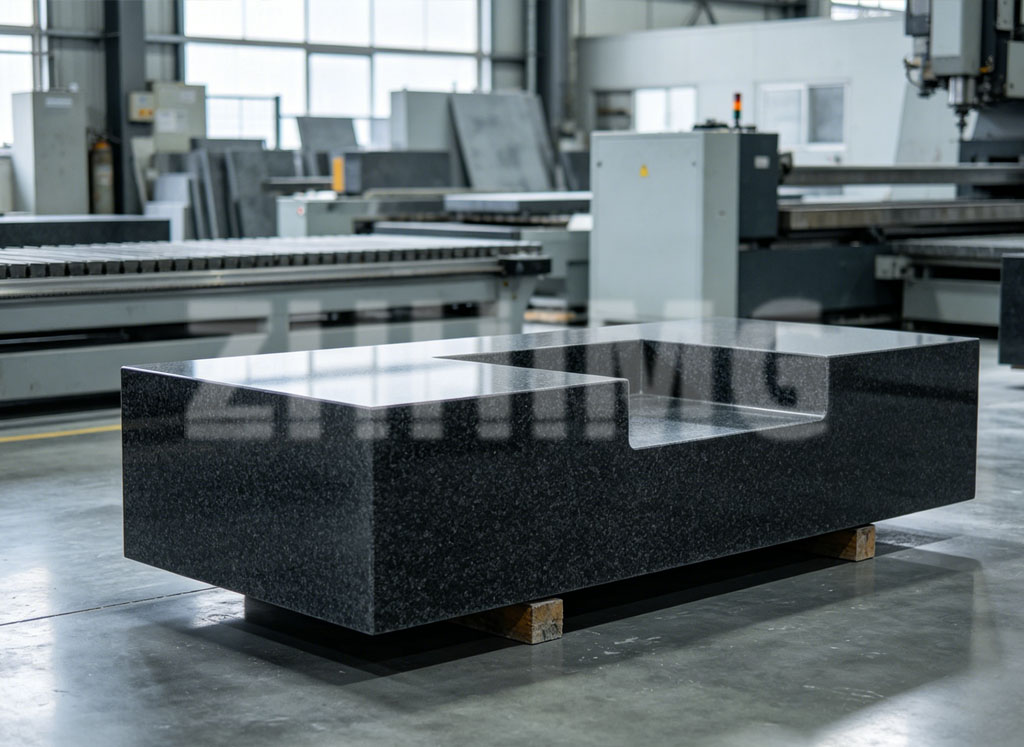
Granite has become the dominant choice for modern high-end CMM structures, and for good reason. From a physical standpoint, black granite is one of the most stable materials found in nature. Its primary strength lies in its coefficient of thermal expansion, which is significantly lower than that of most metals. In a facility where temperature is not perfectly controlled to a fraction of a degree, a metal base will expand and contract, causing the measurement geometry to drift. Granite remains remarkably inert, ensuring that the “zero point” stays exactly where it belongs.
Beyond thermal stability, granite is inherently rust-proof and acid-resistant. In many industrial environments, moisture or chemical vapors can lead to oxidation on metal surfaces. While cast iron requires constant oiling and maintenance to prevent corrosion, granite requires only a simple wipe-down with a specialized cleaner. Furthermore, granite is non-magnetic. For CMMs used in electronics or magnetic-sensitive environments, this is a critical safety and accuracy feature.
One of the most unique characteristics of granite is its “non-burring” nature. If a granite surface plate or machine base is accidentally struck or chipped, the material does not “mushroom” or push up a ridge around the impact site. This means the overall flatness of the surface remains intact, protecting the air bearings and the accuracy of the moving bridge.
The Mechanical Legacy of Cast Iron
While granite dominates the CMM market, cast iron remains an indispensable material in the broader world of precision engineering and heavy-duty manufacturing. High-quality gray cast iron or ductile iron is the gold standard for machine tool beds and large-scale industrial platforms. The reason lies in its structural rigidity and its ability to be cast into complex shapes.
Cast iron platforms offer a level of “structural toughness” that granite cannot match. In applications involving heavy workpieces or high-impact loads, cast iron is less likely to fracture under extreme stress. This is why cast iron platforms are frequently used as the primary assembly and testing surfaces in automotive and aerospace manufacturing. A high-quality cast iron platform, properly seasoned and precision-scraped, provides a reference surface that can handle the rigors of heavy-duty industrial life while maintaining impressive flatness.
Furthermore, cast iron has a high modulus of elasticity, making it excellent for components that must resist deflection under heavy weight. For large-scale inspection tasks where the workpiece weighs several tons, a reinforced cast iron platform often provides the necessary support structure that a purely stone-based system might struggle to accommodate without significant bulk.
Damping and Vibration: The Silent Battle
In any metrology application, vibration is the enemy. It introduces noise into the data and can cause false triggers in sensitive touch probes. Granite excels at damping high-frequency vibrations due to its dense, porous, and non-homogeneous internal structure. It effectively “absorbs” the energy of the shop floor, creating a quiet environment for the measuring bridge to operate.
Cast iron also possesses good damping qualities—much better than steel—but it tends to respond differently to low-frequency resonance. In many high-end manufacturing setups, the ideal solution isn’t necessarily choosing one over the other, but rather understanding where each fits. For the ultra-precise, sub-micron movements of a CMM bridge, the damping of granite is usually preferred. For the heavy, vibrating environment of a machining center or an assembly line, the mass and internal damping of a cast iron platform are often the superior choice.
Maintenance, Longevity, and Cost Efficiency
From a maintenance perspective, granite is the clear winner for CMM applications. Its resistance to wear and environmental factors means that a granite base can maintain its flatness for decades with minimal intervention. However, it is important to note that cast iron platforms offer a unique advantage: they can be “re-conditioned” through hand-scraping or grinding more easily in some large-scale industrial contexts.
When evaluating cost, one must look at the “Total Cost of Ownership.” A granite base may have a higher initial material cost or shipping weight, but the lack of rust-prevention requirements and its immunity to environmental degradation often make it more cost-effective over a 20-year lifespan. Conversely, for large-scale floor-level inspection zones or manual layout tasks, cast iron platforms offer a ruggedness that provides better value in high-traffic areas where stone might be prone to surface damage from heavy steel parts.
Conclusion: Making the Right Choice for Your Facility
The choice between precision granite and cast iron ultimately depends on your specific application. If your goal is high-speed, automated inspection with sub-micron accuracy in a controlled laboratory, the stability and damping of a black granite base are virtually unbeatable. It is the material of the future for precision metrology.
However, the industrial world still relies heavily on the strength and versatility of cast iron platforms for assembly, heavy-duty layout, and large-scale engineering projects. Both materials are essential pillars of modern manufacturing. By understanding the thermal advantages of granite and the structural resilience of cast iron, engineers can build inspection and production systems that are not only accurate today but will remain stable for generations to come. Whether you are installing a new CMM or upgrading your assembly floor, selecting the foundation material is the most important step in ensuring the integrity of your engineering work.
Post time: Apr-28-2026