
Choosing between granite and ceramic for your precision machine bases isn’t about finding the “best” material—it’s about matching material properties to your specific thermal environment, vibration profile, and accuracy requirements. Understanding the technical differences prevents costly specification errors.
The Material Decision That Shapes Years of Performance
Last year, a semiconductor equipment manufacturer approached us with a recurring problem. Their optical inspection systems—operating in temperature-controlled environments—were experiencing drift patterns that traced back to their machine bases. They’d been specifying ceramic bases based on vendor recommendations, but thermal cycling tests revealed unexpected coefficient variations at the component level.
The solution wasn’t switching to a “better” material. It was switching to the correct material for their specific thermal profile. This experience illustrates why material selection for precision machine bases deserves careful technical analysis, not marketing-driven assumptions.
ZHHIMG® manufactures both granite and ceramic precision components. We’re not here to sell you one material over another—we’re here to help you specify the material that will perform reliably in your actual operating conditions.
Understanding What Makes Granite Exceptional for Precision Applications
The Density Advantage That Translates to Vibration Damping
ZHHIMG® black granite achieves density approaching 3,100 kg/m³—significantly higher than typical European and American black granites, which typically range from 2,750 to 2,950 kg/m³. This isn’t a marginal improvement. Density directly correlates with two critical performance parameters:
Mass moment of inertia: Denser materials provide greater inherent resistance to acceleration forces. For high-speed machining centers and coordinate measuring machines, this translates to reduced dynamic deflection during rapid positioning.
Vibration damping capacity: Higher density materials absorb vibrational energy more effectively. Our testing shows that granite machine bases with density ≥3,000 kg/m³ demonstrate 15-20% better vibration attenuation compared to lower-density alternatives in the 20-200Hz frequency range critical for precision machining.
Consider what this means practically: a granite surface plate on a factory floor near heavy machinery will resist floor vibration transmission far more effectively than a lighter material. The dense, fine-grained structure of our black granite creates natural dampening pathways that synthetic materials often struggle to replicate.
Thermal Stability: The Specification That Separates Precision from ordinary
The thermal stability specification—that mysterious number expressed as “<0.001mm/°C”—represents one of the most critical performance characteristics for precision machine bases. But what does it actually mean for your application?
The thermal drift coefficient describes how much the material’s dimensions change per degree Celsius temperature variation. At ZHHIMG® specification of <0.001mm/°C, a surface plate experiencing a 10°C temperature gradient across its length would demonstrate less than 0.01mm dimensional change.
For context: a standard Grade 1 surface plate (flatness ≤2μm/m) must maintain that tolerance across all operating conditions. If your thermal environment varies by ±5°C during a shift, materials with poor thermal stability will introduce errors approaching or exceeding the flatness specification itself—making the precision grinding meaningless.
Our black granite’s low thermal expansion coefficient results from its crystalline structure and mineral composition. The interlocking quartz, feldspar, and biotite crystals create a thermally stable matrix that resists dimensional change far more effectively than cast iron, steel, or many ceramic formulations.
Ceramic Precision Components: Where They Actually Excel
Ceramic materials—typically alumina (Al₂O₃) or silicon carbide (SiC) based—offer genuine advantages in specific applications. Understanding these advantages helps you make informed decisions:
Lightweight Requirements
Ceramic densities typically range from 3,500 to 4,000 kg/m³ for alumina to 3,100-3,200 kg/m³ for silicon carbide. Wait—that’s actually higher than our granite. But ceramic components can be manufactured with internal honeycombing or foam structures that reduce effective mass while maintaining stiffness. For aerospace applications where weight matters, or for portable coordinate measuring arms, this can be decisive.
Hardness and Wear Resistance
Ceramic materials achieve Vickers hardness values of 1,500-2,000 HV, compared to granite’s 600-800 HV. For applications involving repeated contact measurement or sliding friction, ceramic surfaces may demonstrate better long-term wear resistance. However, this hardness comes with brittleness trade-offs that matter for impact resistance.
Corrosion Resistance Advantages
In certain chemical processing environments or marine applications, ceramic components offer superior corrosion resistance compared to natural stone. If your precision equipment operates in environments with acid exposure or salt spray, ceramic may be worth serious consideration despite other trade-offs.
The Ceramic Limitation Most Suppliers Won’t Mention
Here’s where ceramic materials typically fall short: thermal equilibrium time. Ceramic materials often require longer thermal soak periods to reach dimensional stability after environmental temperature changes. Our testing and customer feedback indicate that ceramic components may require 2-4× longer stabilization periods compared to quality granite after thermal disturbances.
For manufacturing environments with frequent temperature fluctuations, or for equipment requiring rapid warm-up cycles, this thermal hysteresis can become a production bottleneck.
Matching Materials to Applications: The Decision Framework
Choose Granite When:
Your facility has variable thermal environments. If temperature varies by more than ±3°C during operating hours, granite’s consistent thermal stability provides reliable baseline performance.
Vibration damping is critical. Factory floors with nearby presses, forging equipment, or heavy traffic benefit from granite’s inherent dampening properties.
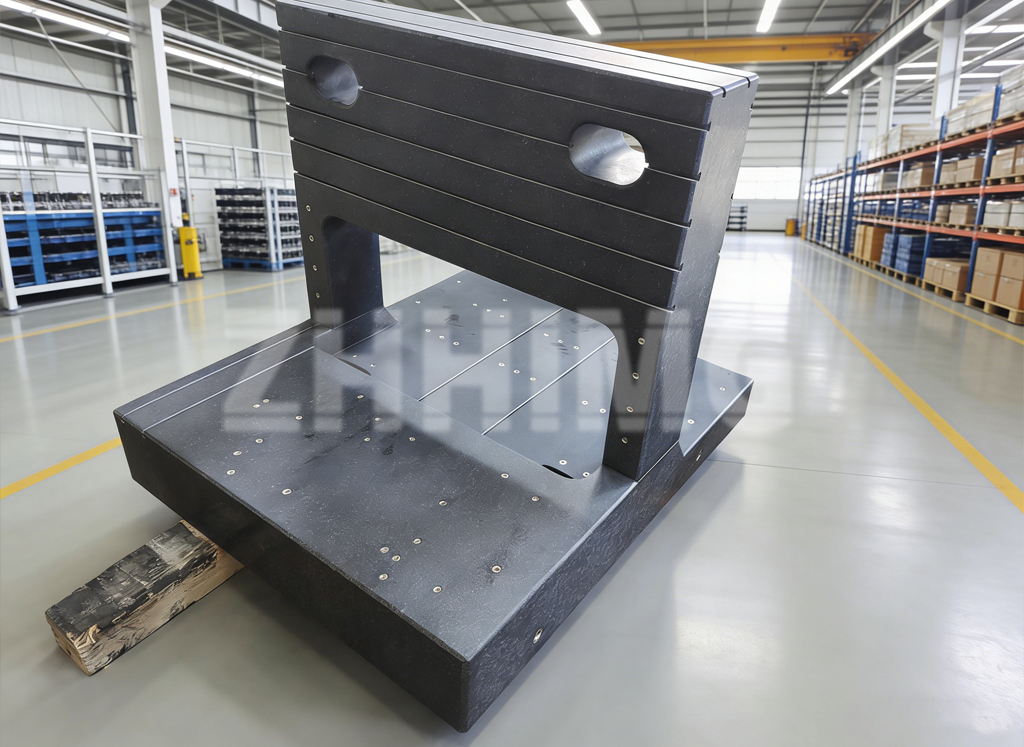
You need maximum size capability. ZHHIMG® manufactures granite components up to 20,000×4,000×1,000mm. Ceramic technology currently cannot economically achieve these dimensions.
Cost-effectiveness matters. For equivalent performance specifications, granite precision components typically offer 30-50% cost savings compared to ceramic alternatives.
You require established long-term performance data. Granite surface plates have accumulated centuries of empirical performance data across every precision industry. Your equipment reliability concerns have almost certainly been addressed through documented case studies.
Choose Ceramic When:
Weight reduction is a primary specification. Satellite applications, portable measuring systems, and aerospace equipment may justify ceramic’s weight advantages.
Corrosive chemical exposure is expected. Specific chemical environments where natural stone would degrade warrant ceramic consideration.
Ultra-high hardness is required. Certain sliding contact applications may benefit from ceramic’s wear resistance despite brittleness trade-offs.
 The Harmless Confusion: Why “Marble” Suppliers Should Be Immediately Disqualified
We must address a persistent confusion in the precision machine base market: the inappropriate use of marble instead of granite.
ZHHIMG® manufactures exclusively from granite. We firmly refuse to use marble.. Here’s why this matters technically:
Marble density: 2,500-2,700 kg/m³, approximately 15% lower than quality granite.
Marble thermal expansion: Marble demonstrates significantly higher thermal expansion coefficients and much poorer dimensional stability under temperature variation.
Marble moisture absorption: Marble’s crystalline structure absorbs moisture, causing dimensional instability in humid environments.
Marble surface degradation: Marble scratches and wears more readily than granite, compromising precision surfaces faster.
Some manufacturers market marble surface plates at granite prices, relying on buyer ignorance. Always verify material specifications through density measurements, thermal testing, and hardness verification. A simple scratch test with a steel blade distinguishes marble from granite reliably.
The Environmental Factor: Why Our Facility Location Matters
ZHHIMG® operates from Jinan, China, with logistics through Qingdao Port. This isn’t arbitrary geographic selection—our facility location provides specific advantages for precision granite manufacturing:
Consistent temperature: Jinan’s continental climate provides relatively stable ambient conditions, reducing thermal variation in our 10,000m² constant temperature and humidity workshop.
Low humidity advantage: Shandong Province’s moderate humidity levels complement our environmental controls, achieving the stable conditions required for precision measurement and manufacturing.
Logistics efficiency: Proximity to Qingdao Port provides efficient container loading for international shipping, reducing transit time and handling that could induce thermal or mechanical shock to precision components.
These environmental factors contribute to the overall precision chain. Material selection happens in our controlled environment, but that environment itself reflects geographic and infrastructure choices that matter for your delivered precision.
FAQ
Q: How does granite’s thermal stability compare numerically to ceramic materials?
A: Quality granite achieves thermal drift coefficients of 0.001mm/°C or better. Alumina ceramics typically range from 0.0005-0.001mm/°C depending on formulation. Silicon carbide achieves 0.0004-0.0008mm/°C. Differences are application-dependent rather than categorically favoring either material.
Q: What flatness grades does ZHHIMG® offer for ceramic components?
A: We manufacture ceramic precision components to the same Grade 00 (≤0.5μm/m), Grade 0 (≤1μm/m), and Grade 1 (≤2μm/m) specifications as our granite products. Contact our technical team for specific application consultation.
Q: Can granite machine bases handle the same loads as ceramic?
A: Yes, for most precision equipment applications. Our granite machine bases support loads exceeding 50,000 kg per square meter. For extremely concentrated point loads or impact loading, ceramic’s hardness may provide advantages, but standard precision equipment loads are well within granite capability.
Q: How do I verify I’m receiving genuine granite and not marble?
A: Simple verification methods include: steel blade scratch test (marble scratches easily), water absorption test (marble absorbs water rapidly), density calculation from dimensional weight measurements, and thermal conductivity comparison using standard instruments.
Q: What maximum dimensions are available in ceramic vs. granite?
A: ZHHIMG® granite reaches 20,000×4,000×1,000mm. Ceramic components currently face manufacturing constraints limiting practical maximum dimensions to approximately 1,500×1,500×300mm for equivalent precision grades.
Q: Does granite require more maintenance than ceramic?
A: For precision surface plates, both materials require similar care: protection from impact, avoidance of moisture pooling, regular cleaning, and periodic recertification of flatness. Granite may require more frequent surface refinishing in high-wear applications but offers easier flatness restoration due to material consistency.
Post time: Jun-12-2026