
Introduction: The New Era of Extreme Precision
Manufacturing has always been driven by one fundamental goal:
To create products with higher performance, greater reliability, and smaller tolerances.
Over the past decades, industrial manufacturing has experienced a remarkable transformation.
From traditional machining with millimeter-level accuracy to modern manufacturing systems achieving micron-level precision, technology has continuously pushed the boundaries of what is possible.
Today, industries such as semiconductor manufacturing, aerospace, optical engineering, medical technology, robotics, and advanced energy systems are entering a new era:
The era of nanometer-level engineering.
In this new generation of manufacturing, precision is no longer only about producing smaller components. It is about creating complete systems where materials, structures, measurement technologies, and manufacturing processes work together with extreme accuracy.
What Is Ultra-Precision Manufacturing?
Ultra-precision manufacturing refers to advanced manufacturing processes capable of achieving extremely high levels of accuracy, typically involving:
- Micron-level positioning
- Sub-micron measurement
- Nanometer-scale surface control
- Extremely low geometric errors
Unlike conventional manufacturing, ultra-precision manufacturing requires control over factors that were previously considered insignificant, including:
- Thermal expansion
- Material stability
- Environmental vibration
- Surface quality
- Measurement uncertainty
Every component becomes part of a precision system.
A small deformation in one structural element may affect the performance of an entire machine.
The Evolution From Micron Accuracy to Nanometer Precision
The Micron Era: Precision Manufacturing Development
For many decades, achieving micron-level accuracy represented a major engineering achievement.
Industries developed:
- CNC machining technology
- Precision grinding systems
- Coordinate measuring machines
- Advanced calibration methods
These technologies enabled significant progress in:
- Automotive manufacturing
- Industrial automation
- Mechanical engineering
- General precision equipment
However, modern industries are demanding even higher performance.
The Nanometer Era: New Engineering Challenges
Today, semiconductor technology, optical systems, and advanced scientific instruments require accuracy beyond traditional precision levels.
Applications such as:
- Semiconductor inspection
- Advanced lithography systems
- Precision optical equipment
- High-speed motion platforms
require engineers to control errors at extremely small scales.
At this level, traditional manufacturing concepts are no longer enough.
The entire manufacturing environment must become a controlled precision ecosystem.
Why Semiconductor Development Is Driving Precision Innovation
The semiconductor industry is one of the strongest forces pushing ultra-precision technology forward.
Modern electronic devices depend on semiconductor chips with increasingly complex structures.
As chip manufacturing advances:
- Feature sizes become smaller
- Inspection requirements become stricter
- Positioning accuracy becomes more critical
Semiconductor equipment manufacturers require:
- High-stability structures
- Low-vibration platforms
- Precision motion systems
- Advanced measurement solutions
This creates increasing demand for materials and components capable of maintaining accuracy over long operating periods.
Advanced Materials Are Becoming the Foundation of Future Precision
Future precision manufacturing cannot rely only on traditional materials.
Engineers are increasingly selecting materials based on:
- Thermal stability
- Mechanical rigidity
- Vibration damping
- Long-term reliability
Important precision materials include:
Precision Granite
Precision granite remains one of the most widely used foundation materials for ultra-precision equipment.
Its advantages include:
- Excellent dimensional stability
- Superior vibration damping
- High rigidity
- Long-term accuracy retention
Applications include:
- Semiconductor equipment bases
- CMM structures
- Precision inspection platforms
- Optical systems
Precision Ceramics
Advanced ceramics provide:
- High hardness
- Excellent wear resistance
- Thermal stability
- Electrical insulation properties
They are increasingly used in:
- Semiconductor components
- Precision mechanical parts
- High-temperature environments
Mineral Casting
Mineral casting materials offer:
- Excellent vibration absorption
- Flexible structural design
- Good damping performance
They are becoming increasingly important for:
- Machine bases
- Automation equipment
- Precision machinery
Carbon Fiber Precision Structures
Carbon fiber materials provide:
- Lightweight structures
- High stiffness-to-weight ratio
- Low thermal expansion
They are suitable for:
- Precision bridges
- Motion systems
- Aerospace-related applications
The Growing Importance of Precision Measurement
As manufacturing accuracy improves, measurement technology must advance at the same speed.
The future of precision manufacturing depends on:
Manufacturing capability + Measurement capability
Advanced metrology enables engineers to:
- Detect microscopic errors
- Control manufacturing processes
- Improve repeatability
- Maintain long-term accuracy
Without advanced measurement systems, nanometer-level manufacturing would not be possible.
Future factories will increasingly integrate:
- Automated inspection
- Real-time measurement
- AI-based analysis
- Digital quality control
Smart Manufacturing and the Role of Data
The next generation of precision manufacturing will not only depend on machines.
It will depend on data.
Modern manufacturing systems are moving toward:
Real-Time Process Monitoring
Manufacturers can continuously monitor:
- Temperature
- Vibration
- Position accuracy
- Manufacturing conditions
Digital Manufacturing Models
Digital twins allow engineers to simulate:
- Machine behavior
- Material response
- Manufacturing processes
before physical production begins.
Artificial Intelligence in Precision Control
AI technologies will help:
- Identify process deviations
- Predict equipment behavior
- Improve manufacturing efficiency
The combination of AI and precision engineering will create smarter and more reliable production systems.
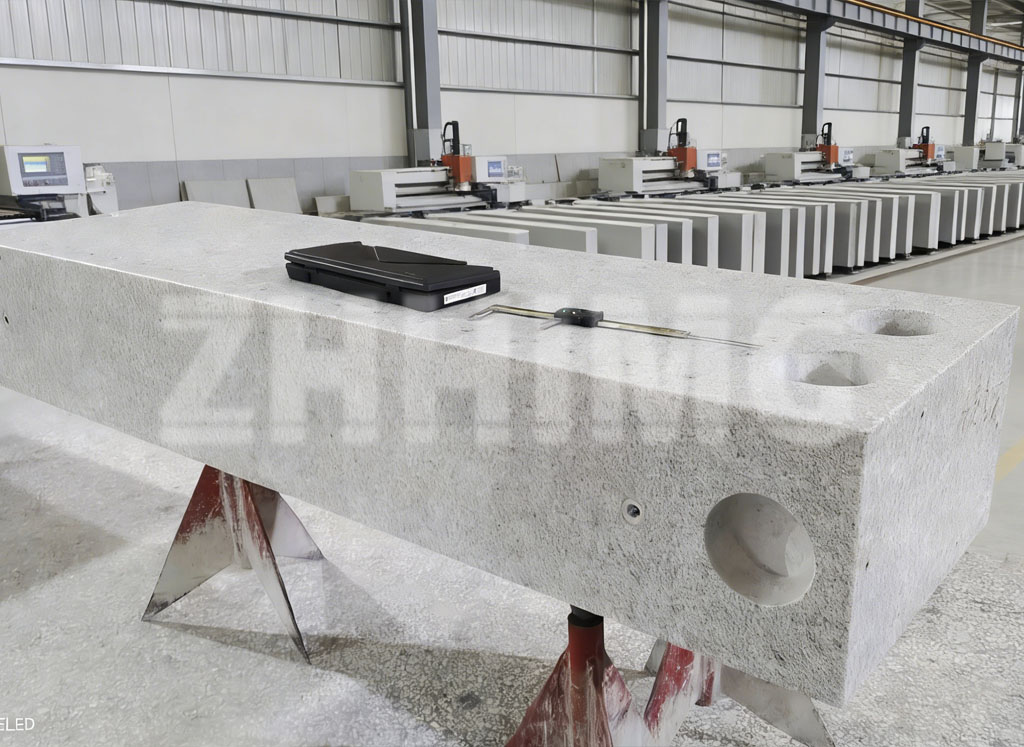
Environmental Control Becomes Critical for Ultra Precision
When accuracy reaches the micron and nanometer level, environmental conditions become part of the manufacturing process.
Important factors include:
- Temperature stability
- Humidity control
- Air cleanliness
- Vibration isolation
For example, advanced precision manufacturing facilities often require:
- Constant temperature environments
- Vibration-resistant foundations
- Clean production areas
At ZHHIMG®, precision granite assembly and inspection processes are performed in controlled environments designed to minimize external influence.
The company operates dedicated temperature and humidity-controlled workshops to maintain stable manufacturing conditions for precision components.
Human Expertise Remains Essential in Advanced Manufacturing
Although automation continues to develop, human engineering experience remains irreplaceable.
Ultra-precision manufacturing requires:
- Understanding of materials
- Manufacturing experience
- Problem-solving ability
- Precision craftsmanship
Experienced engineers can identify subtle problems that automated systems may not immediately recognize.
At ZHHIMG®, many precision grinding engineers have more than 30 years of practical experience in precision finishing.
Their knowledge represents the combination of traditional craftsmanship and modern technology.
ZHHIMG® and the Development of Ultra-Precision Industry
As industries move toward higher precision requirements, ZHHIMG® continues focusing on the development of advanced manufacturing solutions.
The company specializes in:
- Precision granite components
- Granite measuring instruments
- Granite air bearing structures
- Precision ceramic components
- Precision metal machining
- Precision glass solutions
- Mineral casting
- UHPC precision structures
- Carbon fiber precision beams
- Advanced manufacturing solutions
With large-scale manufacturing facilities, advanced processing equipment, and professional metrology capabilities, ZHHIMG® supports customers developing next-generation precision equipment.
The company’s mission is:
“Promote the development of ultra-precision industry.”
Future Trends in Ultra-Precision Manufacturing
Looking ahead, several trends will continue shaping the industry.
1. Higher Accuracy Requirements
Industries will continue moving from:
Micron → Sub-micron → Nanometer precision
2. More Advanced Materials
Future equipment will increasingly use:
- Hybrid materials
- Composite structures
- Advanced ceramics
- Carbon fiber systems
3. Intelligent Manufacturing
Factories will become:
- More automated
- More connected
- More data-driven
4. Integrated Precision Systems
Future manufacturing will combine:
- Mechanical engineering
- Material science
- Metrology
- Software intelligence
Precision will no longer depend on a single component, but on the entire system.
Conclusion: Precision Has No Final Limit
The history of manufacturing is a continuous journey toward higher accuracy.
From traditional machining to micron-level manufacturing, and now toward nanometer-level engineering, each technological breakthrough requires new materials, new measurement methods, and new manufacturing philosophies.
The future of industry will belong to companies that can combine:
- Advanced materials
- Precision manufacturing
- Accurate measurement
- Engineering experience
- Continuous innovation
At ZHHIMG®, we believe:
Precision manufacturing is not only about making components smaller.
It is about making the future more accurate.
Post time: Jul-15-2026