
In the relentless pursuit of perfection that defines modern manufacturing, the foundational elements supporting precision processes are as critical as the cutting-edge technologies themselves. As industries push the boundaries of miniaturization, speed, and accuracy, the demand for components that can provide unwavering stability and exactitude has never been higher. Among the materials that have risen to this challenge, granite stands out as an indispensable cornerstone, particularly in the form of precision components integrated into advanced manufacturing systems and rigorous quality assurance protocols. Its unique blend of physical and mechanical properties makes it an ideal choice for applications where even microscopic deviations can lead to catastrophic failures or significant performance compromises.
The Unparalleled Advantages of Granite in High-Precision Environments
Granite’s prominence in modern manufacturing is not accidental; it is a direct consequence of its inherent characteristics that align perfectly with the stringent requirements of high-precision engineering. These properties collectively contribute to the superior performance and reliability of systems that rely on granite components.
Exceptional Dimensional Stability and Ultra-Low Thermal Expansion
One of the most critical attributes of granite is its extraordinary dimensional stability, primarily driven by its remarkably low coefficient of thermal expansion (CTE). Unlike metallic materials, which are prone to expanding and contracting significantly with temperature fluctuations, granite exhibits minimal dimensional changes. For instance, granite’s CTE is typically in the range of 3 to 7 × 10⁻⁶/°C, which is substantially lower than that of steel or cast iron . This inherent resistance to thermal deformation is paramount in environments where temperature variations, even subtle ones, can introduce significant measurement errors or structural shifts. In applications like photolithography in semiconductor manufacturing, where features are patterned at the nanometer scale, maintaining consistent dimensions is non-negotiable. Granite’s thermal stability ensures that the foundational elements of such equipment remain geometrically true, safeguarding the integrity of the manufacturing process .
Superior Vibration Damping Capabilities
Modern manufacturing processes, especially those involving high-speed machining, ultra-fine positioning, or sensitive optical measurements, are highly susceptible to the detrimental effects of vibration. Vibrations can lead to tool chatter, reduced surface finish quality, inaccurate measurements, and even damage to delicate components. Granite excels in mitigating these issues due to its excellent natural vibration damping characteristics. Its dense, crystalline structure effectively absorbs and dissipates mechanical vibrations, preventing them from being transmitted to critical components or workpieces. This passive damping capability is crucial for creating a
stable and “quiet” environment for sensitive operations. For example, when external vibrations are transmitted to production equipment, granite precision parts can effectively absorb and attenuate over 80% of the vibration energy, significantly reducing the impact on precision equipment . This ensures that the relative position error between critical elements, such as a silicon wafer and a photolithography mask, is controlled at the nanometer level .
Inherent Hardness, Wear Resistance, and Long-Term Reliability
Granite is an exceptionally hard and wear-resistant material, typically possessing a Mohs hardness of 6 to 7. This characteristic allows granite precision components to withstand long-term mechanical movements and loads without significant wear or degradation of their precision surfaces. In continuous and long-term production processes, such as semiconductor manufacturing, equipment needs to operate stably for extended periods. Granite precision parts are not prone to wear and tear and can consistently maintain stable performance and accuracy . Furthermore, unlike metals, granite does not experience fatigue deformation or performance degradation during long-term use. This means that equipment utilizing granite components can maintain high precision and stability after prolonged operation, effectively reducing the product defect rate caused by the decline in equipment precision and lowering overall production costs .
Granite Precision Components in Semiconductor Manufacturing
The semiconductor industry represents the pinnacle of modern manufacturing precision, where the scale of operations has descended into the nanometer realm. In this highly demanding environment, granite precision components play a critical, irreplaceable role.
Photolithography and Wafer Handling
Photolithography is a crucial step in transferring the design patterns of chips onto silicon wafers. This process requires the worktable of the photolithography machine to maintain extremely high stability. Granite precision workbenches isolate vibration interference from the workshop floor and other equipment, ensuring that the relative position error between the silicon wafer and the photolithography mask is controlled at the nanometer level during the exposure process, thereby guaranteeing the precise transfer of the pattern . Additionally, precision granite air bearings provide a stable, low-friction platform for the handling and movement of semiconductor wafers, ensuring they are positioned accurately for processing, inspection, and testing .
Etching and Packaging Equipment
In the chip etching process, even a slight change in temperature may cause thermal expansion of key components, resulting in deviations in etching depth and precision. Using granite precision accessories as support and load-bearing components effectively prevents this, ensuring the high precision and consistency of the etching process . Similarly, in chip packaging equipment, high-precision surface quality of components such as granite precision guide rails and sliders significantly reduces friction and wear between moving parts. This ensures that the error of the movement trajectory of the packaging head when picking up and placing the chip is controlled at the micrometer or even nanometer level, achieving precise alignment and reliable connection .
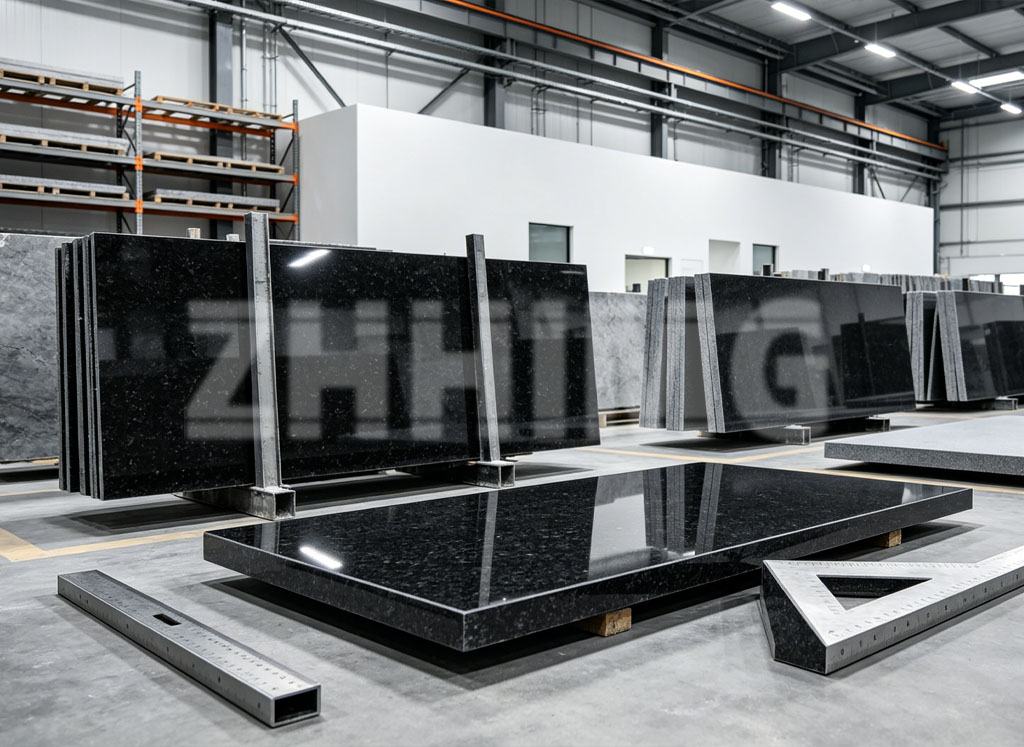
The Crucial Role in Quality Assurance and Metrology
Quality assurance (QA) is the backbone of modern manufacturing, ensuring that products meet stringent specifications and perform reliably. Metrology, the science of measurement, is the core of QA, and granite is the foundational material for many of its most critical instruments.
Coordinate Measuring Machines (CMMs)
Coordinate Measuring Machines (CMMs) are the workhorses of modern dimensional inspection, used to verify the geometry of complex parts across industries from aerospace to automotive. The accuracy of a CMM is fundamentally dependent on the stability of its base and structural elements. Granite is the material of choice for CMM bases and gantries due to its exceptional dimensional stability and vibration damping properties. A granite base provides a rigid, thermally stable reference plane that ensures the measuring probe’s movements are accurately recorded, free from distortions caused by environmental fluctuations or machine vibrations.
Optical Inspection and Calibration Systems
As manufacturing tolerances become tighter, optical inspection systems are increasingly employed for non-contact, high-resolution measurements. These systems, which often utilize lasers and high-magnification optics, are extremely sensitive to vibrations and thermal drift. Granite precision components, such as optical tables and air bearing stages, provide the necessary stability for these delicate instruments. They ensure that optical components remain perfectly aligned and that measurements are not compromised by environmental noise. Furthermore, precision granite air bearings are used to support and calibrate tools and measuring instruments, ensuring they remain aligned and accurate during the calibration process .
Future Trends: Granite in Smart Manufacturing and Industry 4.0
As manufacturing evolves towards Industry 4.0, characterized by automation, data exchange, and smart factories, the role of precision components is also transforming. While the fundamental need for stability and accuracy remains, the integration of granite components into these advanced systems is becoming more sophisticated.
Integration with Advanced Motion Control
The future of precision manufacturing involves highly dynamic, high-speed motion systems. Granite precision components are increasingly being integrated with advanced air bearing technology and linear motors to create ultra-precise, frictionless motion stages. These systems offer unparalleled positioning accuracy and speed, essential for next-generation semiconductor manufacturing, advanced optics, and micro-machining. The combination of granite’s stability with the frictionless movement of air bearings provides a platform capable of meeting the extreme demands of future manufacturing technologies .
Sustainable and Green Manufacturing
As environmental concerns become more prominent, the sustainability of manufacturing processes is under scrutiny. Granite, as a natural material, offers certain environmental advantages over engineered materials that require energy-intensive production processes. Furthermore, the exceptional longevity and low maintenance requirements of granite components contribute to a more sustainable manufacturing lifecycle by reducing the need for frequent replacements and minimizing waste.
Conclusion
Granite precision components are the unsung heroes of modern manufacturing and quality assurance. Their unique combination of exceptional dimensional stability, superior vibration damping, and long-term reliability makes them indispensable in environments where precision is paramount. From the nanoscale operations of semiconductor fabrication to the rigorous dimensional verification of aerospace components, granite provides the solid foundation upon which modern technological advancements are built. As industries continue to push the limits of what is possible, the role of granite precision components will only grow in importance, ensuring that the manufacturing processes of tomorrow can achieve the unprecedented levels of accuracy and reliability required to drive innovation forward.
Post time: May-13-2026