
In the competitive landscape of high-end equipment manufacturing, procurement decisions are rarely straightforward. When specifying the structural base for a Coordinate Measuring Machine (CMM), a laser scanner, or a semiconductor bonding tool, engineers and purchasing managers are often presented with a stark choice: the traditional, geological stability of natural granite or the modern, moldable versatility of polymer concrete (often known as mineral casting or epoxy granite).
On the surface, the decision often comes down to a simple metric: the initial invoice price. However, for equipment designed to operate for decades, this “sticker price” is merely the entry fee. The true cost of material selection is revealed only through a longitudinal analysis of performance, maintenance, and stability. This article provides a comprehensive Total Cost of Ownership (TCO) analysis, helping manufacturers look beyond the initial quote to understand the long-term value of their foundation.
Defining the Contenders
To make an informed comparison, we must first understand the fundamental nature of these materials.
Natural Granite
A naturally occurring igneous rock, formed under immense heat and pressure over millions of years. For precision applications, fine-grain granites (like Black Galaxy) are selected for their high quartz content, hardness, and geological stability. It is a subtractive manufacturing material—it must be cut and ground from a solid block.
A naturally occurring igneous rock, formed under immense heat and pressure over millions of years. For precision applications, fine-grain granites (like Black Galaxy) are selected for their high quartz content, hardness, and geological stability. It is a subtractive manufacturing material—it must be cut and ground from a solid block.
Polymer Concrete
A synthetic composite material. It typically consists of about 80-90% crushed natural aggregate (granite grit) bound together by 10-20% polymer resin (epoxy or polyester). It is a formative material—it is poured into a mold to cure. This allows for complex geometries, embedded inserts, and hollow sections that are difficult to machine from solid stone.
A synthetic composite material. It typically consists of about 80-90% crushed natural aggregate (granite grit) bound together by 10-20% polymer resin (epoxy or polyester). It is a formative material—it is poured into a mold to cure. This allows for complex geometries, embedded inserts, and hollow sections that are difficult to machine from solid stone.
Phase 1: Initial Acquisition Costs
The first battleground in material selection is the upfront capital expenditure.
The Cost of Complexity
For standard, block-like shapes, granite is often cost-competitive. However, as geometry becomes more complex, the cost of granite rises exponentially due to the machining time required. Diamond tooling wears down quickly, and grinding deep pockets or intricate channels is labor-intensive.
For standard, block-like shapes, granite is often cost-competitive. However, as geometry becomes more complex, the cost of granite rises exponentially due to the machining time required. Diamond tooling wears down quickly, and grinding deep pockets or intricate channels is labor-intensive.
Polymer concrete shines here. Once the mold is created, producing complex shapes is relatively inexpensive. The curing process is faster than the grinding process for complex granite parts. For highly specialized, low-volume custom bases, polymer concrete can offer an initial price advantage of 15-20%.
The Supply Chain Factor
Granite is a global commodity. High-quality stone is quarried in specific regions (India, China, Brazil) and shipped globally. This introduces freight costs and lead times. Polymer concrete can theoretically be mixed locally, reducing logistics costs, though high-quality resin systems are often proprietary and expensive.
Granite is a global commodity. High-quality stone is quarried in specific regions (India, China, Brazil) and shipped globally. This introduces freight costs and lead times. Polymer concrete can theoretically be mixed locally, reducing logistics costs, though high-quality resin systems are often proprietary and expensive.
Verdict on Initial Cost:
- Simple Shapes: Granite is often cheaper or price-neutral.
- Complex Shapes: Polymer Concrete is generally cheaper.
Phase 2: The Maintenance Reality (10-Year Horizon)
Once the machine is installed, the “hidden” costs of materials begin to surface. This is where the divergence between stone and synthetic becomes apparent.
Corrosion and Chemical Resistance
- Polymer Concrete: While the aggregate is inert, the binder is a polymer. Epoxy resins can be susceptible to degradation from certain industrial solvents, coolants, and UV light. Over a 10-year period, if the protective coating (gel coat) is breached, the resin matrix can absorb moisture or chemicals, leading to “plasticization”—a softening of the material that compromises structural integrity.
- Granite: It is chemically inert. It does not rust, rot, or react with coolants. In a harsh industrial environment, a granite base can be wiped clean with aggressive solvents without fear of damaging the material itself. It does not require the protective painting or sealing that polymer bases often do.
Physical Durability
- Impact Resistance: Granite is brittle. A sharp, heavy impact can chip or crack it. Polymer concrete is more ductile and can absorb impact energy better without catastrophic failure.
- Wear: Granite is harder than the steel tools used to machine it. Polymer concrete, being a composite, can be softer. If a moving component rubs against the base, it may gouge the polymer surface more easily than a granite surface.
Verdict on Maintenance:
Granite offers a lower maintenance burden over 10 years due to its immunity to chemical degradation and lack of required surface coatings.
Granite offers a lower maintenance burden over 10 years due to its immunity to chemical degradation and lack of required surface coatings.
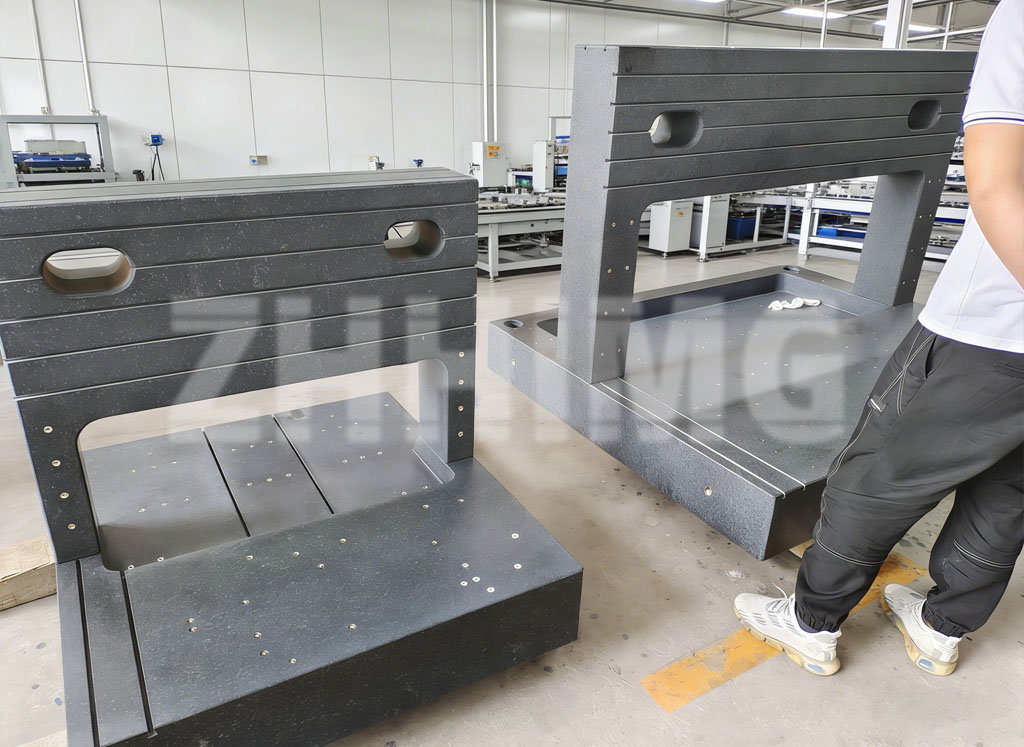
Phase 3: Performance Stability – The “Drift” Factor
This is the most critical metric for precision equipment. If a machine loses accuracy, the cost is measured in scrapped parts and downtime.
Thermal Stability
- Granite: Has a low coefficient of thermal expansion (approx. 5.4 × 10⁻⁶/°C). It reacts slowly to temperature changes (high thermal mass), acting as a heat sink.
- Polymer Concrete: The thermal expansion depends on the aggregate, but the resin binder can be sensitive to heat. More importantly, the curing process of polymer concrete is exothermic. If not cured perfectly, internal stresses can develop. Over years, these stresses can relax, causing the base to “creep” or warp microscopically.
Damping and Vibration
- Polymer Concrete: This is the synthetic material’s superpower. The viscoelastic nature of the epoxy binder provides exceptional damping—often 10 times better than steel and slightly better than granite. For machines plagued by chatter or high-frequency vibration, polymer concrete is an excellent isolator.
- Granite: Offers excellent damping (better than steel), but generally slightly less than optimized polymer composites. However, for the vast majority of precision applications, granite’s damping is more than sufficient.
Long-Term Flatness
Granite is effectively stress-free because it has been under pressure for millennia. Polymer concrete is a man-made mixture; its long-term stability relies entirely on the quality of the mix and the cure. In a 10-year study, high-quality granite consistently maintains its geometric tolerances better than polymer composites, which are subject to aging effects of the plastic binder.
Granite is effectively stress-free because it has been under pressure for millennia. Polymer concrete is a man-made mixture; its long-term stability relies entirely on the quality of the mix and the cure. In a 10-year study, high-quality granite consistently maintains its geometric tolerances better than polymer composites, which are subject to aging effects of the plastic binder.
Phase 4: Total Cost of Ownership (TCO) Analysis
When we aggregate these factors into a financial model, the picture changes.
The TCO Equation:
TCO = Initial Cost + (Maintenance Cost × Years) + (Scrap Cost due to Inaccuracy) + (Downtime Cost)
TCO = Initial Cost + (Maintenance Cost × Years) + (Scrap Cost due to Inaccuracy) + (Downtime Cost)
Scenario A: The Polymer Concrete Base
- Initial Cost: Low ($8,000)
- Maintenance: Medium (Recoating/Inspection every 5 years)
- Performance Risk: Medium (Potential for thermal drift or creep after 8 years)
- End of Life: Difficult to recycle (composite material).
Scenario B: The Granite Base
- Initial Cost: High ($10,000 – premium for machining)
- Maintenance: Near Zero (Inert, no coating)
- Performance Risk: Low (Stable for decades)
- End of Life: High residual value (can be re-lapped or repurposed).
The “Scrap Rate” Variable
Consider a machine that produces $500 worth of parts per hour. If the polymer base drifts thermally by just 2 microns more than the granite base due to daily temperature swings, causing a crash or a bad batch once a month, the cost of that scrap ($12,000/year) instantly eclipses the initial savings of the material.
Consider a machine that produces $500 worth of parts per hour. If the polymer base drifts thermally by just 2 microns more than the granite base due to daily temperature swings, causing a crash or a bad batch once a month, the cost of that scrap ($12,000/year) instantly eclipses the initial savings of the material.
Comparative Data Summary
| Feature | Natural Granite | Polymer Concrete | Winner |
|---|---|---|---|
| Initial Price (Complex) | High | Low | Polymer |
| Vibration Damping | Excellent | Superior | Polymer |
| Thermal Stability | Superior | Good | Granite |
| Long-Term Creep | None (Geological) | Possible (Resin aging) | Granite |
| Chemical Resistance | Superior | Moderate | Granite |
| Repairability | Difficult | Easy (Fill and patch) | Polymer |
| Sustainability | Natural/Recyclable | Synthetic/Hard to Recycle | Granite |
Conclusion: Choosing for the Long Term
So, which material should you choose?
If your priority is rapid prototyping, complex geometry, or extreme vibration damping for a machine with a shorter lifecycle (3-5 years), polymer concrete is a viable, cost-effective engineering solution.
However, if you are building a precision equipment foundation intended to last 10, 20, or 50 years—where accuracy is the non-negotiable currency—granite remains the superior investment. The “True Cost” of polymer concrete often reveals itself in the form of thermal sensitivity and material aging, whereas granite offers a guarantee of stability that only nature can provide.
Post time: Apr-20-2026