
In precision engineering and metrology, granite surface plates are fundamental reference tools used to verify flatness, alignment, and dimensional accuracy. However, the reliability of these tools depends not only on material quality but also on compliance with internationally recognized standards.
Two of the most widely referenced systems are ISO certification and DIN standard granite specifications. These standards define the criteria for surface plate accuracy, testing methods, and permissible tolerances, ensuring consistency across global industries.
For buyers, engineers, and quality managers in international markets, understanding these standards is essential for selecting the right surface plate and ensuring compliance with inspection requirements. This article provides a detailed explanation of ISO and DIN standards and how they relate to surface plate accuracy.
Why Standards Matter in Precision Measurement
In high-precision environments, measurement consistency must be guaranteed across different locations, industries, and equipment. Without standardized benchmarks, results from one laboratory or factory could not be reliably compared with another.
Standards such as ISO and DIN provide:
- Defined flatness tolerance grades
- Uniform testing and calibration methods
- Traceability and certification requirements
- Global compatibility for trade and quality control
For granite surface plates, these standards ensure that a “Grade 0” plate in one country performs equivalently to the same grade elsewhere.
Overview of ISO Standards for Granite Surface Plates
The International Organization for Standardization (ISO) provides globally recognized guidelines for precision measurement tools. The key standard related to granite surface plates is ISO 8512.
ISO 8512: Surface Plates — Requirements and Testing
ISO 8512 defines the specifications for surface plates made from granite and other materials. It focuses on:
- Flatness tolerance grades
- Measurement uncertainty
- Inspection methods
- Support systems and installation
The standard classifies surface plates into different accuracy grades, typically including:
- Grade 0 (high precision)
- Grade 1 (inspection grade)
- Grade 2 (workshop grade)
Each grade has a defined maximum permissible deviation in flatness, usually expressed as a function of plate size.
ISO standards emphasize traceability and require that measurements be verified using calibrated instruments under controlled environmental conditions.
Overview of DIN Standards for Granite Surface Plates
DIN standards originate from Germany and are widely used in European industries. The relevant specification for granite surface plates is DIN 876.
DIN 876: Surface Plates – Classification and Tolerances
DIN 876 provides detailed guidelines for:
- Flatness tolerances
- Material requirements
- Manufacturing processes
- Inspection procedures
Similar to ISO, DIN 876 defines multiple accuracy grades, commonly:
- Grade 00 (ultra-precision)
- Grade 0 (inspection)
- Grade 1 (workshop)
- Grade 2 (general use)
One key distinction is that DIN includes the Grade 00 classification, which represents an even higher level of precision than standard Grade 0 in many cases.
DIN standards are known for their strict tolerance definitions and are often preferred in high-end European manufacturing and metrology labs.
Comparing ISO and DIN Standards
While ISO and DIN standards are closely aligned in principle, there are some differences in structure and classification.
ISO standards are globally harmonized and widely accepted in international trade. They focus on consistency and interoperability across different countries and industries.
DIN standards, while also highly respected, tend to be more detailed in certain aspects and may include stricter tolerances for specific grades. For example, the inclusion of Grade 00 in DIN provides an additional level of classification for ultra-precision applications.
In practice, many manufacturers design their granite surface plates to comply with both ISO and DIN requirements, ensuring compatibility with global markets.
Surface Plate Accuracy: What Do the Grades Mean?
The accuracy of a granite surface plate is defined by its flatness tolerance—the maximum deviation from a perfectly flat plane.
This tolerance depends on:
- Plate dimensions
- Material quality
- Manufacturing precision
- Environmental conditions
Higher-grade plates have tighter tolerances, meaning less deviation and higher accuracy.
For example:
- Grade 00 / Grade 0 plates are used in calibration labs and high-precision inspection
- Grade 1 plates are suitable for general inspection work
- Grade 2 plates are typically used in workshops and less critical applications
Understanding these grades is essential when selecting a surface plate for a specific application.
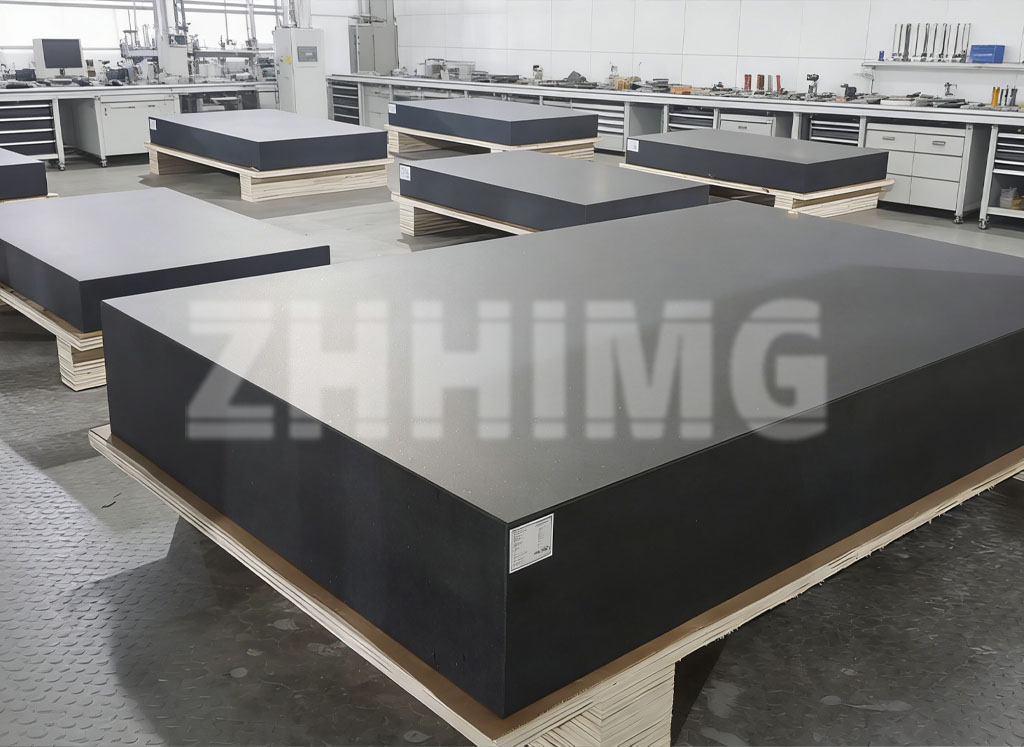
Testing and Calibration Requirements
Both ISO and DIN standards specify rigorous testing methods to verify surface plate accuracy. These methods include:
- Electronic level measurements
- Autocollimator techniques
- Laser interferometry
Measurements must be performed under controlled environmental conditions, typically at a standard temperature of 20°C (68°F).
Support points and installation also play a critical role. Improper support can introduce deformation, affecting measurement results. Standards define optimal support configurations to ensure accuracy.
Regular recalibration is required to maintain compliance, especially in high-use environments.
Material Considerations in Standard Compliance
While standards define performance requirements, material selection plays a crucial role in achieving them.
Granite is the preferred material for modern surface plates due to its:
- High dimensional stability
- Low thermal expansion
- उत्कृष्ट wear resistance
- Non-corrosive properties
High-quality DIN standard granite typically features a dense, fine-grained structure, which contributes to consistent performance and long-term stability.
Manufacturers must carefully select and process granite to meet the strict tolerances defined by ISO and DIN standards.
ISO Certification and Quality Assurance
ISO certification goes beyond product specifications—it reflects a manufacturer’s overall quality management system.
Companies with ISO certification (such as ISO 9001) demonstrate:
- Consistent manufacturing processes
- Documented quality control procedures
- Traceability of materials and production
- Continuous improvement practices
For buyers, ISO certification provides confidence that the surface plates are produced under controlled and reliable conditions.
When combined with compliance to ISO 8512, it ensures both product quality and process reliability.
Choosing the Right Standard for Your Application
Selecting between ISO and DIN standards is not necessarily an either-or decision. Instead, the choice depends on:
- Industry requirements
- Customer specifications
- Regional preferences
- Required accuracy level
For international trade, ISO compliance is often essential due to its global recognition. For European markets or ultra-precision applications, DIN standards may be preferred.
In many cases, specifying compliance with both standards provides maximum flexibility and assurance.
Industry Trends and Global Integration
As global manufacturing becomes increasingly interconnected, the importance of standardized measurement systems continues to grow.
Many modern metrology labs and manufacturers adopt both ISO and DIN standards to ensure compatibility across supply chains. This dual compliance approach helps:
- Facilitate international trade
- Ensure consistent quality across regions
- Meet diverse customer requirements
Advances in manufacturing technology are also enabling tighter tolerances, pushing the limits of surface plate accuracy even further.
Conclusion
Understanding ISO and DIN standards is essential for anyone involved in precision measurement and quality control. These standards provide the framework for defining, testing, and maintaining the accuracy of granite surface plates.
While ISO offers global consistency and widespread acceptance, DIN provides detailed classifications and ultra-precision grades that are highly valued in advanced applications.
For buyers and engineers, the key is not just to choose a surface plate, but to ensure it meets the appropriate standards for your specific needs. By doing so, you can guarantee reliable measurement performance, compliance with industry requirements, and long-term operational efficiency.
In today’s precision-driven industries, standards are not just guidelines—they are the foundation of accuracy and trust.
Post time: Apr-14-2026