
In high‑end manufacturing sectors such as semiconductor equipment, precision metrology, laser processing and new‑energy inspection, the machine base serves as the reference carrier for complete equipment. Its overall performance directly determines measurement accuracy, operational repeatability and service life of the whole system. Various base materials including castings, welded steel structures and mineral castings are widely adopted. Thanks to its unique material properties, precision granite has gradually become the preferred base material for ultra‑precision equipment. With rich project delivery and industry‑university‑research cooperation experience, ZHHIMG, a specialist in ultra‑precision component manufacturing, analyzes multiple core performance advantages of precision granite machine bases from the perspective of real‑world working conditions.
Excellent vibration damping capacity stands out as one of granite base’s most prominent merits. Vibration can be generated by high‑speed linear‑motor movement, air‑bearing startup‑stop and workpiece impact during equipment operation. Tiny vibration will be amplified into measurement errors. Dense internal crystal structure of granite rapidly absorbs and dissipates vibration energy and restrains vibration transmission. It delivers much faster vibration attenuation compared with cast iron and steel. This feature is critical for coordinate measuring machines, femtosecond laser devices and optical inspection instruments. It suppresses micro‑jitter under dynamic working conditions, stabilizes imaging and inspection outcomes, and reduces data fluctuation caused by vibration.
Superior thermal stability with minimal thermal deformation constitutes another key competitive edge of precision granite. Workshops inevitably suffer from day‑night temperature differences, self‑heating of equipment and heat disturbance from surrounding machinery. Metal‑made bases undergo obvious expansion and contraction with temperature variation. High‑grade black granite features an ultra‑low thermal expansion coefficient. It produces negligible dimensional change under ambient temperature fluctuation and maintains the geometric status of reference surfaces over long periods. Even with long‑hours continuous operation, reference offset triggered by temperature shift rarely occurs. It fits precision production lines running non‑stop and lowers the frequency of re‑calibration caused by thermal drift.
High rigidity and dimensional stability resist deformation induced by long‑term stress. Precision granite blanks with proper aging treatment achieve sufficient internal‑stress relief. Unlike certain metal castings which deform gradually due to stress release after long‑time service, granite boasts high material hardness and strong creep resistance. It hardly produces plastic deformation under long‑term static load from equipment dead weight and module assemblies. It retains original geometry for years, making it ideal for large‑travel gantry systems and full‑size CMM bases.
Non‑magnetic property and corrosion resistance adapt to complex industrial sites. Precision granite is non‑magnetic and will not bring magnetic interference to built‑in sensors, optical components and magnetic scales, which cannot be achieved by steel‑based bases. Furthermore, the stone substrate tolerates oil stains as well as weak acid and alkali. Splashes of cutting fluid, coolant and mild chemical agents in workshops will not erode precision working surfaces rapidly. Different from metal bases, it requires no anti‑rust coating, eliminating precision risks brought by coating aging and peeling and easing subsequent maintenance workload. 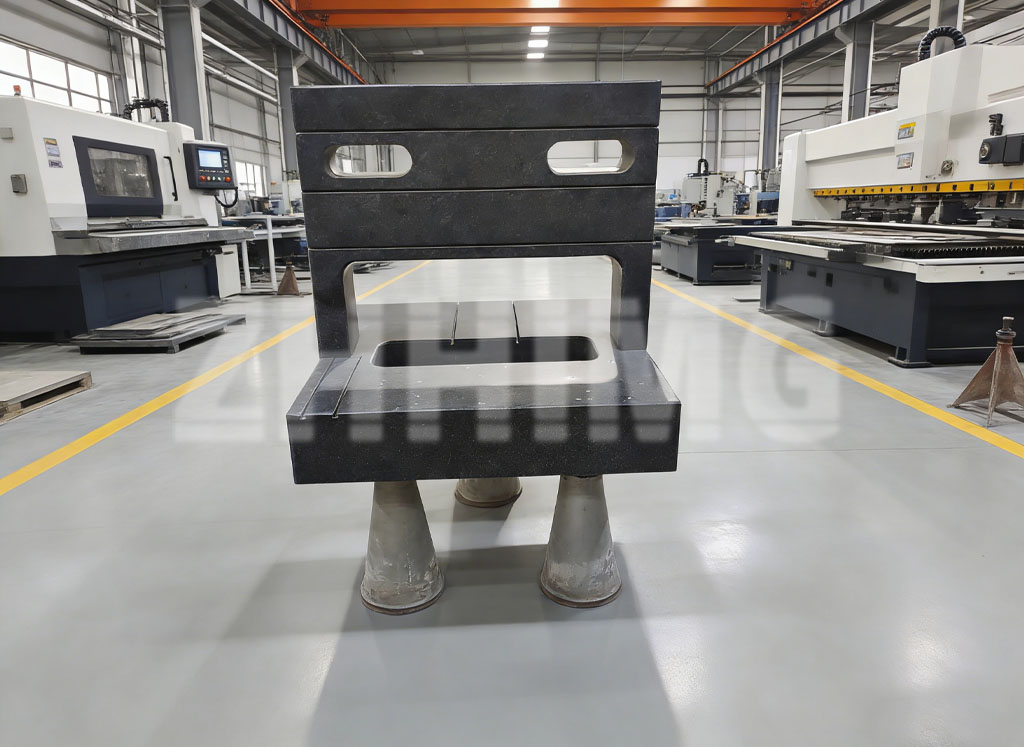
Ultra‑high geometric accuracy of reference surfaces meets nano‑level assembly requirements. Via mechanical grinding and professional lapping processes, granite can attain superior flatness, straightness and perpendicularity. Air‑bearing working surfaces and high‑precision positioning reference planes can be directly machined on granite bases to satisfy assembly demands of linear‑motor stages and air‑bearing motion mechanisms. The base itself can act as a metrological benchmark without attaching extra reference plates, so as to reduce cumulative errors from multi‑layer assembly and simplify overall machine structure.
Nevertheless, granite bases set high thresholds for raw‑material grade, processing environment and lapping craftsmanship. Low‑grade stone will lose all above‑mentioned merits. Some market players pass ordinary marble off as precision granite. Such substitutes contain abundant internal cracks, poor damping performance and large thermal deformation, leading to rapid accuracy degradation after commissioning. ZHHIMG strictly selects premium‑grade black granite blanks and implements complete processing, aging and inspection workflows to guarantee finished bases can fully realize the inherent material advantages of granite.
Against the backdrop of global high‑end manufacturing pursuing ever‑higher precision, material superiority is only the foundation. Raw‑material screening, stress‑relief procedures, precision machining and metrological testing jointly decide whether finished bases can give full play to granite’s innate strengths. ZHHIMG keeps supplying granite base solutions for global research institutes and Fortune‑500 manufacturers, supporting ultra‑precision equipment to deliver stable and high‑accuracy performance.
Post time: Aug-14-2026