
In semiconductor inspection, optical metrology, laser processing and new‑energy testing equipment, the gantry frame serves as the core geometry reference that carries moving modules. The measuring repeatability, imaging clarity and positioning performance of finished equipment largely depend on how the gantry frame behaves under real‑world operating conditions. Many equipment manufacturers find that metal gantries with excellent theoretical drawing parameters often deliver sub‑par field performance after deployment on production floors, constrained by site environments, continuous operation, assembly and commissioning. The value of granite gantry structures lies not merely in superior material specifications on paper, but in tangible benefits across the full lifecycle: machine assembly, on‑site workshop operation and long‑term field service.
From the perspective of equipment assembly and commissioning, granite gantries can substantially lower overall machine setup difficulty. Key reference surfaces for columns, cross‑beams and bases of premium granite gantries are ground within one unified manufacturing workflow, with flatness, perpendicularity and parallelism established in a single process. Compared with metal split‑type gantries assembled and locked via bolts, monolithic granite gantries eliminate substantial human‑induced errors introduced during assembly. Equipment manufacturers may mount guide rails, linear encoders and sensors directly onto stone reference planes, cutting extensive hand‑scraping and adjustment work and shortening total machine‑assembly cycles. For large‑travel inspection machinery, multi‑segment spliced metal gantries demand repeated orthogonal‑alignment corrections during assembly. By contrast, well‑fabricated one‑piece granite gantries lock in geometric relationships in advance, making it far easier for complete machines to hit target precision specifications.
When deployed inside production workshops, environmental adaptability stands out as a prominent practical advantage of granite gantries. Real‑world manufacturing facilities rarely maintain ideal constant‑temperature conditions. Day‑night shifts, heat dissipation from running equipment and HVAC fluctuations all generate minor temperature swings. Disparate thermal‑expansion coefficients among individual metal‑gantry components produce asynchronous dimensional changes under temperature variation, triggering cascading issues such as axis orthogonality offset and optical‑path misalignment. Granite features uniform thermophysical properties across its whole structure. All sections of the gantry deform synchronously when temperatures shift without relative displacement between components. Even amid moderate workshop temperature fluctuations, measurement and motion references remain stable, easing strict constant‑temperature requirements and broadening feasible deployment scenarios. Meanwhile, micro‑vibrations originating from overhead cranes and adjacent machinery cannot be fully isolated. Granite’s inherent damping capacity rapidly dissipates vibrational energy and suppresses resonance. During high‑speed scanning, optical imaging and weak‑signal acquisition, it reduces image jitter and data fluctuation to guarantee consistent, reliable real‑time output. 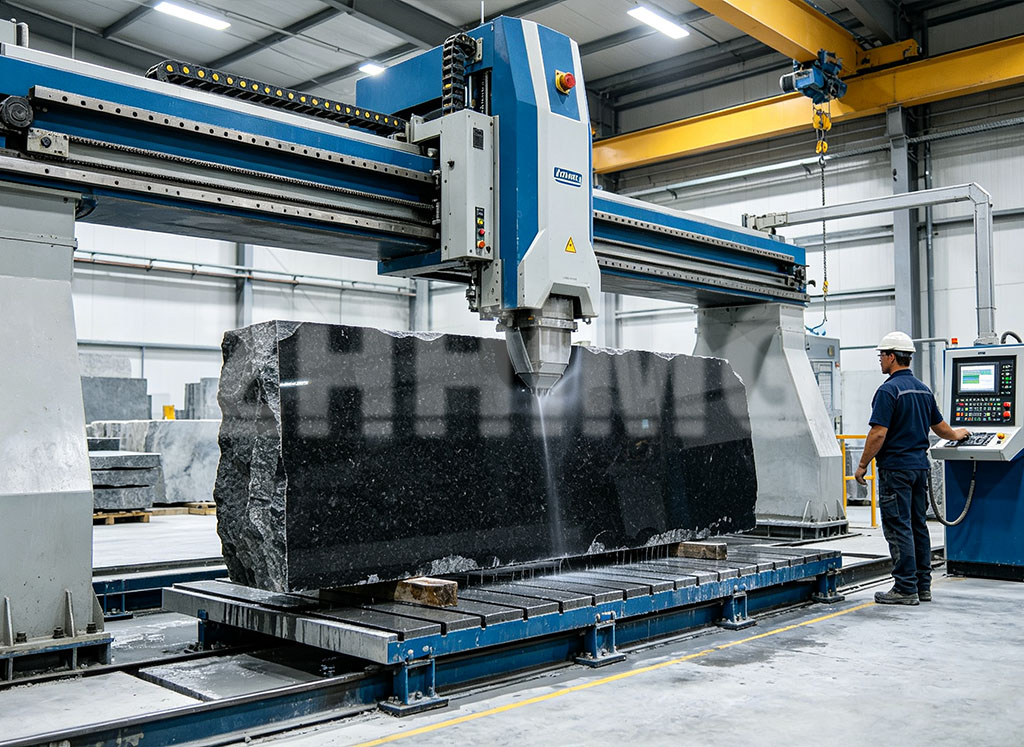
Under heavy‑duty continuous production, granite gantries deliver outstanding precision retention. After casting, welding and CNC machining, metal components retain residual internal stress that releases gradually over years of operation. Gantry frames twist and warp, degrading factory‑calibrated accuracy and requiring costly on‑site disassembly and correction by specialist technicians. Granite undergoes natural geological stress relief over millions of years and suffers no creep deformation after machining. Under non‑stop production cycles, enduring dynamic loads from sliding tables, camera units and inspection modules, its geometric benchmarks resist alteration. For semiconductor fabs and metrology laboratories running equipment year‑round, granite extends stable‑precision cycles, cuts downtime for calibration and boosts equipment uptime.
Granite gantries also bring multiple practical merits regarding daily operation and environmental resistance. The stone neither rusts nor magnetizes. It withstands cutting fluids, dust and humid conditions without anti‑rust coatings that risk aging, peeling and secondary contamination. Within semiconductor and magnetic‑sensor‑oriented equipment, its non‑magnetic characteristic avoids magnetic interference with sensors and chip components. High‑hardness reference surfaces resist wear under reciprocating motion of guide rails and carriages. Minor impacts typically only create localized pitting instead of widespread bulging or frame distortion seen with metal parts, limiting cascading failures caused by component damage.
Nevertheless, raw‑material screening, grinding craftsmanship and metrological verification are prerequisites to unlocking granite gantries’ full potential. Some suppliers sell loosely structured ordinary marble misrepresented as high‑density black granite. Such counterfeit products suffer stress‑triggered deformation and rapid precision decay and cannot realize genuine stone‑material performance. Leveraging comprehensive production infrastructure, vibration‑damped constant‑temperature workshops, highly‑skilled grinding technicians and full sets of traceable metrology instruments, ZHHIMG rigorously selects high‑density black granite raw stock and validates finished‑part geometry against international metrology standards. It translates granite’s intrinsic material strengths into tangible field performance, supplying reliable gantry‑structure solutions for global ultra‑precision equipment manufacturers.
Post time: Sep-08-2026