
Many equipment manufacturers hold a common misconception: granite mechanical systems feature high hardness and great stability, making them nearly maintenance-free substrates that can run unattended after installation. In fact, although ZHHIMG granite bases, machine beds and precision components boast inherent advantages including stress-free deformation, low thermal distortion and excellent vibration damping, they serve as ultra-precision benchmarks at micron and nanometer levels. When exposed to industrial environments filled with machining dust, cutting fluid, temperature fluctuations and accidental impact over long periods, minor external disturbances can gradually compromise benchmark accuracy. The long service life and sustained precision stability of granite mechanical systems rely not only on product quality, but also on a simple, lightweight and standardized routine maintenance regime. Unlike metal machines that require complicated lubrication, rust prevention and part replacement, maintenance for ZHHIMG precision granite systems centers on contamination prevention, impact protection, stable environment and periodic verification. These simple operations can significantly extend the precision service life of equipment.
1. Basic Daily Cleaning: Prevent Contaminants from Damaging Reference Surfaces
Dust, cutting oil, coolant and hand perspiration in workshops are the most common invisible contaminants for precision granite surfaces. Residual oil will form stubborn films over time, while accumulated fine dust can cause micro-scratches on surfaces during mechanical movement, impairing flatness and assembly accuracy. ZHHIMG provides standardized simple maintenance guidelines for daily cleaning, which require no sophisticated tools.
After daily machine shutdown, gently wipe granite reference planes, assembly grooves and mounting holes with lint-free cloth dipped in anhydrous ethanol or neutral stone-specific cleaner to remove dust, oil stains and leftover coolant. Strong acids, strong alkalis, household cleaners, steel wool, sandpaper and other abrasive tools or chemical reagents must be avoided, as they may corrode or scratch the stone surface and ruin the nano-level flat reference plane formed by precision lapping. Ensure the surface is fully dry after cleaning, since prolonged dampness may deteriorate the stone surface and adjacent metal components.
2. Operational Protection: Avoid Hidden Damage from External Force and Environment
Granite mechanical systems are hard yet brittle. In long-term industrial operation, external impact, dragging of workpieces, abrupt temperature changes and liquid immersion are primary causes of edge chipping and benchmark offset, which are key risks to control in daily maintenance.
During operation, never drag or slide metal workpieces and hard fittings directly across granite surfaces. Handle heavy tooling, molds and inspection parts with care; use rubber or copper pads for isolation to prevent hard impact and friction damage. Install oil-proof and splash guards around machining zones to reduce splashing of cutting fluid and chips onto granite base surfaces. Keep the stone base free from standing oil or water to stop contaminants from penetrating and remaining, protecting the integrity of the precision benchmark structure from the source.
In addition, avoid sharp local temperature changes. Do not place hot workpieces or hot air equipment close to granite surfaces for extended periods. Sudden local thermal shock may induce unnecessary minor stress variation and undermine the original excellent thermal stability of ZHHIMG granite systems.
3. Regular Environmental Stabilization: Match Operating Benchmarks of Precision Equipment
Compared with metal beds, granite features stronger environmental adaptability. Nevertheless, prolonged extreme environmental fluctuations will still affect overall machine performance. Simple environmental control in daily maintenance can maximize the stability advantages of granite.
Strict constant-temperature control is unnecessary in ordinary workshops, but long-term operation under high humidity, heavy dust or corrosive gas environments should be avoided. Maintain regular ventilation and cleanliness to reduce long-term erosion of the stone surface by corrosive media and suspended particles. For high-precision granite equipment fitted with linear motors and air bearing guides, keep the operating area clean and dust-free. Fine particles entering motion gaps will damage guide and motor assemblies and cause secondary wear on granite reference surfaces. Inspect leveling feet and supporting structures regularly to ensure even load distribution on the base and prevent slight benchmark tilt caused by uneven long-term stress. 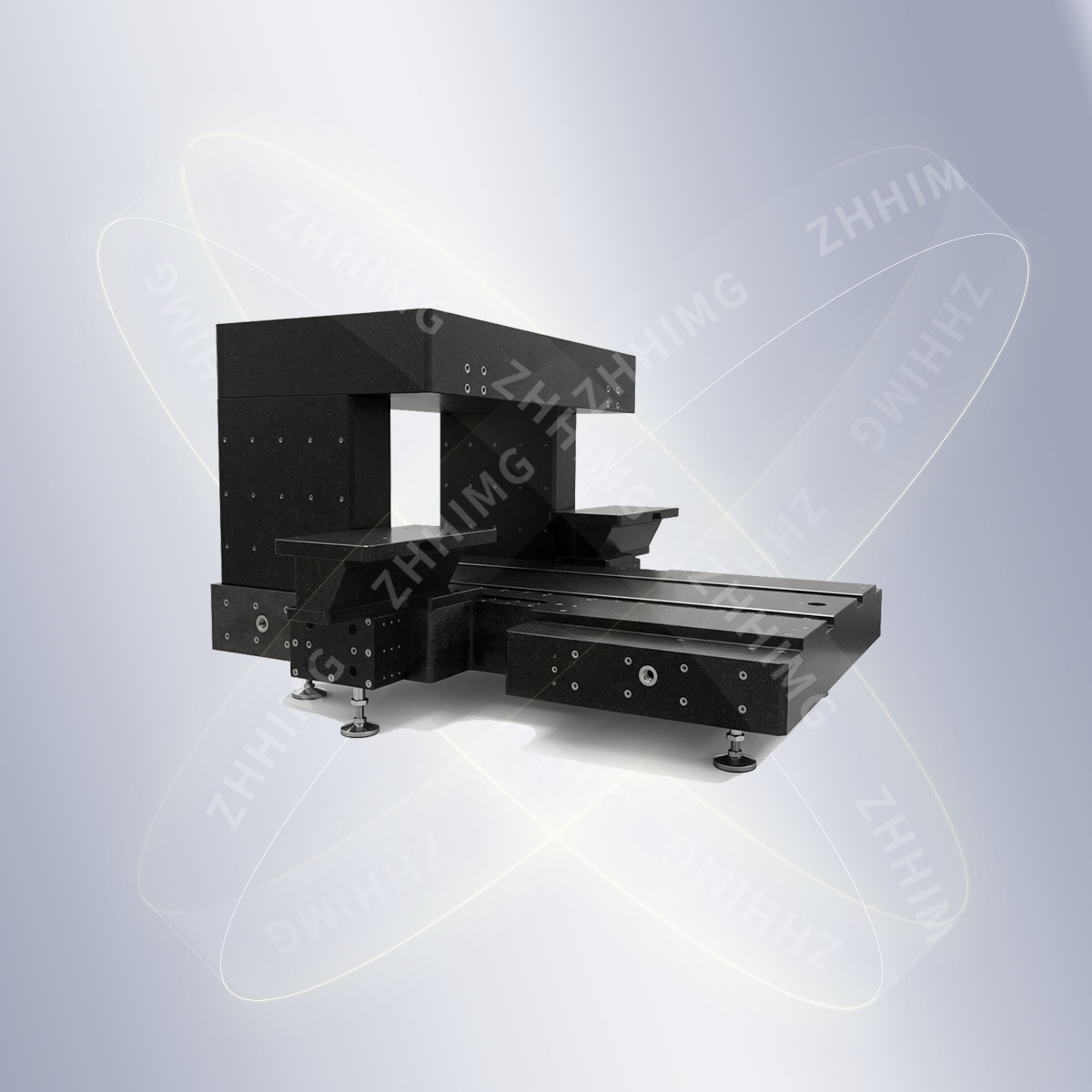
4. Periodic Precision Verification: Secure Long-Term Precision Status at Low Cost
ZHHIMG granite mechanical systems undergo multi-stage aging and stress relief as well as precision lapping in temperature-controlled workshops, so they barely deform naturally. Still, periodic precision verification is needed to detect problems early and eliminate error accumulation caused by cumulative external force and environmental changes over long industrial operation.
Visual inspection and flatness self-check on a monthly basis and full geometric accuracy verification on a quarterly basis are recommended, focusing on reference surface flatness, parallelism, hole position accuracy and overall machine level. Basic inspection can be completed with common metrology tools without frequent disassembly and calibration. Minor accuracy deviations can be adjusted promptly once detected to prevent error expansion. Compared with metal machines that demand frequent calibration and high-cost component replacement, periodic verification for granite systems is low-cost and helps maintain precision stability for years.
5. Ban Unauthorized Modification to Preserve Native Structural Stability
Precision degradation of many machines is not caused by operational wear, but by later unauthorized modification. In daily maintenance, do not drill, cut, grind or slot ZHHIMG granite bases without factory approval. Factory-finished granite components go through complete stress release and closed-loop precision machining, reaching optimal status in structural stress, geometric accuracy and overall rigidity. Unauthorized processing will break the internal stress balance of stone and trigger hidden deformation, permanently damaging long-term machine stability.
If assembly structure adjustment or new mounting interfaces are required, contact ZHHIMG factory for custom machining. Modifications will be implemented without damaging the overall stress structure to guarantee stable long-term machine operation.
Conclusion
The biggest advantage of ZHHIMG granite mechanical systems is low maintenance, high stability and long service life. They do not require complex lubrication, rust prevention or reinforcement maintenance as metal beds do. With five basic maintenance practices — cleaning and anti-fouling, external impact protection, environmental stabilization, periodic verification and prohibition of unauthorized alteration — granite benchmarks can retain nano-level precision for decades. They continuously deliver core strengths of low thermal deformation, high vibration damping and superior stability, providing long-lasting precision support for precision CNC, inspection equipment and semiconductor machinery.
Post time: Sep-18-2026