
When an EUV lithography machine operates inside a semiconductor fab, its base must hold nanometer-level tolerances while dissipating vibrations from nearby equipment. That extreme stability requirement explains why major chipmakers trust an unlikely material: natural granite. This stone, formed over millions of years deep within the Earth’s crust, has become indispensable in precision manufacturing. Its unique combination of thermal stability, vibration damping, and long-term dimensional accuracy makes it the material of choice for equipment where microns—and increasingly nanometers—matter.
The Physics Behind Granite’s Performance
Granite owes its precision manufacturing capabilities to properties that modern engineering continues to exploit. Its coefficient of thermal expansion measures just 0.6–1.2 × 10⁻⁶/°C, roughly ten times lower than steel. This thermal inertia means granite components shift minimally when ambient temperatures fluctuate, a critical factor in environments where semiconductor fabrication demands stability measured in billionths of a meter.
The material’s vibration damping characteristics prove equally important. Within the 50–500 Hz frequency range common in manufacturing equipment, granite absorbs and dissipates 95% of vibrational energy. Its damping ratio of 0.012–0.015 exceeds that of cast iron by a factor of ten. When a CNC spindle reaches 20,000 RPM or a wafer handler performs rapid moves, this damping prevents tool chatter, reduces surface defects, and extends cutting tool life significantly.
Engineers working with granite machine bases report up to 40% reduction in tool vibration during precision milling operations. Combined with 60% less thermal drift compared to steel structures, these properties enable manufacturers to push spindle speeds and feed rates higher while maintaining tight tolerances. The result: better surface finishes, faster cycle times, and fewer rejected parts.
Semiconductor Manufacturing: Where Nanometers Are the Norm
Modern chip fabrication places extraordinary demands on mechanical infrastructure. Advanced lithography systems require base structures maintaining positioning repeatability below 5 nanometers. Meeting such specifications demands materials that simply do not flex, warp, or transmit vibrations the way metals do.
Photolithography equipment represents the most demanding application. EUV machines used in cutting-edge chip production operate with wafer stages that must position and reposition with nanometer accuracy. The granite bases, guideways, and stage components supporting these systems provide the rigid, vibration-free foundation that makes such precision possible. Major suppliers like ASML specify granite components throughout their most advanced platforms.
Wafer inspection systems depend on granite platforms when detecting defects invisible to the human eye. Defect review tools, optical inspection systems, and electron beam review tools all require stable measurement platforms. The flatness specifications for these applications often reach ≤2 μm/m², with surface roughness requirements of Ra ≤0.2 μm—surfaces smooth enough that light itself behaves predictably across their surfaces.
Chemical mechanical planarization (CMP) equipment benefits from granite’s vibration damping during the polishing processes that create truly flat wafer surfaces. The consistent pressure and motion control these systems require depends heavily on machine bases that do not introduce micro-vibrations during operation.
Beyond the core processes, wafer dicing and etching equipment, laser interferometer bases for metrology applications, and wafer handling robots all incorporate granite components. The precision robot arms that transport wafers between process tools ride on granite guide rails whose flatness and stability ensure accurate positioning without wear-induced drift over years of continuous operation.
CNC Machine Tools: Speed, Accuracy, and Surface Quality
The precision granite applications that first come to mind for many engineers involve CNC machine tools. High-performance machining centers increasingly specify granite as their structural foundation material, particularly for operations where surface finish and dimensional accuracy trump metal removal rate.
Coordinate measuring machines (CMMs), the instruments that verify whether manufactured parts meet specifications, rely almost exclusively on granite surface plates and bases. The thermal stability of granite ensures that measurements taken in the morning match those taken after the machine has been running for hours—a consistency impossible to achieve with materials that expand and contract significantly with temperature changes.
PCB drilling equipment presents another compelling application. Modern circuit boards contain thousands of holes with tolerances measured in micrometers. A granite machine base provides the rigid, vibration-free platform that allows high-speed drilling heads to produce clean, accurately positioned holes at rates exceeding 600 hits per minute.
Laser cutting and machining systems benefit similarly. The heat generated during laser processing creates thermal stresses in the workpiece and machine structure alike. A granite base absorbs these effects, maintaining focus accuracy and cut quality throughout extended production runs.
For shops pursuing the tightest tolerances in tool and die making, aerospace component machining, or medical device manufacturing, granite bed CNC machines offer advantages that steel and cast iron simply cannot match. The combination of vibration damping, thermal stability, and long-term dimensional integrity delivers measurable improvements in finished part quality.
Comparing Materials: Why Granite Stands Alone
Engineers selecting base materials for precision equipment typically evaluate granite against three conventional choices: cast iron, steel, and aluminum. Each offers certain advantages, but granite’s combination of properties proves uniquely suited to high-precision applications.
| Property | Granite | Cast Iron | Steel | Aluminum |
|---|---|---|---|---|
| Thermal Expansion (×10⁻⁶/°C) | 4.5 | 10-12 | 12 | 23 |
| Damping Ratio | 0.012-0.015 | 0.001 | 0.0006 | 0.0001 |
| Specific Stiffness | 28.3 | 17.4 | 26.5 | 25.7 |
These numbers reveal granite’s fundamental advantage: it expands less than steel when heated, yet dampens vibrations far more effectively than any metal. While aluminum offers lightweight convenience and steel provides high strength, neither matches granite’s combination of thermal stability and vibration absorption.
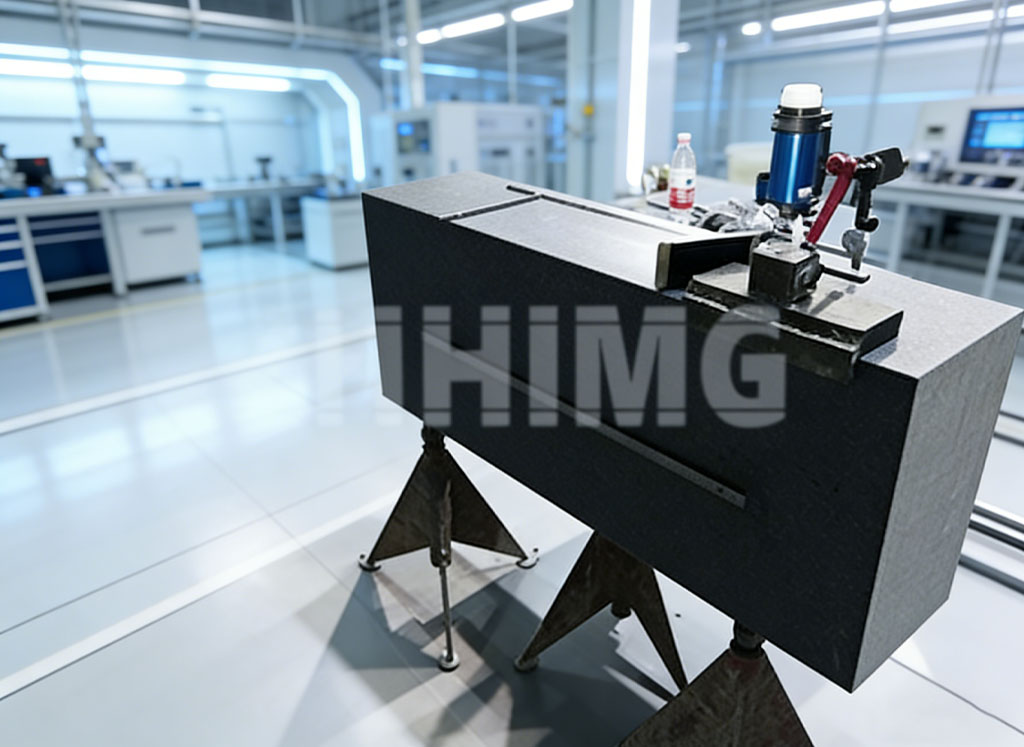
Cast iron, once the dominant material for machine tool bases, offers respectable damping but expands and contracts with temperature changes far more than granite. Steel, though strong, transmits vibrations readily and responds quickly to thermal changes. Aluminum’s thermal expansion alone disqualifies it for most precision applications.
Granite additionally offers properties that metals simply cannot provide. It neither corrodes nor rusts, requires no protective coatings, generates no magnetic interference, and conducts no electricity. These characteristics prove valuable in specialized environments where corrosion resistance or electromagnetic purity matters.
Cleanroom Compatibility and Specialized Environments
Semiconductor fabs operate under cleanliness standards that extend far beyond floor sweeping. ISO Class 1 through 3 cleanrooms—the cleanest environments on Earth—require surfaces that shed virtually no particles. Granite’s non-porous surface, properly finished, meets these requirements. Unlike machined metals that can release microscopic chips or wear particles during operation, polished granite maintains its integrity indefinitely.
The material resists attack from the chemicals used in semiconductor processing, including acids and bases that would corrode metal surfaces over time. Optional anti-static treatments further reduce particle attraction, a valuable feature in environments where electrostatic discharge could damage sensitive components.
Aerospace and automotive manufacturers have adopted granite-based inspection systems for similar reasons. Turbine blade inspection stations, engine block measurement fixtures, and battery module assembly platforms all benefit from granite’s combination of stability, cleanliness, and long-term accuracy retention. The materials used in these applications face inspection requirements where a few microns of error can compromise safety or performance.
Market Drivers and Industry Trajectory
The global market for granite machine tool components is expanding at approximately 6.8% annually through 2030, driven by accelerating demand for precision manufacturing capabilities. Several converging trends fuel this growth.
The semiconductor industry represents the most significant driver. Industry projections indicate 78 new 300mm wafer fabrication facilities coming online, each requiring extensive precision granite infrastructure for lithography, inspection, and metrology equipment. As chip features shrink toward 2nm and beyond, the tolerances that granite helps manufacturers achieve become even more critical.
Electric vehicle production is reshaping manufacturing priorities as well. EV powertrain components, battery modules, and power electronics demand precision levels that traditional automotive manufacturing never required. The 220% increase in EV manufacturing capacity translates directly into demand for granite-based inspection and machining equipment.
Medical device manufacturing, aerospace defense programs, and advanced electronics assembly all contribute to expanding demand for precision granite applications. As products across industries shrink, lighten, and require tighter tolerances, granite’s role as the foundation of accurate measurement and manufacturing continues to grow.
Engineering Specifications That Matter
Professional-grade granite for precision applications meets strict material specifications. Industry-standard ASTM C615 Grade A granite provides consistent mineral composition, ensuring predictable thermal and mechanical properties across large components. Density typically ranges from 2,970 to 3,070 kg/m³, with Shore hardness exceeding HS70 and compressive strength between 245–254 N/mm². The Young’s modulus of 60–100 GPa provides the stiffness necessary for demanding applications.
Manufacturing processes for precision granite components involve extended aging and thermal conditioning. Natural aging for six months or longer allows internal stresses to dissipate before machining begins. Thermal cycling—72 hours of controlled heating and cooling—simulates long-term temperature exposure, accelerating any dimensional changes that might occur in service. Final machining uses 5-axis CNC equipment achieving positioning accuracy of ±0.01mm, followed by laser interferometer verification of flatness and straightness.
Conclusion
Natural granite has earned its place in advanced manufacturing through physics that cannot be replicated in engineered materials. Its extraordinary thermal stability, vibration damping capacity, and long-term dimensional accuracy provide the foundation for equipment that shapes modern technology—from the chips in smartphones to the machine tools that manufacture everything else.
For engineers and procurement professionals evaluating equipment investments, understanding the role of granite in precision applications helps explain why certain machines deliver performance that others cannot match. In industries where tolerances are measured in microns or nanometers, the material beneath the cutting tool or optical system matters as much as the technology it supports.
The growing demand for semiconductor devices, electric vehicles, and precision-engineered products shows no signs of slowing. As manufacturing tolerances continue to tighten, granite’s unique combination of properties ensures it remains essential to the equipment that enables modern industry.
Post time: Apr-15-2026