
Traditional cast iron machine beds suffer from severe acoustic resonance, limiting cutting speeds and ruining surface finishes. Mineral casting—an advanced composite of natural granite aggregates and epoxy resin binders—delivers 10 times better vibration damping than grey cast iron. Implementing ZHHIMG® mineral casting technology stabilizes high-speed linear motor systems, reduces thermal inertia, and extends cutting tool lifespans significantly.
Ten-Fold Increase in Vibration Damping for Superior Tool Finishes
High-velocity milling heads generate severe cyclical harmonic frequencies that chatter through metal structures. ZHHIMG® mineral castings utilize a proprietary multi-graded stone aggregate matrix that absorbs mechanical energy instantly. This exceptional damping capacity suppresses tool chatter, allowing CNC machines to operate at higher feed rates while producing flawless surface finishes.
Excellent Thermal Inertia Mitigates Structural Expansion Risks
Spindle heat and ambient shop temperatures cause rapid dimensional changes in metallic machine beds. Mineral casting possesses a very low thermal conductivity and high specific heat capacity. This high thermal inertia means the machine bed reacts incredibly slowly to environmental temperature changes, protecting the CNC axis alignment from localized heat distortion.
Monolithic Multi-Material Integration Cast in a Single Mold
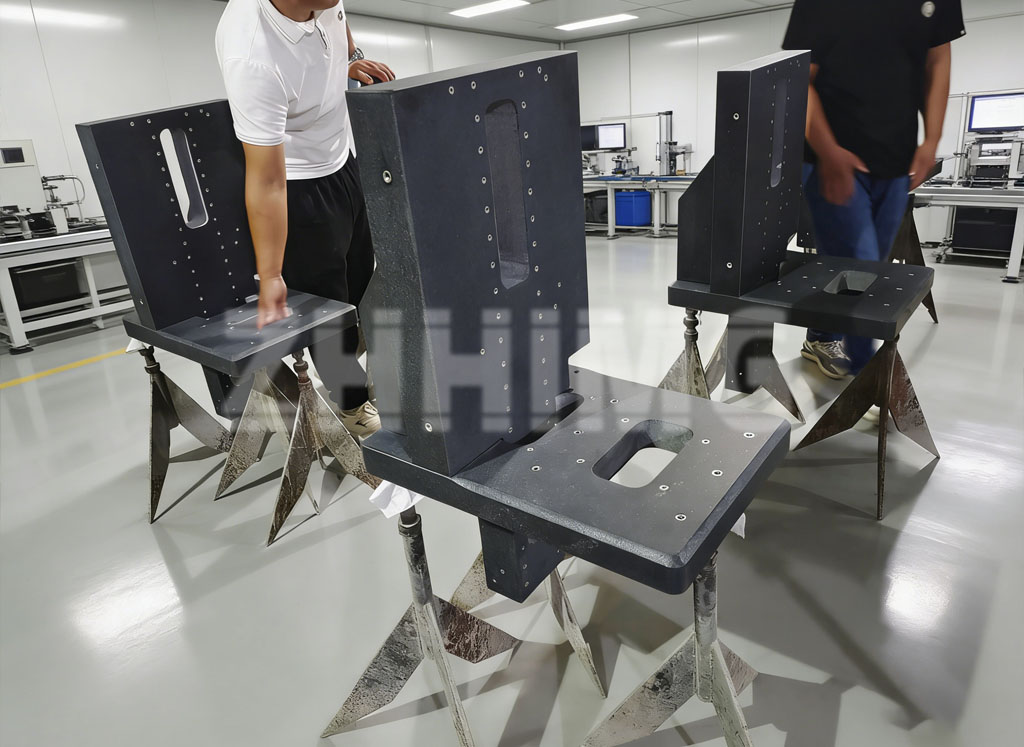
Unlike metal structures that require extensive secondary assembly, mineral casting allows complete integration during pouring. We can embed internal conduit paths, coolant return channels, and steel anchor plates directly into a single monolithic mold. This advanced casting process eliminates costly machining steps and ensures perfect structural integrity.
Eco-Friendly Production Process Lowers Global Carbon Footprints
Traditional iron foundries consume massive amounts of energy and emit substantial carbon during smelting cycles. Mineral casting is a cold-pouring process requiring zero fossil fuel combustion. By utilizing natural stone aggregates and low-emission epoxy resins, ZHHIMG helps machine builders meet modern ISO 14001 environmental sustainability initiatives.
Structural Physics: Mineral Casting Composite vs. Traditional Grey Cast Iron
| Physical Property | ZHHIMG® Mineral Casting | Grey Cast Iron (GG25/GG30) | Welded Steel Structure |
| Logarithmic Damping Decrement | Very High (~0.02 – 0.03) | Low (~0.002 – 0.003) | Extremely Low (~0.001) |
| Thermal Conductivity (W/m·K) | Excellent Insulation (~1.5) | High Distortion Vector (~50) | High (~45) |
| Material Density (kg/m³) | Lightweight (~2,400) | Heavy (~7,200) | Heavy (~7,850) |
| Tensile Strength Profile | Moderate (Requires steel inserts) | High Brittle Tensile | Very High Elastic Tensile |
| Post-Casting Internal Stress | Zero Stress (Room temp curing) | High Residual Stress (Needs aging) | Severe Stress (Needs heat treatment) |
Frequently Asked Questions (FAQ)
Q1: What exactly is the composition of ZHHIMG® mineral casting?
A1: Our mineral casting consists of approximately 88-92% multi-graded natural granite aggregates (ranging from fine quartz sand to coarse stone pieces) bonded with 8-12% high-performance hydrophobic epoxy resin and specialized curing agents.
Q2: Can mineral casting be machined if modifications are needed later?
A2: Mineral casting is extremely difficult to machine because the granite aggregates rapidly wear down standard cutting tools. All mounting surfaces, T-slots, and threaded holes must be precisely pre-engineered and cast directly into the mold structure.
Q3: How does ZHHIMG ensure the precision of embedded steel guide rails?
A3: We place high-precision steel inserts into the mold before pouring. After curing, our master craftsmen utilize our 10,000m² constant temperature workshop and manual hand-lapping techniques to align the exposed metal faces to absolute micron tolerances.
Q4: Is mineral casting susceptible to degradation from CNC cutting fluids?
A4: No. Our proprietary epoxy resin formulation is specifically engineered to be entirely resistant to synthetic coolants, cutting oils, solvents, and water. The material will not swell, degrade, or absorb industrial fluids over decades of use.
Q5: What is the maximum single-unit weight ZHHIMG can pour?
A5: Our advanced industrial mixing and pouring facility is equipped to handle heavy-duty manufacturing up to 100-ton single monolithic casting units, making us the premier partner for massive gantry milling machine beds globally.
Q6: Does mineral casting exhibit long-term dimensional shrinkage?
A6: Epoxy resins experience a minor exothermic shrinkage during the initial room-temperature curing phase. Our engineering team calculates this precisely into the mold design, ensuring that once cured, the bed achieves permanent, lifelong dimensional stability.
Post time: Jun-05-2026