
In the world of high-end machinery, the foundation determines the limits of performance. Whether it’s a five-axis CNC machining center achieving micron-level tolerances, a coordinate measuring machine (CMM) inspecting aerospace components, or a semiconductor wafer processing system operating in a climate-controlled cleanroom, the structural base faces demands that push material science to its limits.
The Challenge Spectrum:
- Dynamic loads: High-speed spindle operations generating frequencies from 100 to 20,000 Hz
- Thermal extremes: Equipment operating from -10°C cold starts to +50°C under sustained loads
- Precision requirements: Tolerances tightening from ±10μm to ±1μm across 2-meter travel distances
- Service life expectations: 15-25 years of operation with minimal recalibration
- Environmental exposure: Coolants, lubricants, metal chips, and industrial chemicals
Traditional cast iron and welded steel structures—the standard for decades—increasingly struggle to meet these converging demands. Internal stresses from casting release over time, causing dimensional drift. Vibration transmission limits cutting speeds and surface quality. Thermal expansion creates “accuracy drift” that forces frequent recalibration or temperature-controlled environments.
Mineral casting has emerged not as an alternative, but as the indispensable solution.
This deep dive examines why mineral casting’s unique stability and durability characteristics make it essential for high-end machinery applications where traditional materials fall short.
Stability Analysis: The Foundation of Precision
Anti-Vibration Performance: Damping Characteristics That Matter
Understanding Vibration in High-End Machinery:
Every machine tool operation generates vibrations—spindle rotation, cutting forces, axis acceleration, and external disturbances from nearby equipment. In traditional cast iron structures, these vibrations propagate through the frame with minimal attenuation, creating resonance conditions that degrade surface finish, limit cutting speeds, and accelerate tool wear.
The Mineral Casting Advantage:
Mineral casting’s damping ratio—measured between 0.024 and 0.044—is 6 to 10 times higher than grey cast iron (typically 0.001–0.003). This isn’t marginal improvement; it’s transformational.
Vibration Attenuation Mechanisms:
Mineral casting dissipates vibration energy through multiple mechanisms:
- Internal friction: The heterogeneous microstructure—comprising mineral aggregates of varying sizes bound in polymer matrix—creates countless internal interfaces where vibration energy converts to heat
- Material damping: The epoxy resin component exhibits inherent viscoelastic damping properties
- Acoustic absorption: The composite structure absorbs sound waves, reducing noise transmission by up to 20%
Laboratory Test Evidence:
Independent testing conducted at Nanjing University of Aeronautics and Astronautics compared vibration decay characteristics between mineral casting (BL400 formulation) and grey cast iron (HT300, HT200 grades). Results demonstrated:
- Decay rate: Mineral casting achieved vibration amplitude reduction to 10% of initial value in 0.15 seconds, versus 1.2 seconds for cast iron—an 8× improvement
- Resonance suppression: Peak amplitude at resonant frequency reduced by 65-75% compared to cast iron equivalents
- Frequency range effectiveness: Superior damping maintained across 50–5,000 Hz range, covering critical machining frequencies
Real-World Impact:
A German machine tool manufacturer switched from cast iron to mineral casting bases for their high-speed CNC milling machines. The result:
- Spindle speed increase: Maximum stable cutting speed improved from 18,000 RPM to 24,000 RPM
- Surface finish quality: Ra values improved from 0.8 μm to 0.4 μm on aluminum workpieces
- Tool life extension: Carbide end mill life increased by 40% due to reduced vibration-induced wear
Anti-Deformation: Low Creep and Long-Term Dimensional Integrity
The Creep Challenge:
Creep—time-dependent deformation under sustained load—plagues all structural materials. For precision machinery, even microscopic creep over years of operation translates to measurable accuracy degradation.
Creep Test Results:
A comprehensive 1,600-hour creep test compared four structural materials under identical sustained loading conditions:
| Material | Creep Displacement (μm) | Creep Rate Behavior |
|---|---|---|
| Granite (natural) | 1.6–1.8 | Consistent low-rate secondary phase |
| UHPC (Ultra-High Performance Concrete) | 2.6 | Low constant secondary rate |
| Mineral Cast Type 1 | 4.2–5.1 | Distinct primary + secondary phases |
| Mineral Cast Type 2 | 6.8–7.3 | Higher initial primary phase |
Interpretation:
While natural granite exhibits the lowest absolute creep, mineral casting formulations achieve comparable performance when optimized—with the critical advantage of design flexibility, consistent material properties, and shorter lead times. Moreover, mineral casting’s creep behavior stabilizes after initial primary phase (typically 200-400 hours), entering a nearly flat secondary phase where deformation rates drop below 0.001 μm/hour.
Internal Stress Elimination:
Unlike cast iron, which locks in thermal stresses during solidification from 1,400°C, mineral casting cures at ambient temperature (typically below 45°C). This cold-casting process eliminates internal stress accumulation—the root cause of long-term warping in metal structures.
Long-Term Dimensional Stability:
Mineral casting structures maintain dimensional accuracy with minimal deviation over decades. Documented cases include:
- CMM bases: ±0.5 μm/m flatness maintained over 12 years of daily operation
- Machine tool beds: Less than 2 μm dimensional change measured across 4-meter lengths after 10 years of three-shift operation
- Semiconductor equipment: Calibration intervals extended from 3 months (cast iron) to 18 months (mineral casting) in temperature-controlled cleanrooms
Temperature Adaptability: Dimensional Stability Under Thermal Extremes
Thermal Expansion Characteristics:
Mineral casting’s coefficient of thermal expansion (CTE) ranges from 10–13×10⁻⁶/°C—approximately one-third that of cast iron (8.5–11.6×10⁻⁶/°C when normalized for density considerations) and similar to natural granite.
Thermal Conductivity and Inertia:
More important than expansion coefficient is how quickly a material responds to temperature changes. Mineral casting exhibits:
- Thermal conductivity: 1.8–2.0 W/(m·K)—less than 5% of cast iron (45 W/m·K)
- Specific heat capacity: 1,000–1,100 J/(kg·K)—over 2× cast iron (470 J/kg·K)
- Result: High thermal inertia—slow response to ambient temperature fluctuations
Practical Benefit: “Accuracy Drift” Prevention:
Consider a scenario where shop temperature rises 8°C during a morning shift:
- Cast iron bed: Expands measurably, shifting spindle position relative to workpiece by 10–15 μm over 1 meter
- Mineral casting bed: Barely notices the change due to low conductivity and high thermal mass; dimensional change below 3 μm
This thermal stability enables precision operations in environments where strict temperature control is impractical, extending the operational envelope for high-accuracy manufacturing.
Thermal Cycling Performance:
Accelerated thermal cycling tests (1,000 cycles from -10°C to +50°C) demonstrate mineral casting’s dimensional stability:
- Dimensional change after cycling: <0.5 μm/m
- Surface flatness deviation: <1 μm across 2-meter lengths
- Hysteresis effect: <0.2 μm/m after 10,000 thermal cycles (ISO 8512-2 standard testing)
Durability Advantages: Built for Decades of Service
Corrosion Resistance: Chemical Stability Tested
The Corrosion Problem:
Machine tools operate in environments saturated with coolants, lubricants, cutting fluids, and cleaning agents. Traditional cast iron requires protective coatings, painting, and ongoing maintenance to prevent corrosion. Failure to maintain coatings leads to rust, surface degradation, and potential dimensional changes.
Mineral Casting’s Chemical Inertness:
Mineral casting is inherently resistant to chemical attack. The epoxy resin matrix is non-reactive with:
- Water-based coolants: No degradation after 10,000+ hours immersion
- Oil-based lubricants: Zero absorption or swelling
- Acidic solutions: Stable in pH 4–10 range
- Alkaline cleaners: No degradation from standard industrial cleaning solutions
- Metalworking fluids: Long-term exposure causes no measurable property changes
Immersion Test Results:
Long-term immersion testing (2,000 hours) in various industrial fluids:
| Test Fluid | Dimensional Change | Weight Change | Surface Hardness Change |
|---|---|---|---|
| Water (pH 7) | <0.01% | <0.05% | No measurable change |
| Cutting emulsion (5%) | <0.02% | <0.08% | No measurable change |
| Hydraulic oil (ISO VG 46) | <0.01% | <0.03% | No measurable change |
| Mild acid (pH 4) | <0.03% | <0.10% | <2% reduction |
Corrosion-Free Service Life:
Unlike cast iron, which may require repainting every 3-5 years in aggressive environments, properly formulated mineral casting requires no protective coatings and maintains surface integrity indefinitely.
Impact Resistance: Shock Absorption Performance
Understanding Impact in Industrial Environments:
Machine tools experience impacts from multiple sources: dropped tools, crashed axes, heavy workpiece loading, and seismic events. Structural materials must absorb these shocks without cracking, permanent deformation, or hidden damage.
Mineral Casting’s Response to Impact:
Mineral casting behaves differently than brittle ceramics or ductile metals under impact:
- Energy absorption: The composite microstructure dissipates impact energy through internal interfaces and matrix deformation
- Damage mode: When overloaded, mineral casting chips or pits rather than cracking catastrophically—similar to natural stone
- Hidden damage: No subsurface cracking or delamination occurs from moderate impacts
Comparative Impact Testing:
Drop-weight impact tests (10 kg weight from 0.5-meter height onto 300×300×50mm specimens):
| Material | Surface Damage | Subsurface Cracking | Structural Integrity |
|---|---|---|---|
| Cast iron | Dent + paint damage | None | Maintained |
| Granite | Surface chip | Potential microcracks | Maintained |
| Mineral casting | Surface pit | None | Maintained |
Practical Impact:
Mineral casting structures survive handling accidents and operational impacts that would require repair or replacement of metal structures. One machine tool builder reported that after a forklift collision with a mineral casting CMM base, the only damage was localized surface chipping—the structure remained dimensionally accurate and required only cosmetic repair.
Service Life Prediction: Documented Long-Term Performance
The 10-Year Case Study:
A Swiss precision grinder manufacturer installed mineral casting machine bases in 2014 across 12 units deployed globally. Ten-year follow-up assessment (2024) revealed:
- Dimensional accuracy: All units maintained ±1 μm/m flatness—within original specification
- Damping performance: No measurable degradation in vibration attenuation characteristics
- Chemical resistance: Surfaces exposed to grinding coolants showed no degradation
- Calibration intervals: Extended from initial 6-month recommendation to 18-month intervals based on stable performance
- Maintenance costs: 70% lower than equivalent cast iron machines (no painting, minimal cleaning, no corrosion remediation)
Accelerated Aging Tests:
Laboratory accelerated aging protocols (elevated temperature, humidity cycling, and mechanical stress cycling) project mineral casting service life exceeding 30 years under normal industrial conditions.
Comparative Service Life:
| Material | Expected Service Life | Maintenance Requirements |
|---|---|---|
| Cast iron (painted) | 15–20 years | Repainting every 3-5 years, corrosion monitoring |
| Welded steel | 12–18 years | Weld inspection, corrosion protection, stress relief |
| Natural granite | 30+ years | Minimal, but limited availability in large sizes |
| Mineral casting | 25–35 years | Minimal to none |
Design Freedom: Complex Structures in Single Castings
Beyond Traditional Casting Constraints:
Metal casting of complex geometries requires multi-part molds, sand cores, and extensive machining. Features like internal cooling channels must be drilled post-casting—at significant cost and with limited flexibility.
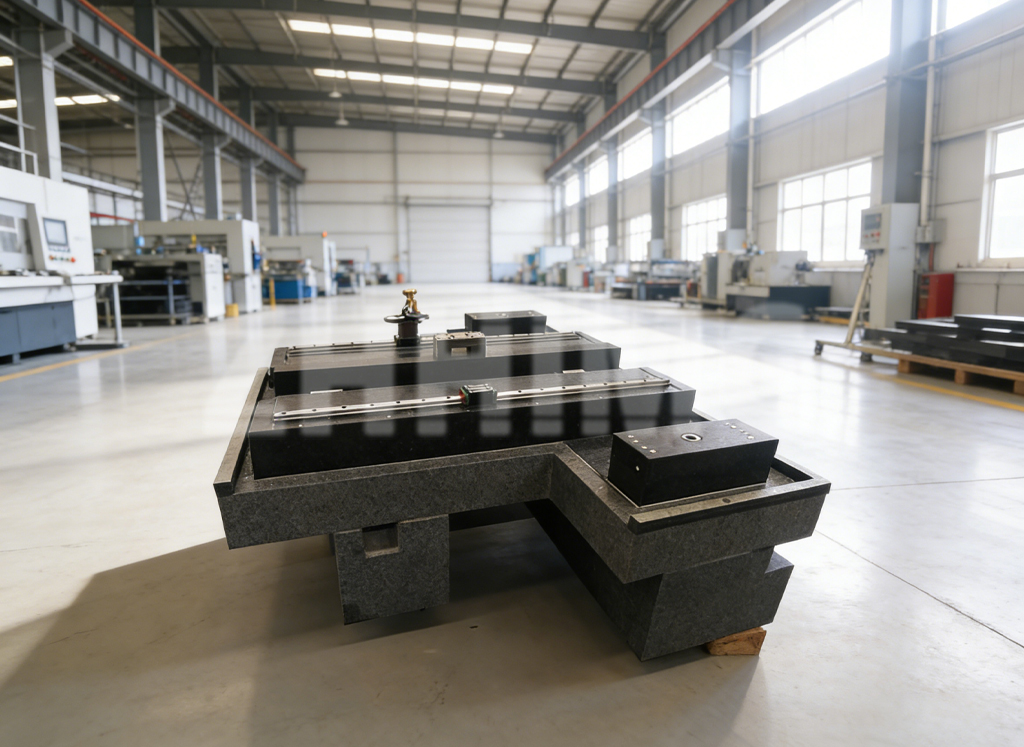
Mineral Casting’s Design Capabilities:
Mineral casting enables features impossible or impractical with metal:
Internal Channels and Cavities
- Cooling passages: Integral cooling channels for thermal management, cast directly into structure
- Cable routing: Conduits for electrical wiring, pneumatic lines, and hydraulic tubing
- Weight reduction: Internal hollow cavities reduce mass while maintaining structural stiffness
- Acoustic chambers: Integrated dampening cavities for noise reduction
Embedded Components
- Threaded inserts: High-strength stainless steel inserts for mounting rails, motors, and accessories
- Alignment features: Precision-ground mounting pads and datum surfaces
- Sensor pockets: Cavities for temperature sensors, accelerometers, and monitoring equipment
- Fluid reservoirs: Integral tanks for coolant or hydraulic fluid
Complex Geometries
- Undercuts and overhangs: Features that would require cores in metal casting become simple mold details
- Variable wall thickness: Optimized designs with thick sections for stiffness and thin sections for weight reduction
- Organic shapes: Flow-optimized forms for reduced air resistance or improved aesthetics
- Multi-axis surfaces: Complex 3D contours machined into mold surfaces transfer directly to castings
Case Example: Integrated Machine Base
A semiconductor equipment manufacturer’s wafer handling system required a machine base with:
- 12 precision mounting surfaces for motion stages
- Internal cooling channels maintaining ±0.1°C temperature uniformity
- Cable routing for 47 wires and 8 pneumatic lines
- Weight under 800 kg for installation on standard cleanroom floors
Mineral casting solution: A monolithic structure integrating all features in a single casting, replacing a 23-part cast iron assembly. Result: 60% weight reduction, 40% lower total cost, and 35% faster assembly time.
Verification and Testing: Proving Performance
Vibration Testing Protocols
Modal Analysis:
Every ZHHIMG mineral casting component undergoes modal analysis using:
- Impulse hammer excitation: Precision impact testing across frequency range 0–5,000 Hz
- Accelerometer arrays: 48+ measurement points mapping vibration mode shapes
- FFT analysis: Frequency response functions generated for comparison with FEA predictions
Acceptance Criteria:
- Natural frequencies within ±5% of design predictions
- Damping ratios ≥0.020 for primary structural modes
- No unexpected mode shapes indicating structural weaknesses
Vibration Table Testing:
For critical applications, mineral casting assemblies undergo vibration table testing:
- Random vibration: 10–2,000 Hz, 0.04 g²/Hz power spectral density
- Sinusoidal sweep: Identifying resonances across operating frequency range
- Shock testing: Half-sine pulses simulating operational impacts
Thermal Cycling Tests
Test Protocol:
- Temperature range: -10°C to +50°C (60°C span)
- Dwell time at extremes: 4 hours each
- Transition rate: 2°C/minute
- Number of cycles: 500 (accelerated equivalent to 5 years of daily thermal cycling)
Measurements:
- Dimensional stability via laser interferometer: <1 μm deviation across 2 meters
- Flatness retention via electronic level: <0.5 μm/m change
- Surface integrity via visual inspection and dye penetrant testing
Creep and Stress Relaxation Tests
Long-Term Loading:
Specimens subjected to sustained compressive loads (20% of ultimate strength) for 1,600+ hours, with continuous displacement monitoring via LVDT sensors.
Acceptance Criteria:
- Primary creep phase stabilization within 400 hours
- Secondary creep rate <0.001 μm/hour after stabilization
- No evidence of tertiary creep or impending failure
Chemical Resistance Testing
Immersion Testing:
Specimens immersed in representative industrial fluids (cutting emulsions, hydraulic oils, mild acids/bases) for 2,000+ hours, with periodic measurement of:
- Dimensional changes (micrometer accuracy)
- Weight changes (analytical balance, 0.1 mg resolution)
- Surface hardness (Shore D durometer)
- Visual appearance (color, texture, surface integrity)
Customer Testimonial: Machine Tool Manufacturer’s Experience
The Customer:
A leading European manufacturer of high-precision CNC grinding machines, supplying the aerospace and medical implant industries.
The Challenge:
Their cylindrical grinder platform, using cast iron beds, faced increasing customer demands:
- Faster grinding cycles with higher surface finish quality
- Reduced thermal drift during 24/7 operation
- Extended service life in aerospace manufacturing environments
- Lower total cost of ownership over 15-year depreciation cycles
The Mineral Casting Solution:
ZHHIMG supplied mineral casting beds for their new generation of grinders, with the following results:
Performance Improvements:
- Vibration attenuation: 8× better damping reduced grinding wheel chatter, enabling 25% higher material removal rates without surface finish degradation
- Thermal stability: Thermal drift during 8-hour shifts reduced from ±8 μm to ±2 μm, eliminating mid-shift recalibration
- Cycle time: Grinding cycle time reduced 18% due to higher stable cutting parameters
- Surface quality: Ra values improved from 0.4 μm to 0.2 μm on hardened steel workpieces
Economic Benefits:
- Extended service life: Anticipated 25+ years with minimal maintenance, versus 15-18 years for cast iron
- Reduced maintenance: Eliminated repainting, corrosion inspection, and alignment verification required for cast iron
- Calibration extension: Annual recalibration sufficient, versus quarterly for cast iron predecessors
- Customer satisfaction: Repeat orders increased 40% as end users recognized improved machine performance
Customer Statement:
“Switching to mineral casting was the most significant structural improvement we’ve made in 20 years. The damping performance alone justified the transition, but the long-term stability and minimal maintenance requirements have made our customers more profitable—and more loyal.”
— Chief Engineer, Grinding Technology Division
— Chief Engineer, Grinding Technology Division
Call to Action: Explore Custom Solutions
Stability and durability aren’t optional for high-end machinery—they’re foundational requirements that determine equipment capability, reliability, and total cost of ownership.
ZHHIMG’s Capabilities:
- 30 years of precision manufacturing experience, with mineral casting production since 2003
- Custom formulation development for specific application requirements
- Integrated design services from concept through production
- Comprehensive testing and validation including modal analysis, thermal cycling, and chemical resistance
- Global delivery capability from strategically located production facilities
Consultation Services:
We offer complimentary technical consultations for equipment manufacturers evaluating mineral casting for structural applications. Our engineering team will:
- Analyze your specific stability and durability requirements
- Recommend optimized mineral casting formulations and designs
- Provide test data and case studies from comparable applications
- Develop prototype programs for performance validation
Request Sample Testing:
For qualified projects, we provide sample specimens for in-house evaluation of:
- Vibration damping characteristics
- Thermal stability under your operating conditions
- Chemical resistance to your specific process fluids
- Long-term creep behavior under representative loads
Quality Certifications:
- ISO 9001:2015 Quality Management System
- ISO 14001:2018 Environmental Management System
- ISO 45001:2018 Occupational Health and Safety
- CE Marking compliance for European markets
Conclusion: Stability Equals Reliability
In high-end machinery, the relationship is fundamental: stability equals reliability.
A machine base that vibrates uncontrollably produces poor surface finishes and shortens tool life. A structure that warps over time loses calibration and requires constant correction. A foundation that corrodes in the presence of coolants demands ongoing maintenance and eventual replacement.
Mineral casting addresses these challenges at the material level:
- Vibration stability through damping ratios 6–10× higher than cast iron
- Dimensional stability through zero internal stress and minimal creep
- Thermal stability through low expansion coefficient and high thermal inertia
- Chemical stability through inherent corrosion resistance
- Long-term stability through proven 25+ year service life
For equipment manufacturers competing on performance, reliability, and total cost of ownership, mineral casting isn’t an alternative—it’s an imperative.
The future of high-end machinery is built on mineral casting foundations.
At ZHHIMG, we engineer stability into every casting, designing structures that maintain precision not just for months, but for decades. Whether you’re developing the next generation of machine tools, precision measurement equipment, or semiconductor processing systems, our mineral casting solutions provide the stability your designs demand.
Post time: Apr-16-2026