
Ask a structural engineer why the CMM bridge in their lab and the wafer inspection stage across town are both built on granite, and you will usually get a short answer: “stiff and stable.” The real answer is a set of five material properties that no single engineering alternative delivers at once – and a set of honest trade-offs against cast iron, ceramics and mineral casting that every machine designer should understand before freezing a base design.
The Five Properties That Put Granite Under Precision Machines
- Thermal stability. Fine-grained black granite has low thermal conductivity and a low coefficient of thermal expansion (roughly 5-6 μm/m·°C for common precision grades – several times better than steel). A slow temperature ramp moves the whole structure nearly uniformly instead of bending it; a short heat burst from a motor or laser does not soak deep into the stone.
- Vibration damping. Granite’s internal structure dissipates mechanical vibration many times faster than cast iron or steel. On a granite machine base, a disturbance from a nearby press or an internal linear motor decays before it can appear as an error signal on the measurement axis.
- Long-term dimensional stability. Granite is an elastic, fully aged material – millions of years old and free of internal casting stresses. It does not creep under static load cycles and does not “season” the way a fresh iron casting does after machining releases residual stress.
- No rust, no coatings. Granite survives coolants, cleaning agents and humid cleanroom air with no plating, painting or maintenance – geometry does not depend on the integrity of a surface treatment.
- Non-magnetic. No interference with magnetic encoders, linear motors, electron optics or magnetic workholding – and no attraction of ferrous chips onto reference surfaces.
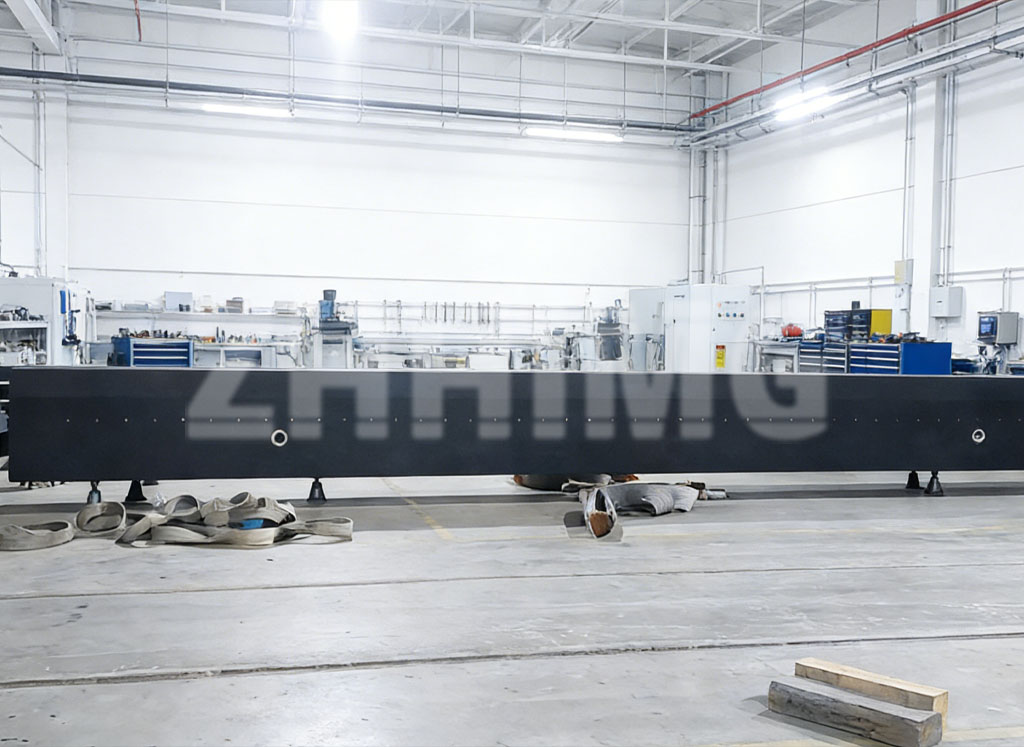
A lapped granite beam for a CMM bridge on leveling stands – the cross-section is engineered for stiffness-to-weight, not just cut from a slab.
Honest Comparison: Granite vs Cast Iron, Ceramics and Mineral Casting
No base material is free. The engineer’s job is matching weaknesses to the application:
| Material | Strengths | Limitations vs Granite |
|---|---|---|
| Cast iron | Tough, thread-friendly, high design freedom, cheap sections | Damps vibration poorly; rusts without coatings; castings carry residual stress that moves geometry over months; higher thermal expansion |
| Engineering ceramics (e.g. alumina, SiC) | Extremely hard and light; superb for moving components and wear parts | Brittle – poor for large impact-exposed bases; sintering limits size; much higher cost at structural volumes |
| Mineral casting (epoxy granite) | Castable around inserts into complex monolithic shapes; excellent damping; fast, low-cost mid-size production | Lower stiffness and compressive strength than natural granite; polymer binder is more temperature- and creep-sensitive; not the choice for metrology reference surfaces |
This is why the most advanced platforms increasingly use hybrid structures: a natural granite base and reference surfaces where stability is non-negotiable, ceramic elements where weight and wear dominate, and mineral-cast frames where complex geometry and damping matter more than metrology-grade stability. ZHHIMG® machines the granite side of that system – and integrates with ceramic and mineral-cast partners’ components on the same datum scheme.
Where Granite Bases Are the Default Choice
- Coordinate measuring machines (CMM). The granite machine base is the datum everything else is calibrated against; bridge beams like the one above combine high stiffness-to-weight with lapped bearing surfaces for air pads.
- Semiconductor inspection and metrology equipment. AOI, wafer inspection and overlay metrology stages demand sub-micron error motion in vibrating, thermally active environments – the natural habitat of semiconductor equipment granite structures.
- Laser processing and micromachining systems. Femtosecond and picosecond laser heads hold micrometer-class spot position; granite keeps the beam path geometry stable while absorbing the motion system’s own vibration.
- XY precision stages and linear motor platforms. Granite’s non-magnetic, non-conducting body coexists cleanly with linear motor magnets, and its damping kills cogging-induced stage vibration – a pairing completed by granite air bearings for frictionless travel.
- Optical inspection and flat-panel display production. Large-format glass handling needs wide, flat, stable platforms – an area where granite’s scale-up advantages are decisive.
Design Guidance for R&D Teams
- Decide the datum first. Whatever carries the reference surfaces should be granite; everything else can be lighter, cheaper materials.
- Design the cross-section, don’t just specify the block. Ribs, pockets and weight-reduction cutouts tune stiffness-to-weight for moving members.
- Plan the interfaces early. Threaded inserts, air channels, sensor bosses and cable slots should be machined at the source, not improvised at integration.
- Order base and bearings as one system. Matched lapping between a base and its air-bearing rails removes the largest single source of integration error.
Specifying a base for a new CMM, AOI or laser platform? Send ZHHIMG® your envelope, load and accuracy targets. Our engineering team will return a granite structure proposal – with cross-section design, interface machining and the measurement report to verify it.
Post time: Sep-21-2026