
The Base Sets the Accuracy Limit
Semiconductor, CMM and laser equipment use granite machine bases because granite stays stable, damps vibration and provides extremely flat reference surfaces, so the machine’s moving parts can hold their position to the micron level and below.
Every axis, guideway, sensor and optical element in a precision machine is mounted on, or measured from, the base. If the base moves with temperature, rings after each acceleration, or slowly changes shape, that error passes straight into the part, the wafer or the measurement.
This article explains the properties that make granite the usual choice, how they apply to six types of equipment, and what to include when you ask a supplier for a quote.
Five Properties That Make Granite Work
No single property explains the choice. It is the combination of five that makes granite hard to replace in precision equipment.
- Thermal stability. Granite has low thermal expansion and low thermal conductivity, so it changes size slowly and only slightly when room temperature moves. That keeps alignment steady during a shift and from day to night.
- Vibration damping. Granite absorbs vibration energy much better than steel or cast iron. Motors, stages and floor vibration die out quickly, which shortens settling time and improves repeatability.
- Long-term dimensional stability. Natural granite has aged for millions of years and carries almost no residual stress, so a lapped surface holds its shape for years instead of slowly creeping.
- Non-magnetic and corrosion-free. Granite does not rust and does not disturb magnetic fields. This matters for linear motors, magnetic encoders and some inspection tools.
- Lappable, flat surfaces. Granite can be lapped to micron and sub-micron flatness, and the smooth surface can serve directly as the reference for air bearings and for mounting rails.
The quality of the stone decides how much of this you get. ZHHIMG® Black Granite has a density of about 3,100 kg/m³, which is a good indicator of a fine-grained, low-porosity stone.
How Granite Serves Six Types of Equipment
Coordinate Measuring Machines (CMMs)
A CMM measures to the micron, so its base must not move while it measures. Granite tables and bridges give a stable, flat reference, and granite guideways with air bearings give smooth, friction-free motion. Thermal stability also keeps the machine’s calibration valid between temperature changes.
Semiconductor Equipment
Wafer inspection, lithography support and process tools need very low vibration and very stable alignment. Granite’s damping and thermal stability protect positioning, and its non-magnetic, rust-free surface suits clean environments. Granite bases also serve as the stable platform for XY stages and metrology modules.
Femtosecond and Picosecond Laser Machines
Ultrafast laser machining holds the beam on a target a few microns wide, so any base movement shows up as a defect in the part. A damped, thermally stable granite base keeps the beam position steady while the stages accelerate and stop.
PCB Drilling and Routing Machines
PCB drilling machines move at high speed and accelerate hard, then must place small holes accurately. Granite damping reduces the residual vibration after each move, which supports both speed and hole position accuracy.
Optical Inspection (AOI), X-ray and Industrial CT
Optical and X-ray inspection systems need a stable platform for cameras, sources and detectors. A granite base keeps the geometry between them fixed over long inspection runs, so image position and measurement stay consistent.
XY Tables and Linear Motor Stages
High-precision stages need a flat reference for the bearings and a base that does not distort under the moving mass. Granite is non-magnetic, so it does not interfere with the magnets of a linear motor, and a lapped surface can carry air-bearing pads directly. See our granite air bearing range.
What a Precision Granite Base Includes
A machine base is more than a block of stone. It is a finished component with measured geometry and integrated features, made to your drawing.
| Feature | What it does |
|---|---|
| Lapped reference surfaces | Flat, parallel and square faces for rails, bearings and sensors |
| Air-bearing faces | Smooth surfaces for frictionless guideways and stages |
| Threaded inserts | Strong, accurate fixing points for rails, brackets and covers (standard and custom) |
| T-slots and through holes | Mounting for fixtures, cable routing and leveling |
| Gantry and portal structures | Stable bridges and columns for moving heads (granite gantry systems) |
| Mounting and isolation | Supports and anti-vibration devices that isolate the base from the floor (supports) |
How We Make and Measure Them
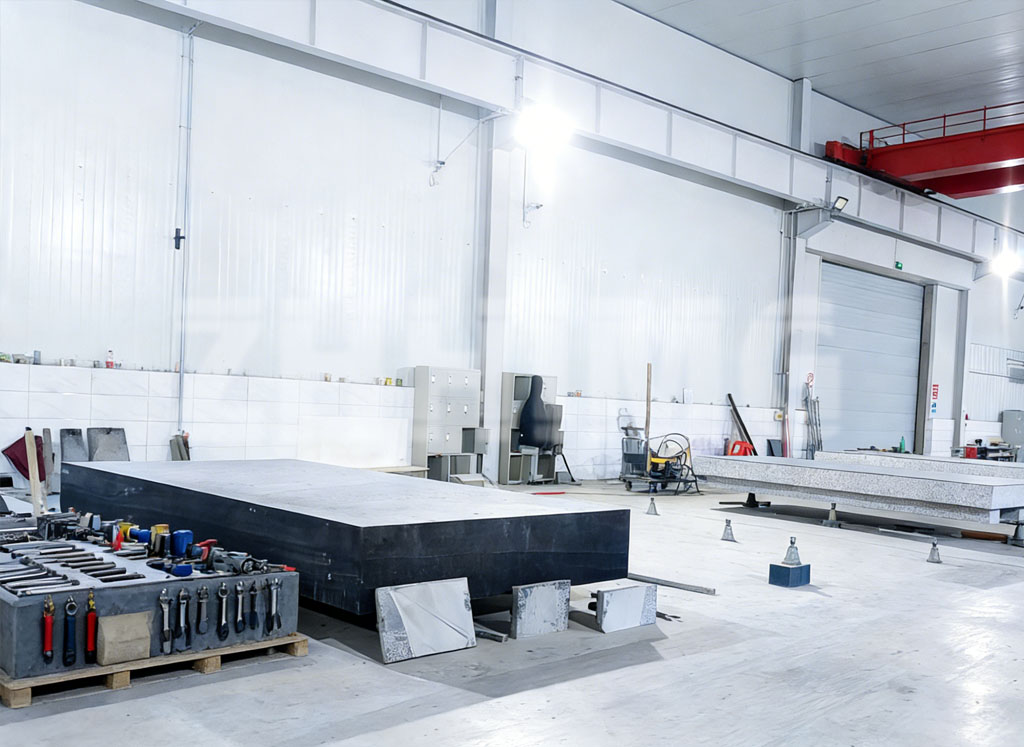
At ZHHIMG, bases are ground on large grinding machines that handle precision platforms up to 6,000 mm long and finished by experienced lapping technicians. Final lapping, measuring and assembly take place in a 10,000 m² temperature- and humidity-controlled workshop. Its floor is ultra-hard concrete at least 1,000 mm thick, surrounded by vibration isolation trenches 500 mm wide and 2,000 mm deep, and the overhead cranes are the silent type.
We also have a separate temperature- and humidity-controlled, dust-free workshop that simulates a semiconductor equipment workshop, used for assembling granite components. Measuring uses instruments with calibration certificates traceable to the national metrology institute.
What to Include When You Request a Quote
A complete request lets the supplier quote accurately and spot problems before production. Send as much of this as you have:
- A 2D drawing and, if possible, a 3D model with dimensions and weight
- Required flatness, parallelism, squareness and straightness, with the standard and grade
- Which surfaces are reference surfaces, and which are non-critical
- Insert types, thread sizes, positions and pull-out load requirements
- T-slots, through holes, steps, pockets and any air-bearing faces
- Operating environment: temperature range, humidity, cleanroom class
- Mounting and isolation plan: support points, leveling, anti-vibration devices
- Assembly needs: rails, bearings, stages or covers to be fitted and inspected before shipping
- Inspection report and certificate requirements
- Quantity, delivery time and destination, including packaging and transport needs
Where Granite Has Limits, and How Designers Handle Them
Granite is the usual choice, not the universal one, and good design works around its limits.
- It is brittle. Granite resists compression well but not impact or sharp point loads. Designers spread loads over wide faces, protect edges, and use bonded inserts instead of loading the stone directly.
- It needs inserts for threads. Threaded features are made with bonded inserts. Specify insert type, position and pull-out load early, because they are part of the base design.
- It is heavy. Weight helps damping but complicates handling and floor loading. Plan lifting points, the floor and shipping from the start.
- Thermal gradients still matter. Granite is stable, but a heat source on one side can still bend a large base. Place motors and electronics with this in mind.
- Very light, very stiff moving parts need other materials. For beams and stages that move, technical ceramics or carbon fiber are often the better choice, and they are commonly mounted on a granite base.
Frequently Asked Questions
Why is granite better than steel for a CMM base?
Granite has lower thermal expansion, much better damping and no corrosion, and a lapped surface holds its flatness for years. Steel is tougher and easier to modify, but it rings after movement and responds faster to temperature changes.
Can granite be used in a cleanroom for semiconductor equipment?
Yes. Granite does not rust or flake and is easy to clean. For cleanroom use, specify the surface finish, any sealing or coating, and the cleaning method in your request.
What accuracy can a granite machine base reach?
That depends on the size, the stone and the finishing process. Lapped surfaces are commonly specified in the micron range, and in the sub-micron range for the most demanding applications. State the flatness, parallelism and squareness you need and ask for the measured values.
Can a granite base include air bearings?
Yes. Granite surfaces can be lapped to serve directly as the reference for air-bearing guideways, and bases can be supplied with air-bearing faces and assembled stages. See our granite assembly work.
How long does a custom granite base take to produce?
It depends on size, features and accuracy. Send your drawing and quantity, and we will confirm the schedule with the quotation.
A Stable Foundation for Precision
Granite earns its place under semiconductor, CMM and laser equipment because it stays stable, damps vibration and provides flat reference surfaces that stay flat. Choose the stone carefully, specify the geometry and features clearly, and plan the mounting and environment, and the base will support the accuracy your machine is designed for.
ZHHIMG supplies custom granite machine bases, gantries, assemblies and air-bearing components for precision equipment makers. Send us your drawing, accuracy requirements and application through our contact page, or browse our granite mechanical components and precision granite solutions first.
Post time: Oct-30-2026