
In the world of heavy industrial metrology, not all surfaces are created equal. When you’re inspecting a massive engine block, aligning a wind turbine gearbox, or welding a heavy chassis, a standard lab surface plate just won’t cut it. You need muscle, rigidity, and unwavering stability.
At ZHONGHUI Group (ZHHIMG), we understand that heavy-duty cast iron worktables are the unsung heroes of the shop floor. They are the “foundation” upon which quality control is built. But what exactly makes a cast iron table truly “heavy-duty” and suitable for precision inspection? Let’s break down the essential features you need to look for.
1. The Material: It’s All About Damping & Rigidity
First, let’s talk about the iron itself. You can’t just pour any molten metal into a mold and call it a precision table. High-quality heavy-duty platforms are typically cast from high-strength gray iron (HT250, HT300) or ductile iron (like QT400-15).
Why these specific grades?
- Vibration Damping: The flake graphite structure in high-grade gray iron acts as a natural shock absorber. In fact, cast iron has a damping capacity 6 to 10 times greater than steel. This means if a forklift drives by or a hammer drops nearby, the vibration dissipates quickly and doesn’t throw off your dial indicator readings.
- Massive Load Capacity: A well-designed heavy-duty table, reinforced with dense ribbing, can safely support 10 to 30 tons (or more) without the surface warping or “sagging” in the middle.
2. The “Invisible” Process: Stress Relief (Aging)
This is the single most critical feature that separates a premium table from a cheap one. When cast iron cools, it holds internal stress. If you machine it immediately, that stress will release over time, causing the table to twist and lose its flatness.
To prevent this, the casting must undergo rigorous stress relief (aging) treatments.
- The Process: This involves heating the casting to around 600-700°C (artificial aging) and/or letting it sit naturally for months or even years (natural aging).
- The Result: This thorough eliminates internal stresses. A properly aged table guarantees that the precision you buy today is the precision you’ll have five years from now. At ZHHIMG, we never skip this step—it’s the backbone of long-term stability.
3. The Work Surface: T-Slots vs. Flat Top
Heavy-duty tables aren’t just for placing things on; they are for securing things.
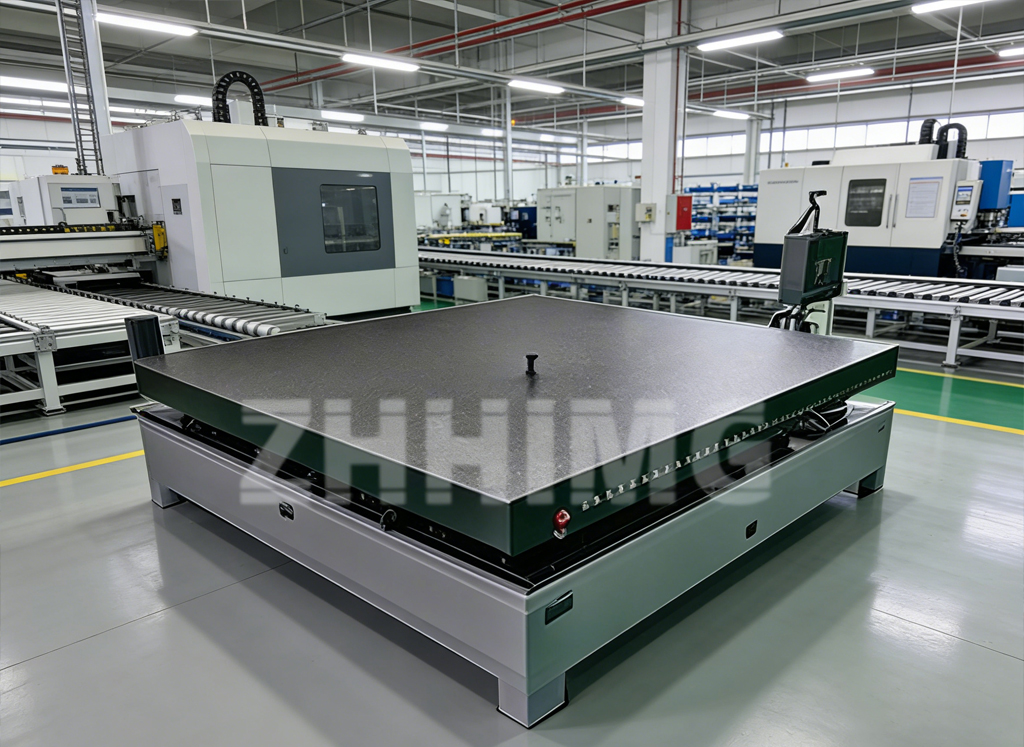
- T-Slot Tables: Most heavy inspection and welding tables feature a grid of T-slots. These allow you to use clamps, stops, and brackets to firmly lock down massive, irregular workpieces. Whether you’re aligning a complex assembly or setting up a welding jig, T-slots provide the flexibility you need.
- Flat Top Tables: If your primary goal is pure dimensional inspection using height gauges or CMM probes, a perfectly flat, slot-free surface is ideal to provide an uninterrupted datum plane.
4. Accuracy Grades: Matching Precision to the Task
Just like granite surface plates, cast iron tables come in different accuracy grades (often defined by standards like GB/T 22095 or DIN 876).
- Grade 0 / Grade 1 (Precision Grade): Used for high-accuracy inspection and tooling setup. The flatness tolerance is incredibly tight (e.g., within a few microns over a meter). These surfaces are often hand-scraped to create a pattern of “contact points” (around 25 points per 25x25mm square), which ensures perfect contact and oil retention.
- Grade 2 / Grade 3 (Workshop Grade): Perfect for general layout, heavy assembly, and welding. While the flatness tolerance is slightly looser, the focus here is on ruggedness and wear resistance.
5. Smart Structural Design
A heavy-duty table isn’t a solid block of iron—that would be impossibly heavy and wasteful. Instead, it uses a smart box-type structure with dense internal ribs (often arranged in a “well” or honeycomb pattern).
This design achieves two things:
This design achieves two things:
- Maximizes Rigidity: It prevents the table from bending under heavy loads.
- Optimizes Weight: It keeps the table manageable while maintaining its structural integrity.
Quick Selection Cheat Sheet
| Feature | What to Look For | Why It Matters |
|---|---|---|
| Material | HT250, HT300, or Ductile Iron | Superior vibration damping and high load-bearing capacity. |
| Stability | Double Stress Relief (Annealing) | Prevents warping and ensures the table stays flat for decades. |
| Surface | Hand-Scraped (for high grades) | Creates a wear-resistant, high-contact datum plane. |
| Design | Dense Internal Ribbing | Supports heavy loads (10T+) without deflection. |
| Function | T-Slots (for assembly/welding) | Allows secure clamping of heavy workpieces during inspection. |
Final Thoughts from ZHHIMG
A heavy-duty cast iron worktable is a long-term investment. It’s not just a piece of metal; it’s the reliable baseline for your entire production quality. Choosing a table that hasn’t been properly aged or is made from inferior iron will cost you dearly in recalibration fees and measurement errors down the road.
At ZHONGHUI Group (ZHHIMG), our mission is to promote the development of the ultra-precision industry. Whether you need a massive custom casting for a gantry machine or a standard heavy-duty inspection table, we apply the same rigorous standards to every product.
Need a heavy-duty solution for your workshop?
Our team understands the critical balance between massive load capacity and micron-level precision. Contact us today, and let’s build a solid foundation for your metrology needs.
Post time: May-25-2026