
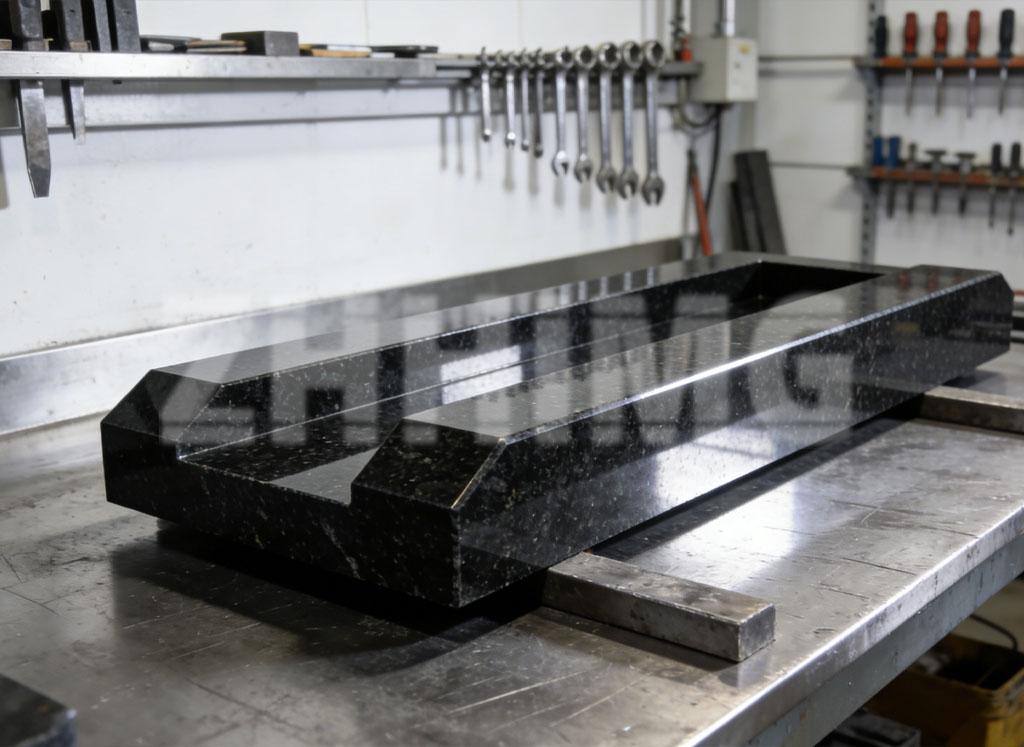
Mechanical ball-bearing guides introduce microscopic friction, backlash, and mechanical wear, which limits positioning repeatability in high-end automation. Ultra-precision granite air bearings eliminate physical contact by floating payloads on a micro-thin layer of clean compressed air. Utilizing the absolute flatness of ZHHIMG® black granite (3100kg/m³), these systems provide completely frictionless motion, zero hysteresis, and sub-nanometer positioning resolution.
Complete Elimination of Mechanical Friction and Component Wear
Physical contact between moving parts creates unavoidable friction, resulting in component degradation and accuracy loss over time. Granite air bearings operate via a continuous 5 to 10-micron air gap, eliminating solid-to-solid contact entirely. This zero-friction design ensures that your linear motor stages maintain identical factory-certified precision across billions of operating cycles.
Sub-Nanometer Positioning Repeatability via Zero-Backlash Guidance
Mechanical guide rails suffer from stick-slip effects, where extra force is required to initiate motion, causing minor positioning overshoots. Because air bearings float freely, they respond instantly to fractional linear motor inputs with zero stiction or backlash. This unmatched fluidity allows laser processing systems to achieve reliable sub-nanometer positioning repeatability.
Inherent Averaging Effect Smooths Out Minor Surface Imperfections
Even flat surfaces contain minute micro-topography variations when viewed under a microscope. When an air bearing pad glides over our hand-lapped black granite track, the pressurized air film acts as a natural integration filter. This air film pressure averages out microscopic surface deviations, resulting in a linear travel straightness that surpasses the physical track flatness.
Zero-Maintenance and Cleanroom-Compatible Cleanroom Architecture
Mechanical bearings require continuous oil lubrication, which attracts abrasive airborne grit and outgasses in vacuum chambers. Granite air bearings use clean, dry compressed gas, requiring no lubrication fluids. This cleanroom-compatible operation eliminates particulate contamination, making it the premier choice for semiconductor lithography and vacuum environments.
Guidance Mechanism Analysis: Granite Air Bearings vs. Mechanical Linear Guides
| Operational Parameter | ZHHIMG® Precision Granite Air Bearing | Standard Ball-Bearing Profile Guide | Crossed-Roller Friction Guide |
| Static & Kinetic Friction | Absolute Zero (0.0000) | High Stiction (0.005 – 0.01) | Moderate Friction (0.002) |
| Mechanical Rail Wear | None (Infinite operational lifespan) | High (Requires regular replacements) | Medium (Prone to structural pitting) |
| Lubrication Requirements | None (Uses clean compressed air) | Mandatory (Requires grease or oil) | Mandatory (Requires oil bath) |
| Cleanroom Particle Output | Zero (100% cleanroom compatible) | High (Emits oil mist and metal dust) | Moderate |
| Positioning Resolution | Sub-nanometer scale capability | Limited to micron scale by backlash | Limited by stick-slip mechanics |
Frequently Asked Questions (FAQ)
Q1: How much air pressure does a granite air bearing require to operate?
A1: Most industrial granite air bearings operate optimally at a stable supply pressure between 4.0 to 6.0 bar (60 to 90 PSI). The air supply must be strictly filtered to remove water, oil, and particles larger than 0.1 microns.
Q2: Will a sudden loss of air pressure cause catastrophic machine damage?
A2: We engineer our systems with integrated safety margins. If air pressure drops, the bearing pad settles gently onto the natural black granite track. Because granite is self-lubricating and non-galling, it prevents immediate structural seizing.
Q3: What is the maximum flatness deviation allowed for the granite track?
A3: To maintain a highly stable 5-micron air gap, the granite guide track must be lapped to an extraordinary flatness specification, typically less than 1.0 micron per meter, handled within our constant temperature workshop.
Q4: Can granite air bearings be utilized in vacuum chamber environments?
A4: Yes. For vacuum environments, we implement specialized vacuum-preloaded (VPL) air bearings. These configurations combine positive air pressure with a vacuum extraction ring, preventing air from escaping into the chamber.
Q5: How does ZHHIMG achieve high stiffness in a non-contact bearing?
A5: Air bearing stiffness increases as the air gap decreases. By optimizing the air distribution grooves, fly height, and pad size via finite element analysis (FEA), we maximize film rigidity to resist high dynamic loads without deflecting.
Q6: What typical applications require ZHHIMG® granite air bearings?
A6: They are widely integrated into semiconductor wafer inspection systems, flat panel display scanners, ultra-precision laser cutting machinery (femtosecond/picosecond), industrial CT X-ray coordinate tools, and high-end automated metrology sensors.
Post time: Jun-05-2026