
In precision measurement, laser processing and semiconductor inspection equipment, external micro‑vibration acts as a hidden culprit that undermines the consistency of output results. Vibrations transmitted from operating equipment on the floor, ground disturbances caused by personnel walking, and low‑frequency resonance triggered by start‑stop of surrounding factory machinery will propagate to core working areas through the base. During product selection for many projects, users only focus on platform weight, overall dimensions and surface flatness indicators, while ignoring internal material damping, a critical intrinsic factor. For granite vibration‑isolation platforms with identical appearance and specifications, some can efficiently dissipate various external disturbances, whereas others suffer amplified response even to faint vibrations. Such discrepancy originates from the internal damping level brought by the stone’s crystalline structure. Drawing on rich practical experience from precision‑oriented projects, ZHHIMG analyzes the functional mechanism of internal damping and illustrates how damping characteristics govern the actual anti‑interference capacity of granite vibration‑isolation platforms.
Internal damping can be simply understood as a material’s inherent capacity to dissipate vibration energy. When vibration waves travel into the granite substrate, energy generates frictional loss at mineral grain interfaces and grain‑bonding positions, converting vibrational kinetic energy into tiny amounts of heat for dissipation and thereby weakening vibration transmission. Higher damping delivers more efficient energy dissipation. With low damping, vibration energy can hardly be absorbed by the substrate; vibration waves pass straight through the platform and may even trigger resonance amplification. This is fundamentally different from vibration suppression achieved merely by increasing self‑weight. Higher mass only reduces vibration excitation, yet cannot consume vibrational energy that has already entered the material. By contrast, internal damping dissipates disturbances at the micro‑level of material structure, realizing essential vibration suppression.
The internal damping of granite is not a fixed constant. It is closely related to mineral composition of raw blanks, grain interlocking state and compactness. High‑quality bed‑grade black granite features tightly interlocked crystal grains and abundant grain boundaries. Vibration waves undergo continuous scattering and frictional loss while propagating inside the substrate, yielding excellent damping performance. In comparison, alternative materials such as loosely‑structured marble have simple mineral components and few grain‑bonding interfaces, resulting in poor internal damping. Even if the platform is built with heavy mass to suppress vibration, low‑frequency disturbances from factory buildings may still induce vibration amplification, bringing about issues such as jumping measurement data and offset processing light spots. This explains why some low‑cost granite vibration‑isolation platforms meet nominal specifications on paper yet fail to deliver satisfactory anti‑interference performance on‑site.
Internal damping shows distinct suppression effects for vibrations of different frequency bands. For high‑frequency micro‑vibrations, namely high‑frequency disturbances generated by reciprocating motion of linear motors, air compressors and running motors, the relatively high internal damping of granite absorbs energy rapidly with fast vibration attenuation. It protects optical lenses and inspection sensors from high‑frequency jitter. This is a major reason why granite vibration‑isolation platforms are preferred for laser processing and image‑inspection equipment. Nevertheless, material damping alone cannot fully isolate low‑frequency vibrations originating from building structures. Coordination with external vibration‑isolation structures is required. Material damping dissipates residual vibrational energy entering the platform and prevents platform‑body resonance. Desirable anti‑interference results can only be achieved through combined effects. If the granite substrate has insufficient damping performance, residual vibration will keep oscillating inside the platform even with external vibration isolators installed, greatly weakening the effectiveness of external isolation assemblies.
Many practitioners hold a misconception that the anti‑vibration capacity of granite vibration‑isolation platforms derives entirely from platform mass. In fact, mass serves as a basic condition, while internal damping is the core factor determining whether vibrational energy can be consumed. Stone platforms with heavy mass yet low damping tend to produce sustained vibration reverberation at resonant frequencies, and disturbances take a long time to subside. For granite platforms with high damping, incoming vibration energy dissipates quickly with short vibration decay time, allowing equipment to return to stable working status rapidly. This is vital for precision devices requiring continuous sampling and real‑time inspection. In scenarios such as semiconductor visual inspection and femtosecond laser micro‑machining, the system must stabilize quickly after each movement. The fast‑decay capability brought by damping directly influences equipment production cycle and product yield. 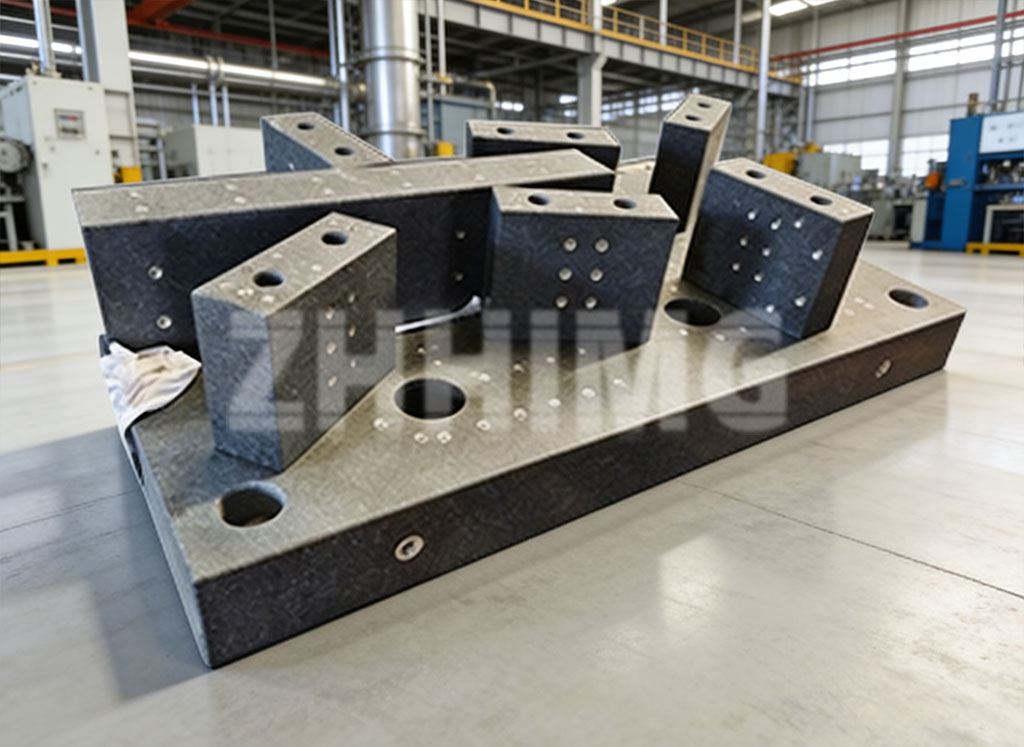
That said, the inherent advantages of material damping need proper manufacturing processes to be fully unlocked. Even if raw blanks possess outstanding damping properties, sustained vibration disturbances during fine machining will impair the flat reference of finished platforms. Besides, improper treatment of mating assembly surfaces will create interfacial gaps where vibrations reflect repeatedly, offsetting granite’s native damping merits. At the raw‑material screening stage, ZHHIMG evaluates crystal structure and compactness indicators of blanks, selecting high‑density black granite of 3100 kg/m³ and rejecting blanks with loose grains and abundant cracks. Fine machining is completed in dedicated constant‑temperature anti‑vibration workshops, supported by a complete set of traceable metrological inspection equipment and process technicians proficient in multiple national metrology standards. The intrinsic damping advantages of stone are converted into real‑world on‑site anti‑interference performance of platforms. Possessing ISO triple‑system certifications, CE certification and multiple international patents and trademarks, the company adheres to strict raw‑material criteria and opposes the practice of using low‑damping stone as counterfeit substrates for high‑performance vibration‑isolation platforms.
During project evaluation and selection, apart from flatness, dimensions and load‑bearing capacity, material internal‑damping performance shall be taken into consideration. Especially for production sites surrounded by numerous mechanical devices and complicated ground disturbances, increasing platform weight alone cannot resolve vibration problems. Only substrates with favorable internal‑damping properties can effectively dissipate incoming vibrational energy, lower resonance risks and mitigate adverse impacts of micro‑vibration on precision processes.
With continuous iteration of ultra‑precision technologies, equipment tolerates fewer environmental disturbances. The anti‑interference performance of granite vibration‑isolation platforms depends not merely on appearance and weight parameters; material internal damping acts as an indispensable underlying logic. A sound understanding of damping mechanisms and rational matching of substrates together with external vibration‑isolation solutions enable precision equipment to achieve designed performance steadily in complex factory environments.
Post time: Sep-03-2026