
Selecting a precision granite surface plate requires matching material properties—primarily density, flatness grade, and dimensional stability—to your specific metrology application. For calibration laboratories requiring ISO/IEC 17025 compliance, Grade 00 plates (≤0.5μm/m flatness) manufactured from Jinan Black Granite (≈3,100 kg/m³) deliver the necessary reference accuracy. Production metrology labs typically balance Grade 0 specifications with budget and size requirements, while understanding that the initial investment in higher-grade granite pays dividends through decades of stable service and eliminated maintenance costs.
1. Understanding Flatness Grades and Their Practical Implications
The flatness grade of a granite surface plate determines its suitability for different metrology applications. These grades are internationally standardized through specifications including German DIN, American ASME B89.3.7, Japanese JIS, Chinese GB, British BS, and Russian GOST—meaning you can specify and procure surface plates with confidence regardless of geographic origin.
Grade 00 represents the pinnacle of surface plate precision, with flatness tolerances of ≤0.5μm/m. This specification makes Grade 00 plates essential for calibration laboratories, national metrology institutes, and research institutions where traceability to measurement standards is paramount. The near-perfect flatness of Grade 00 plates enables calibration of other measuring instruments with confidence that the plate itself contributes negligible uncertainty to the measurement process.
Grade 0 plates, with tolerances of ≤1μm/m, serve the majority of production metrology applications. Coordinate measuring machines (CMMs), optical measurement systems, and precision inspection stations commonly utilize Grade 0 surface plates as their primary reference surface. The doubled tolerance compared to Grade 00 translates to significantly reduced manufacturing costs while maintaining adequate accuracy for most industrial measurement applications.
Grade 1 plates (≤2μm/m) provide cost-effective solutions for general-purpose inspection, tooling setup, and large-scale measurement applications where sub-micron precision is not required. These plates are frequently employed in machine shops, assembly areas, and quality control stations where surface plates serve as work-holding or alignment references rather than precision measurement standards.
Understanding these grade distinctions enables procurement professionals and quality engineers to specify appropriate surface plates without over-engineering solutions or compromising measurement capability.
2. Material Properties: Why Black Granite Dominates Precision Applications
Not all granite is equal for precision metrology applications. The mineral composition, grain structure, and processing methodology dramatically influence final performance characteristics. Jinan Black Granite from Shandong Province has emerged as the premium material choice for precision surface plates due to its superior physical properties and established processing expertise.
The characteristic dark color indicates high quartz content, which contributes to the material’s exceptional hardness and wear resistance. Black granite’s fine-grained structure enables smoother surface finishes and better flatness retention compared to lighter granites with coarser mineral distributions. The density of approximately 3,100 kg/m³ provides substantial mass for vibration damping—a critical consideration in production environments with mechanical equipment operating nearby.
Thermal stability distinguishes granite from alternative materials in precision applications. The thermal expansion coefficient of <0.001mm/°C means granite surface plates maintain their specified flatness across typical facility temperature ranges without requiring climate-controlled environments. This thermal stability is particularly valuable for manufacturers operating in facilities without precise temperature control or experiencing seasonal temperature variations.
Zero porosity is another critical characteristic of quality granite. Fully dense granite prevents liquid ingress that could cause contamination or staining, while also ensuring consistent material properties throughout the plate thickness. Lower-quality granite with visible porosity may absorb oils, coolants, or cleaning solvents that compromise measurement accuracy and create cleaning challenges.
3. Dimensional Considerations and Size Selection
Selecting the appropriate surface plate size requires balancing measurement needs against practical constraints including facility space, budget, and handling considerations. The maximum manufacturing capability of 20,000mm length enables surface plates for the largest coordinate measuring machines and multi-station inspection systems.
For bench-top metrology applications, surface plates in the 300mm to 1000mm range serve most needs. These plates sit on inspection benches or integrate with small CMMs for component measurement. The 500mm × 400mm size represents a common “sweet spot” offering adequate measurement area for small precision components while remaining manageable for single-operator handling and cleaning.
Medium-format surface plates from 1000mm to 3000mm accommodate larger components and multi-feature measurement sequences. These plates typically require pedestal supports with three-point mounting systems that provide stable, vibration-damping foundations. Floor space planning should account for both the plate dimensions and adequate clearance for operator access on all sides.
Large-format plates exceeding 3000mm are specialized items typically employed in aerospace, heavy equipment manufacturing, and large-scale metrology facilities. These plates often feature reinforced ribbing on undersides to prevent deflection under their own weight and may require custom transport and installation logistics. Lead times for large plates typically exceed standard items, and factory capability should be confirmed with manufacturers before specifying unusual dimensions.
Surface plate thickness affects rigidity and deflection characteristics. Thicker plates resist bending under load but add weight and cost. A general guideline suggests plate thickness should be approximately 1/20th of the shorter dimension—meaning a 1000mm × 750mm plate would typically be 50mm thick. Custom thickness specifications are available for applications with unique deflection or resonance requirements.
4. Certifications, Traceability, and Compliance Requirements
Modern metrology labs operate within regulatory frameworks that require documented evidence of measurement capability and equipment calibration. Surface plates serving as reference standards require appropriate certifications to satisfy quality system requirements and customer audit expectations.
ISO/IEC 17025 compliance has become the baseline requirement for calibration and testing laboratories worldwide. This standard requires documented evidence that measurement equipment contributes appropriately to overall measurement uncertainty. Grade 00 and Grade 0 surface plates should be accompanied by calibration certificates demonstrating actual measured flatness values, measurement uncertainty, and traceability to national standards.
ISO 9001:2015 certification for the surface plate manufacturer demonstrates systematic quality management in the production process. This certification indicates that the manufacturer maintains documented procedures for material sourcing, processing, inspection, and delivery that consistently produce conforming products.
For surface plates used in regulated industries such as aerospace, medical devices, or automotive safety components, additional documentation may be required including material certificates, processing records, and supplier audits. Proactively specifying certified manufacturers simplifies compliance documentation and reduces supply chain risk.
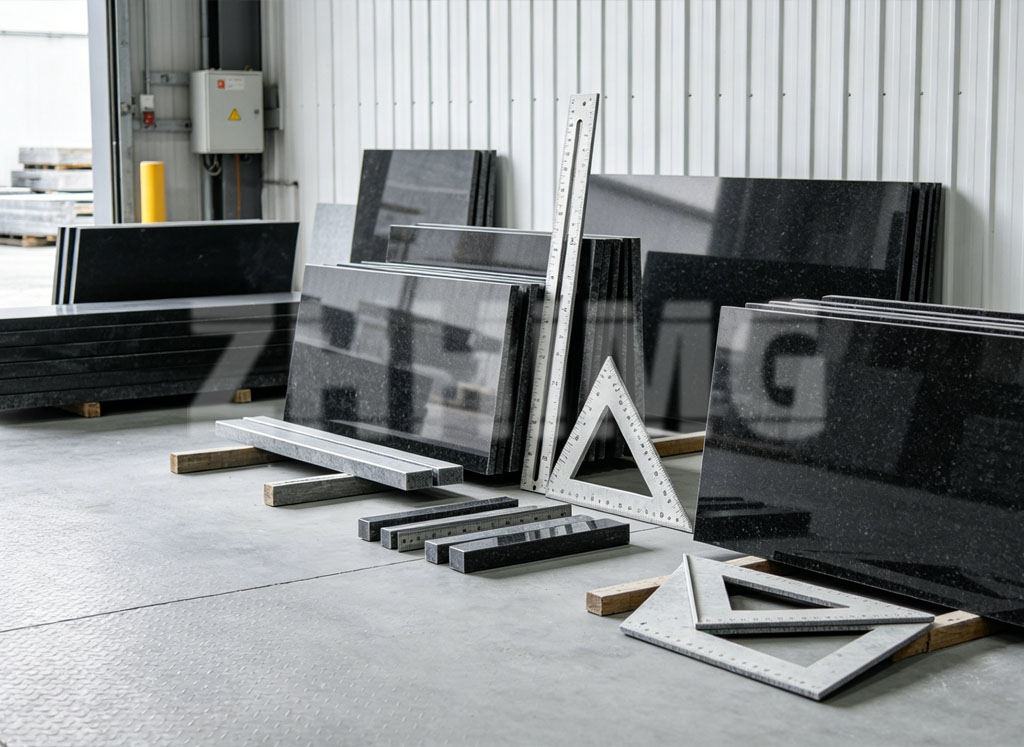
5. Support Systems and Accessories
The surface plate itself is only one component of an effective metrology reference system. Appropriate support, handling equipment, and accessories complete the installation and ensure long-term performance.
Three-point support systems provide the most stable foundation for precision surface plates. This configuration allows the plate to “float” on its support points, preventing stress concentrations that could cause deflection or flatness degradation over time. The three points should contact the plate at locations calculated to minimize deflection under expected loading conditions.
Tennon stands offer adjustable-height support for surface plates used in multiple locations or requiring frequent repositioning. These stands typically feature leveling mechanisms and vibration-damping mounts that isolate the plate from floor vibrations.
Protective covers prevent dust accumulation, accidental impact damage, and contamination during non-operating periods. Custom-fit covers manufactured from non-marring materials protect plate surfaces without introducing scratches or particles. Clear acrylic covers allow visual inspection of plate condition without removal.
Handling equipment including plate carts, lifting fixtures, and protective gloves prevents injury during transport and positioning. Surface plates of significant size can weigh hundreds of kilograms—appropriate handling equipment is essential for operator safety and plate protection.
Frequently Asked Questions
What is the difference between Grade 00, Grade 0, and Grade 1 surface plates?
Grade 00 specifies flatness ≤0.5μm/m, Grade 0 specifies ≤1μm/m, and Grade 1 specifies ≤2μm/m. Grade 00 plates serve calibration and reference applications, Grade 0 plates support production metrology, and Grade 1 plates are suitable for general inspection and tooling applications.
How often should a granite surface plate be re-calibrated?
Calibration frequency depends on usage intensity and accuracy requirements. Calibration laboratories typically recalibrate Grade 00 plates annually, while production surface plates may require recalibration every 1-3 years. Any impact damage, visible wear, or suspected accuracy degradation warrants immediate recalibration.
Can granite surface plates be repaired if they are damaged?
Minor surface scratches can often be removed through professional resurfacing by skilled technicians. However, significant damage including chips, cracks, or deep scratches may render the plate unsalvageable. Prevention through proper handling, storage, and use is always preferable to repair.
What cleaning methods are appropriate for precision granite surface plates?
Clean, lint-free cloths with petroleum-based solvents (not water) effectively remove most contaminants. For precision cleaning, specialized surface plate cleaners are available. Never use abrasive materials, steel wool, or acidic cleaners that could damage the granite surface.
How do I verify a surface plate’s flatness without laboratory equipment?
The “twist test” using precision gage blocks can indicate surface flatness degradation. Place three equal-height gage blocks in a triangular pattern on the plate and check for consistent contact across all combinations. Significant variations suggest the need for professional inspection or recalibration.
What temperature range can granite surface plates operate within?
Granite surface plates perform reliably from approximately 10°C to 40°C without special accommodations. For temperatures outside this range or with rapid temperature changes, consult with the manufacturer regarding specific recommendations for your application.
Find Your Perfect Surface Plate Match
Selecting the right precision granite surface plate balances technical requirements, budget constraints, and long-term performance expectations. ZHHIMG® manufactures surface plates in all standard grades with flatness tolerances from 0.5μm/m (Grade 00) to 2μm/m (Grade 1) , using premium Jinan Black Granite with density of 3,100 kg/m³.
Our ISO-certified manufacturing facilities produce surface plates up to 20,000mm in length, with monthly capacity exceeding 20,000 units. Every plate undergoes rigorous inspection and documentation before shipment, supporting your ISO/IEC 17025 compliance requirements.
Request a quotation for your metrology lab surface plate requirements. Our technical sales team will recommend appropriate specifications based on your application requirements, helping you balance performance and budget for optimal value.
Post time: Jun-02-2026