
Here’s a question that doesn’t get asked often enough: when a semiconductor lithography machine needs to hold nanometer-level positioning accuracy across a 1.5-meter wafer stage, what is it actually standing on?
The answer isn’t titanium. It isn’t carbon fiber composites. It’s granite.
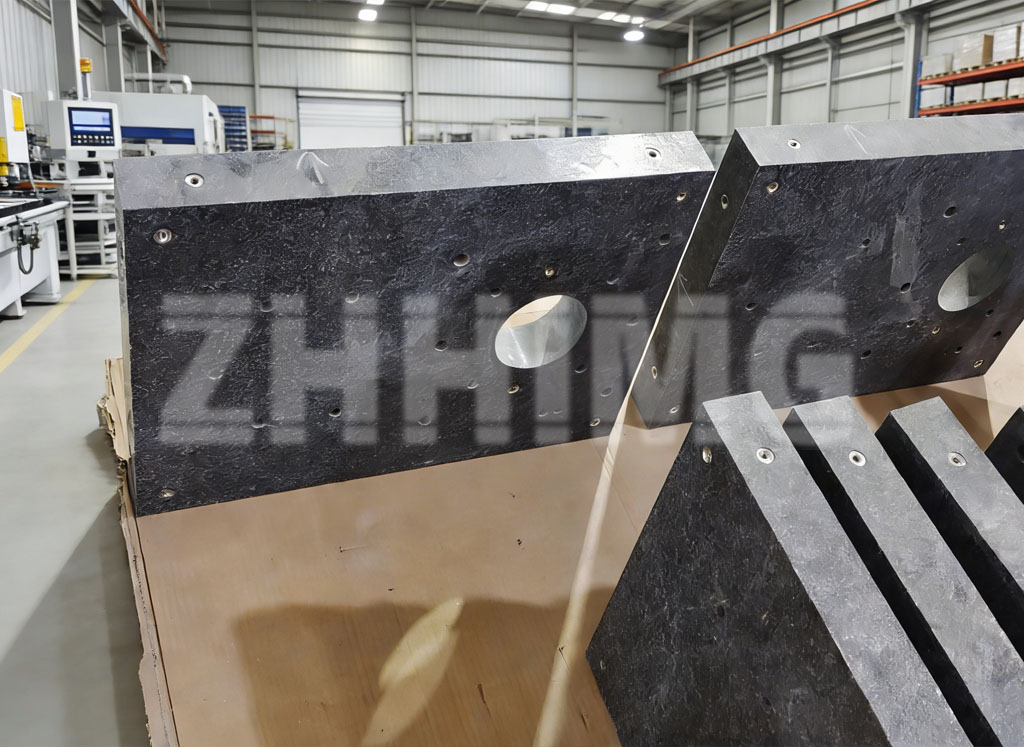
More specifically: it’s a precision granite machine base — a massive, meticulously machined block of black granite that forms the foundational structural element of some of the most sophisticated manufacturing equipment on Earth.
This is the part of the precision components story that most articles skip over. Everyone wants to talk about surface plates and measuring instruments. But the real action — the applications where granite structural parts carry the most demanding loads and the tightest tolerances — is in the machine bases, columns, ways, and worktables that form the skeleton of precision engineering equipment.
Why Granite Makes Sense as a Structural Material
The case for granite as a structural material in precision equipment comes down to a specific combination of physical properties that no other common material matches in the same package.
Thermal stability is the headline feature. Granite has a very low thermal expansion coefficient — roughly half that of cast iron and about a quarter that of aluminum. For equipment that operates across temperature variations, or that needs to maintain positional accuracy as ambient conditions change, this matters enormously. A machine base that expands and contracts less with temperature is a machine base that holds its geometry more predictably.
Damping capacity is the second advantage. Granite absorbs vibration better than many people assume. Its crystalline microstructure interrupts the propagation of vibration waves, reducing the resonance amplification that plagues rigid metal structures. For precision equipment operating in factory environments — where floor vibration, HVAC systems, and nearby machinery all create low-frequency vibration noise — this damping characteristic translates directly into better positioning accuracy and surface finish.
Chemical stability and corrosion resistance round out the package. Granite doesn’t rust. It doesn’t corrode in humid or mildly acidic environments. It doesn’t require lubrication. Once installed, a granite structural component requires essentially no ongoing maintenance — which matters significantly in applications where access for maintenance is difficult or costly.
The combination of these properties — thermal stability, damping, corrosion resistance, and near-zero maintenance — makes granite the default structural material for the most demanding precision applications. Not because it’s the cheapest option, or the most exotic, but because the physics works in its favor.
Where Granite Structural Parts Show Up in Real Equipment
Granite structural parts aren’t found in every machine shop. They’re specified in equipment where precision requirements exceed what conventional metal structures can deliver without extraordinary environmental controls.
Semiconductor manufacturing equipment is the most demanding application category. Lithography systems, wafer handling platforms, and inspection tools all require granite bases and way systems to achieve the nanometer-level positioning accuracy required at advanced process nodes. The granite components in these systems are custom-engineered to the millimeter, with ultra-precision scraped surfaces and carefully designed mounting interfaces.
Precision machine tools — particularly grinding machines, jig borers, and gear-cutting equipment — use granite for machine beds, columns, and work tables. The granite structure provides a thermally stable reference frame that reduces the thermal drift that plagues metal machine beds during warm-up cycles.
Optical and laser systems have specific requirements that granite addresses elegantly. Optical benches and laser platform bases made from granite provide the vibration isolation and thermal stability needed for interferometry, laser machining, and optical assembly. The low thermal expansion coefficient means optical alignments stay put across normal temperature ranges.
CMM and precision metrology equipment uses granite for the same reasons surface plates do — but at the structural level. CMM bridges, columns, and base plates made from granite provide the dimensional reference frame that the entire measurement system depends on.
Precision printing and electronics manufacturing — including PCB drilling systems, screen printing platforms, and component placement equipment — rely on granite structural parts to maintain the positional accuracy needed for fine-pitch components and microvia drilling.
The Difference Between a Machine Base and a Surface Plate
This distinction matters and is frequently misunderstood.
A surface plate is a measurement reference — its function is to provide a known geometric reference plane for manual and semi-manual measurement. Its requirements center on flatness and surface texture.
A granite machine base is a structural component — its function is to support loads, resist deformation under gravity and process forces, provide mounting interfaces for precision slides and actuators, and maintain geometric relationships between mounted components over time and temperature.
The requirements profile is different. A surface plate needs excellent surface geometry. A machine base needs structural rigidity, internal stress uniformity, consistent material properties across its full volume, and long-term dimensional stability — not just surface flatness.
This is why a granite machine base from a qualified manufacturer isn’t just a bigger version of a surface plate. It’s a different design, a different manufacturing approach, and a different quality assurance process. The material grade, the internal homogeneity, the stress relief during machining, and the mounting interface geometry all matter in ways that don’t apply to measurement surface plates.
Buyers who specify machine bases based only on dimensional tolerances and surface flatness are missing the critical parameters that determine whether the base will perform over years of service.
What Makes One Manufacturer’s Structural Parts Better Than Another
The difference between a granite machine base that performs for 20 years and one that develops problems within 3 shows up in the details most buyers never see.
Raw material selection is the first differentiator. Not all black granite meets the same quality standard. The grain structure needs to be fine and uniform — coarse or variable grain patterns create inconsistent material properties that affect dimensional stability. The density needs to be consistently high — low-density material absorbs more moisture and has worse thermal characteristics. A manufacturer who sources raw blocks selectively and verifies material properties before committing them to production has a fundamentally better starting point than one who buys material opportunistically.
Internal stress management during machining is the second critical factor. When granite is machined — cut, milled, and ground — the material nearest the machined surface experiences stress redistribution. If this stress isn’t relieved through proper procedure, it will slowly release over time, causing dimensional changes in the finished part. Premium manufacturers control their machining approach to minimize induced stress and then verify stress-free condition before final finishing.
Surface finishing approach differs between surface plates and structural parts. A scraped measurement surface and a ground structural interface are finished to different requirements using different techniques. A manufacturer who understands both applications — and knows when to use scraping versus grinding versus lapping — produces better results than one who applies a single technique universally.
Quality assurance depth separates the tiers. A surface plate might be verified at a limited number of points for flatness. A precision machine base needs dimensional verification across all critical interfaces, including perpendicularity, parallelism, and mounting hole positions — in addition to surface flatness where applicable. The inspection equipment, the measurement methodology, and the documentation trail all reflect the manufacturer’s commitment to quality.
Sourcing Custom Granite Structural Parts: What Buyers Get Wrong
Custom granite structural parts — machine bases, columns, worktables, and similar components — are a different sourcing challenge than standard surface plates. Most buyers underestimate the complexity.
“Custom” doesn’t mean “anything goes.” There are practical limits to what can be manufactured: maximum dimensions are constrained by raw block availability and machine tool capacity; minimum wall thicknesses are constrained by material properties; and some geometries are simply impractical for granite as a material. A good manufacturer will tell you when a design is impractical before you commit to tooling, not after.
Tolerances should match the application, not the aspiration. Specifying tighter tolerances than your process actually requires adds cost without benefit. Specifying looser tolerances than your equipment needs creates problems downstream. The right tolerance is the one that supports your actual process capability — no more, no less.
Mounting interfaces need to be designed for the material. Granite can’t be threaded the way metal can. Mounting bolt holes, T-slots, and fixture mounting patterns need to be designed with the material’s properties in mind — which means working with a manufacturer who understands how granite structural parts are actually installed, not just how they’re drawn.
The specification document matters more than most buyers write. A vague specification — “Grade 00 machine base, 1,500 by 800mm” — misses the information a manufacturer needs to produce a part that performs. A good specification includes: dimensional tolerances at all critical features, surface finish requirements for each functional surface, mounting interface specifications, material grade requirements, and any environmental conditions the part will operate in.
The Questions That Separate Serious Buyers From Casual Shoppers
When you’re sourcing granite structural parts for precision equipment, the questions you ask before placing an order determine whether the outcome is smooth or painful.
Can you provide material certification for the specific granite batch you’ll use in my parts? Traceability to specific raw material batches tells you the manufacturer is controlling their material sourcing, not just buying what’s available.
What is your dimensional tolerance capability across all critical features, not just the primary surface? If the mounting interfaces are out of tolerance, the part won’t work even if the main surface is perfect.
What inspection data do you provide with each part? A single flatness certificate isn’t enough for a complex structural part. You need dimensional verification across all critical features.
What is your experience in my specific application area? A manufacturer who’s built machine bases for semiconductor equipment understands different requirements than one who primarily builds inspection plates. Application-specific experience reduces the learning curve on your project.
What are your lead times for custom components, and do you have capacity for rush orders? Custom granite structural parts aren’t commodities with fast stock availability. Understanding the realistic production timeline upfront prevents procurement disasters.
What is your quality hold and rework policy if a part arrives outside tolerance? The answer tells you how much confidence you can have in the supplier’s quality system — and what happens if something goes wrong.
The Real Value of Getting This Right
A precision granite structural part is not the most exciting line item in a piece of equipment’s bill of materials. It’s not the motor, the controller, the linear stage, or the software. But it’s the foundation everything else sits on — literally.
When that foundation holds its geometry across years of thermal cycles, vibration loads, and production throughput, the machine performs predictably, the quality system produces consistent data, and the maintenance team sleeps at night.
When it doesn’t, no amount of investment in high-precision actuators or advanced control algorithms can compensate. The machine drifts. The measurements become unreliable. The process capability indices drop. And the investigation into why — which usually takes weeks and costs far more than the original price difference — starts from scratch.
That’s the real cost of a bad granite structural part. Not the part itself. The downstream cascade of problems it enables.
Choosing a manufacturer with the experience, material sourcing discipline, manufacturing capability, and quality system to build structural parts that last 20 years isn’t a premium decision. For equipment where precision matters, it’s the only decision that makes sense.
Post time: May-26-2026