
Ultra-precision granite components are made in stages: careful stone selection, heavy cutting and CNC machining, fine grinding, hand lapping, measurement in a temperature-controlled room, and assembly. This article walks through each stage at ZHHIMG, so buyers can see what to look for in any granite manufacturer.
The Process at a Glance
From raw stone to a certified component, each granite part passes through these stages:
- Stone selection and inspection: dense black granite blocks are chosen and checked.
- Cutting and CNC machining: the block is cut to size and machined to near-final shape.
- Fine grinding: large grinding machines bring the working surfaces to their first precision.
- Hand lapping: experienced technicians lap the surfaces to the final tolerance.
- Measurement and verification: parts are measured in a temperature-controlled, vibration-isolated room.
- Assembly: inserts, air-bearing surfaces and sub-assemblies are fitted and checked.
- Reporting, packing and shipping: inspection records are issued and the part is crated for export.
The sections below explain what happens at each stage and what a buyer should ask about it.
Stages 1 and 2: Stone Selection, Cutting and CNC Machining
Stone selection. Everything starts with the stone. ZHHIMG uses its own ZHHIMG® black granite, a dense, fine-grained stone with a density of about 3,100 kg/m³. The blocks are stored in a dedicated stone yard of roughly 20,000 m² and inspected before cutting, so that cracks, veins and soft inclusions are found while they are still cheap to reject. The stone choice matters because marble and lighter stone are softer and more porous, and they do not hold their geometry as well.
Cutting and CNC machining. Large blocks are cut and machined on heavy CNC equipment. The plant can handle single pieces of up to 100 tonnes and machine lengths up to 20 m, widths up to 4,000 mm and thicknesses up to 1,000 mm. Handling a piece of that size in one part, instead of joining sections, avoids joints that could add error.
CNC machining removes most of the stone and forms holes, pockets and slots. It leaves a small allowance for the grinding and lapping that follow.
What buyers should ask: what stone is used, how it is checked, and what the largest single piece is that the factory can machine and handle.
Stages 3 and 4: Fine Grinding and Hand Lapping
Fine grinding. After machining, the working surfaces are ground on large grinding machines. ZHHIMG runs four extra-large Taiwanese grinding machines that can grind metal and non-metal precision platforms up to 6,000 mm long. Grinding sets the flatness, parallelism and squareness to within a small allowance of the final tolerance, and it does so in a repeatable way, which matters for orders with many identical parts.
Hand lapping. The final step is done by hand. Most of the lapping technicians at ZHHIMG have more than 30 years of experience. They work the surface with lapping tools and abrasives, check it repeatedly, and take off only a few micrometres at a time. Customers describe them as “walking electronic levels” because they can judge by feel how much material a pass has removed.
Machines are fast and consistent, but hand lapping reaches finer results on the most demanding surfaces, such as the faces of air-bearing guides and reference plates. The two methods work best together: the machine does the bulk of the work, and the technician finishes it.
What buyers should ask: which surfaces are machine-ground and which are hand-lapped, and how many experienced lapping technicians the factory has.
Stage 5: Measuring in a Controlled Environment
A factory’s accuracy claim is only as good as its ability to measure. As the company puts it: if you cannot measure it, you cannot make it.
The room. ZHHIMG’s constant-temperature and constant-humidity workshop covers about 10,000 m². Its floor is poured from ultra-hard concrete at least 1,000 mm thick, and the room is surrounded by vibration-isolation trenches 500 mm wide and 2,000 mm deep. The overhead cranes are the silent type, so moving a heavy part does not disturb measurements elsewhere in the hall. A separate constant-temperature, dust-controlled workshop that simulates a semiconductor-equipment environment is used to assemble granite parts.
The instruments. Typical measuring equipment includes:
| Instrument | Used for |
|---|---|
| Mahr indicators (0.5 µm resolution) | Local flatness and height comparison |
| Mitutoyo indicators, digital calipers and roughness testers | Dimensions and surface finish |
| Inductive (electronic) micrometers | Fine displacement and form measurement |
| WYLER electronic levels | Flatness and straightness over long lengths |
| Renishaw laser interferometer | Straightness and positional checks over long travels |
Traceability. The measuring instruments carry calibration certificates issued by the Jinan and Shandong provincial metrology institutes, and the calibration can be traced back to the national metrology institute. This chain of calibration is what makes a measurement report credible, because it shows that the numbers can be compared with those from another lab.
Method and standards. All staff receive metrology training and study inspection standards from several countries each year, including DIN (for example DIN 876, DIN 875 and DIN 650), ASME, JIS, GB and BS standards. The measuring method follows the standard named in the order.
Research partners. ZHHIMG also works with universities and national metrology bodies to explore more accurate measuring methods. This keeps its methods up to date as accuracy requirements tighten.
Stages 6 and 7: Assembly, Reporting and Shipping
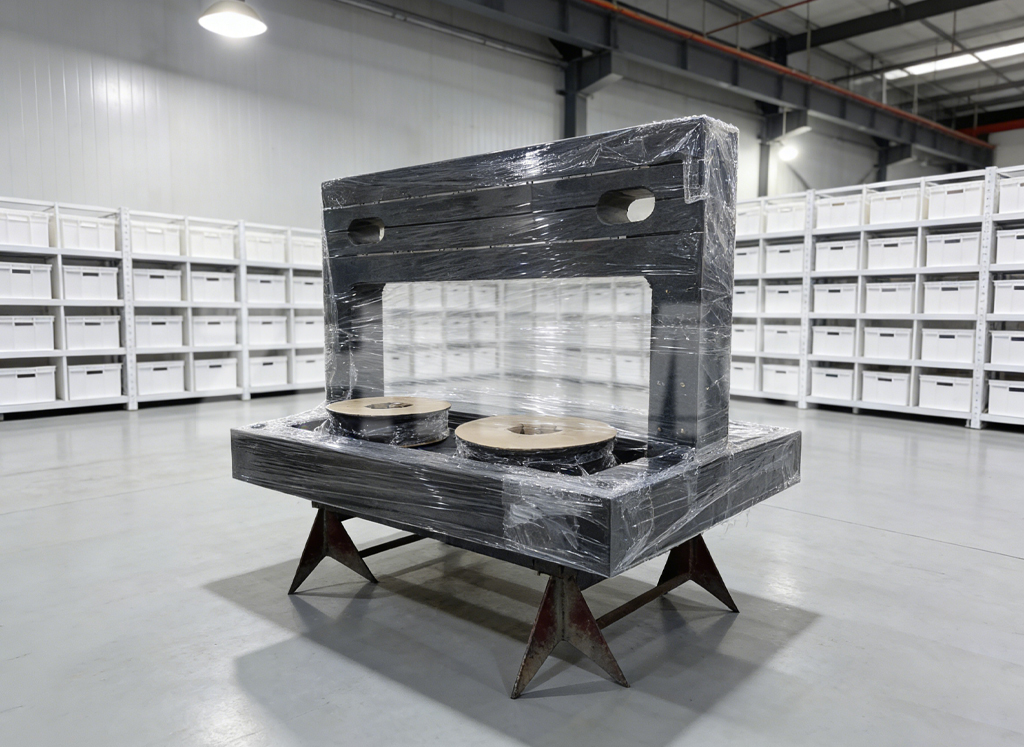
Assembly. Many granite parts leave the factory as assemblies: a base with bonded inserts, an air-bearing guide, a gantry fitted to a table, or a set of beams and plates matched to each other. These are assembled and checked in the controlled workshop, so the geometry that was measured on the individual parts is confirmed on the finished unit.
Inspection report. Each order is delivered with the measurement results for the agreed dimensions and tolerances, the standard used, the instruments and their calibration status, and the measuring conditions. A report that names these items lets the buyer repeat the check on arrival.
Packing and shipping. Heavy granite is crated for export with shock protection and secure fixing. The head office is in Jinan, close to the port of Qingdao, which makes shipping to overseas customers straightforward.
The Quality System and the Team
The factory works under certified management systems: ISO 9001 for quality, ISO 14001 for the environment and ISO 45001 for occupational health and safety, and its products carry CE marking where it applies. The company’s quality policy is that the precision business cannot be too demanding, and its promise to customers is no cheating, no concealment and no misleading.
The most important resource, though, is the team. Every staff member receives metrology training, and the lapping technicians bring decades of hands-on experience. A well-equipped factory without such people cannot reach the finest tolerances, and skilled people without equipment cannot prove them.
Frequently Asked Questions
Can ZHHIMG make custom granite components? Yes. Send a drawing or the key dimensions, tolerances, load and application, and the engineering team will review the design and advise on stone, support and inspection.
What is the largest granite part you can make? Single pieces up to 100 tonnes, with lengths up to 20 m, widths up to 4,000 mm and thicknesses up to 1,000 mm.
Do you provide inspection reports and calibration certificates? Yes. Reports list the standard, the measured results, the instruments and their calibration status. The instruments are calibrated by recognized metrology institutes.
Which standards do you work to? Common ones include DIN 876, ASME, JIS, GB and BS, as well as the customer’s own specification. Please name the standard and edition in your enquiry.
How do you ship heavy granite overseas? Parts are crated for export with shock protection and secure fixing. The head office is near the port of Qingdao in Shandong.
Conclusion
A good granite manufacturer can show you the whole chain: dense, inspected stone; machines that can handle your size; skilled technicians for the final lapping; a controlled room to measure in; instruments traceable to national standards; and records that prove the result. When you compare suppliers, ask to see each link in that chain. See the ZHHIMG granite product range or send your drawing for a review.
Post time: Nov-13-2026