
Semiconductor lithography serves as the core precision process in chip manufacturing. It relies on nanometer-level optical path calibration, wafer alignment and pattern replication processes to determine the precision and yield of chip manufacturing. The stability of lithography equipment depends not only on optical and electronic control systems, but also on the granite platform that acts as the bearing benchmark for the entire equipment. Its core performance indicators directly decide optical path stability, motion repeat accuracy and process consistency, and serve as the fundamental core to avoid lithography offset, pattern distortion and overlay deviation. Different from general precision equipment platforms, lithography scenarios impose stricter requirements that are more tailored to micro-nano manufacturing processes. As a professional intelligent manufacturing brand in the field of ultra-precision structural parts, ZHHIMG relies on self-developed black granite materials and a complete set of ultra-precision process systems to divide the performance of lithography-dedicated granite platforms into six core dimensions, accurately meeting the extreme precision requirements of high-end lithography equipment.
I. Ultra-Low Thermal Expansion Coefficient: Core Restraining Indicator for Lithography Process Temperature Drift
Lithography workshops inevitably have environmental variables such as slight temperature and humidity fluctuations and thermal radiation generated by equipment operation. Since lithography optical paths and wafer alignment systems tolerate zero micron and nanometer-level deformation, the low thermal expansion coefficient is the primary core indicator of lithography granite platforms. This parameter determines the dimensional stability of the platform in dynamic temperature environments and eliminates optical path offset and wafer positioning deviation caused by thermal expansion and contraction.
High-quality granite platforms suitable for high-end lithography equipment feature a thermal expansion coefficient stably controlled within 2.5~4×10⁻⁶/℃, only 1/6 of aluminum alloy and 1/4 of stainless steel. Most ordinary marble materials on the market suffer from poor thermal stability and high temperature sensitivity, making them unable to adapt to nanometer-level lithography processes. In contrast, ZHHIMG® high-density black granite adopts exclusive mineral source selection and homogeneous crystal structure with no pores or residual stress. Its deformation is controlled within 0.5μm/m in a 24-hour constant temperature environment. It can maintain constant dimensional stability of the equipment benchmark during long-term continuous lithography operation, completely solving lithography pattern stretching and dislocation caused by substrate thermal deformation and ensuring the accuracy of multi-layer lithography overlay.
II. Nanometer-Level Flatness and Geometric Accuracy: Core Precision Indicator for Lithography Benchmark Surfaces
All core operations of lithography equipment, including optical detection, wafer translation and laser etching, take the granite platform as the absolute benchmark plane. Geometric accuracy indicators of the platform such as flatness, straightness and parallelism define the ultimate precision of lithography processes. General precision platforms only meet micron-level accuracy, while lithography scenarios require nanometer-level ultra-high geometric accuracy, which is the core standard distinguishing ordinary granite platforms from semiconductor lithography-dedicated platforms.
High-end lithography matching granite platforms reach the ultra-high precision grade of 000, with the overall flatness error ≤2μm/m and nanometer-level flatness accuracy in core local working areas. Meanwhile, the straightness and parallelism of the platform’s guide rail mounting surface and bearing benchmark surface are fully matched to avoid height difference and inclination deviation of the benchmark. Adopting ten-thousand-ton ultra-precision grinding equipment and constant-temperature dust-free finishing technology, ZHHIMG achieves uniform full-board accuracy without local precision blind spots. It ensures no benchmark offset during high-speed translation of wafer stages and fine adjustment of optical lenses, guarantees verticality and focusing stability of femtosecond and picosecond laser lithography optical paths, and avoids defects such as blurred lithography patterns, jagged edges and dimensional out-of-tolerance from the benchmark level.
III. High-Damping Micro-Vibration Attenuation Performance: Core Dynamic Indicator for Lithography Micro-Disturbance Suppression
Lithography processes are extremely sensitive to vibration. Even nanometer-level micro-tremors can cause optical path offset and wafer micro-displacement, leading to scrapping of entire wafer lithography. Vibration sources in lithography workshops are complex, including low-frequency ground vibration, self-excited vibration from high-speed operating equipment motors and airflow vibration from ventilation systems. External shock absorbers can only isolate external ground vibration but cannot eliminate structural resonance inside the equipment. Therefore, high-damping vibration attenuation performance is an irreplaceable core dynamic indicator unique to granite platforms.
High-quality lithography-dedicated black granite has inherent high damping characteristics. Its dense and uniform crystal structure quickly converts vibration energy into tiny thermal energy for dissipation and avoids superposition and resonance of vibration. Compared with metal substrates that easily conduct and amplify vibration, ZHHIMG ultra-precision granite platforms dedicated to lithography realize instantaneous attenuation of micro-tremors and completely eliminate continuous micro-displacement during equipment operation. This indicator ensures absolute static state of optical paths, wafers and laser heads during lithography, solves the problem of equipment structural micro-vibration that cannot be completely eliminated by external shock absorption systems, and serves as a key dynamic support for high-end lithography machines to achieve nanometer-level processes and stable yield.
IV. Ultra-High Surface Smoothness: Basic Indicator for Air-Floating Motion and Optical Adaptation
Most modern high-end lithography equipment is equipped with granite air-floating motion platforms, which rely on high-pressure airflow to realize frictionless high-speed translation of wafer stages. The platform’s surface roughness directly determines air film uniformity and motion stability, serving as an easily overlooked core indicator of lithography platforms. Rough platform surfaces cause uneven air film thickness, resulting in micro-jitter and positioning offset of the stage and directly damaging lithography alignment accuracy.
The roughness Ra of the granite benchmark working surface adapted to lithography equipment is strictly controlled at 0.01~0.05μm, and the core optical alignment area reaches mirror-level smoothness without scratches, pits or protrusions. Supported by the nano-level precision finishing capability of senior polishing technicians with 30 years of experience, ZHHIMG achieves an ultra-smooth and uniform board surface texture. The ultra-high smoothness not only ensures stable and jitter-free operation of air-floating bearings, but also reduces optical refraction interference, adapts to high-precision optical detection requirements of lithography equipment, lowers dust adhesion probability, and complies with the dust-free operation standards of semiconductor clean workshops. 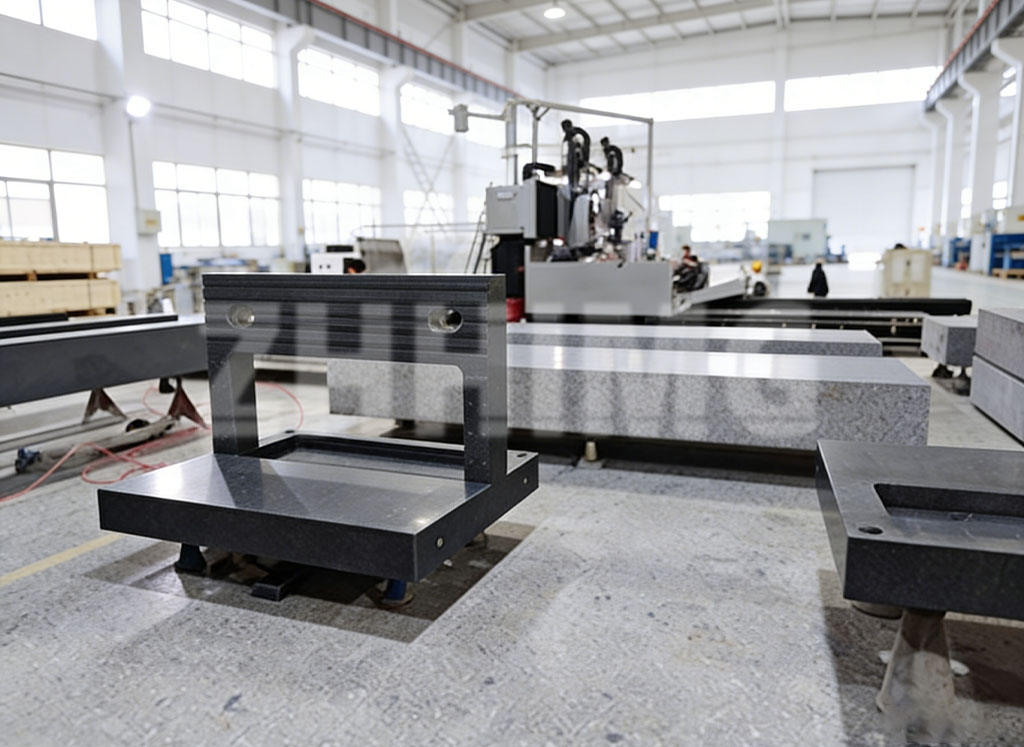
V. High-Density Structural Stability: Anti-Attenuation Indicator for Long-Term Heavy-Load Deformation
Lithography equipment integrates multiple precision components such as optical lenses, precision motors, sensor modules and wafer stages, operating under long-term heavy-load and high-frequency start-stop conditions. Long-term force deformation of the platform will cause continuous precision attenuation, affecting equipment service life and process stability. Material density and structural stability are core basic indicators to ensure long-term precision consistency of lithography platforms.
The density of industry-leading lithography-dedicated granite reaches 3100kg/m³, far exceeding that of ordinary European and American black granite and market marble. ZHHIMG strictly selects high-density primary black granite raw materials, and adopts an ultra-long natural stress relief process and integrated integral forming technology to completely eliminate residual internal stress of substrates. It avoids warpage, deformation and precision attenuation caused by long-term heavy-load operation and temperature and humidity changes. This indicator enables ZHHIMG lithography granite platforms to maintain initial precision benchmarks for more than ten years without frequent calibration and debugging, adapts to 24-hour uninterrupted mass production in semiconductor workshops, and greatly reduces equipment shutdown maintenance costs and mass production yield fluctuation risks.
VI. Environmental Adaptation and Physical-Chemical Stability: Guarantee Indicator for Complex Process Scenarios
Semiconductor lithography workshops are constant-temperature, constant-humidity and dust-free environments with trace process gas and water vapor erosion. Long-term equipment operation requires strict standards of low dust generation, corrosion resistance and non-magnetization. Physical-chemical stability and environmental adaptability are important auxiliary core indicators for long-term reliable operation of lithography platforms.
Qualified lithography matching granite platforms feature non-magnetization, corrosion resistance, oxidation resistance and low dust precipitation, without material aging, surface peeling or precision offset caused by workshop trace chemical media and temperature-humidity cycles. Relying on 10,000-class constant-temperature constant-humidity dust-free production workshops, matched with independent shockproof foundations, full-range shockproof trenches and silent crane supporting systems, ZHHIMG optimizes from production environment to finished product technology. Its lithography-dedicated granite platforms perfectly adapt to semiconductor clean workshop working conditions, with no magnetization, no particle pollution to wafers and resistance to trace process corrosion, fully ensuring the precision and stability of lithography processes from the perspective of environmental adaptation.
Conclusion
The precision upper limit of semiconductor lithography equipment depends on the optical system, while the precision lower limit and mass production stability are completely determined by the core performance indicators of granite platforms. The six core indicators including low thermal deformation, nanometer-level geometric accuracy, high-damping vibration reduction, ultra-high surface smoothness, high-density structural stability and excellent physical-chemical adaptability complement and support each other. With the core advantages of independent material research and development, ultra-precision processing and full-process quality control, ZHHIMG achieves industry-leading levels in the six major performance indicators, builds a solid underlying foundation for lithography equipment to stably output nanometer-level precision processes, and forms core hardware and technical differences that enable the brand to continuously serve the global semiconductor ultra-precision manufacturing field and outperform ordinary stone processing manufacturers.
Post time: Oct-08-2026