
Mineral casting, also called polymer concrete or mineral composite, is increasingly used in precision machine bases, metrology frames, semiconductor equipment structures and high-stability platforms.
Its main advantages are:
- • Very high vibration damping
- • Low thermal sensitivity
- • Good design flexibility for complex shapes
- • Reduced risk of internal stress deformation compared with some metal castings
- • Suitable for hybrid structures with granite, steel or UHPC
Mineral casting is not always better than granite or cast iron. The best choice depends on accuracy requirements, load conditions, thermal environment, production volume and long-term stability needs.
For ultra-precision metrology, laser equipment and semiconductor-related structures, mineral casting and high-density black granite are often complementary rather than competing materials.
What Is Mineral Casting?
Mineral casting is a composite material made from mineral aggregates bonded with a resin or polymer matrix. It is also commonly referred to as:
- • Polymer concrete
- • Mineral composite
- • Resin-based machine base material
- • Epoxy granite in some applications
Unlike traditional concrete, mineral casting for precision equipment uses carefully selected aggregates, controlled mixing ratios and precision molding or casting processes. The result is a material with higher dimensional stability and better damping performance than many conventional construction materials.
Unlike metal casting, mineral casting does not rely on metallic crystal structure. This gives it different thermal, mechanical and vibration characteristics.
Why Precision Equipment Uses Mineral Casting
Precision equipment is sensitive to three main disturbances:
- Vibration
- Thermal deformation
- Long-term structural instability
Mineral casting helps address these issues because it naturally absorbs vibration and expands less with temperature changes than many metals. This makes it attractive for:
- • CMM frames
- • Metrology bases
- • Semiconductor equipment platforms
- • Laser processing machines
- • AOI and optical inspection systems
- • Precision assembly fixtures
- • UHPC and hybrid precision structures
- • Custom non-metallic machine beds
Mineral Casting vs. Granite vs. Cast Iron
| Factor | Mineral Casting / Polymer Concrete | Black Granite | Cast Iron |
|---|
| Factor | Mineral Casting / Polymer Concrete | Black Granite | Cast Iron |
|---|---|---|---|
| Vibration damping | Very high | Very high | Medium–high |
| Thermal stability | Good | Very good | Moderate |
| Rust resistance | Good | Excellent | Requires protection |
| Internal stress risk | Low | Very low | Possible after casting |
| Shape flexibility | High | Limited by stone blocks | High |
| Long-term flatness retention | Good | Excellent | Depends on aging |
| Best for | Complex bases, hybrid structures, damping-critical frames | Surface plates, metrology bases, air bearing platforms | General machine tools, heavy cutting |
No single material wins in every case. Mineral casting is strong when complex geometry, high damping and moderate weight are required. Granite is strong when long-term flatness, wear resistance and metrology-grade stability are critical.
When Mineral Casting Is a Strong Choice
Mineral casting or polymer concrete machine beds are worth considering when:
- • The structure has complex internal channels or embedded features.
- • High vibration damping is required.
- • The equipment operates in a temperature-controlled environment.
- • The base must combine multiple functions, such as mounting, insulation and damping.
- • The design requires non-metallic or low-magnetic properties.
- • The application involves metrology, inspection, laser or semiconductor-related structures.
It is especially useful for equipment where metal bases may transmit too much vibration or where cast iron requires extensive stress-relief treatment.
When Granite Still Has the Advantage
Black granite remains one of the most reliable materials for ultra-precision reference surfaces.
Granite is usually preferred when:
- • The component must serve as a measurement reference plane.
- • Long-term flatness stability is critical.
- • The surface will be used for precision inspection or assembly.
- • The environment requires high wear resistance and corrosion resistance.
- • The application involves surface plates, precision squares, straight edges, V blocks or metrology bases.
- • The equipment requires stable air bearing or linear motion support surfaces.
High-density black granite, such as material with density around 3,100 kg/m³, offers strong mass stability and excellent long-term precision retention when processed in controlled conditions.
UHPC and Hybrid Precision Structures
UHPC, or ultra-high-performance concrete, is another advanced material used in certain precision and heavy-duty structures. Compared with ordinary concrete, UHPC typically offers higher strength, better durability and improved dimensional control.
In precision industrial applications, UHPC and mineral casting may be combined with:
- • Granite reference surfaces
- • Steel reinforcement structures
- • Embedded metal inserts
- • Precision machined interfaces
- • Carbon fiber or composite components
These hybrid designs allow engineers to balance stiffness, damping, weight, thermal behavior and manufacturing feasibility.
For example, a large inspection base may use a mineral casting or UHPC structure for overall damping, while critical measurement surfaces use precision granite components. This approach can reduce cost and weight while maintaining high local accuracy.
How Mineral Casting and Granite Can Work Together
Many high-end equipment designs do not choose only one material. Instead, they combine materials by function.
A typical hybrid structure may include:
- • Mineral casting or polymer concrete base for vibration damping.
- • Granite surface or granite insert for precision reference.
- • Steel or aluminum interfaces for mounting motors, guides and sensors.
- • UHPC or composite support structure for large-span stability.
- • Precision machined locating features for repeatable assembly.
This is especially useful for:
- • Semiconductor equipment frames
- • Large metrology bases
- • Laser machine platforms
- • AOI and optical inspection systems
- • Precision assembly lines
- • Custom non-standard inspection fixtures
The key is not to treat materials as competitors, but to match each material to its strongest role.
Manufacturing Considerations for Mineral Casting Bases
Mineral casting requires careful process control. Small changes in material ratio, curing temperature, mold design or post-processing can affect final accuracy.
Important production factors include:
- • Aggregate selection and quality control
- • Resin or binder system stability
- • Mold precision and surface finish
- • Curing and aging process
- • Embedment accuracy for metal inserts
- • Post-machining capability
- • Flatness and dimensional inspection
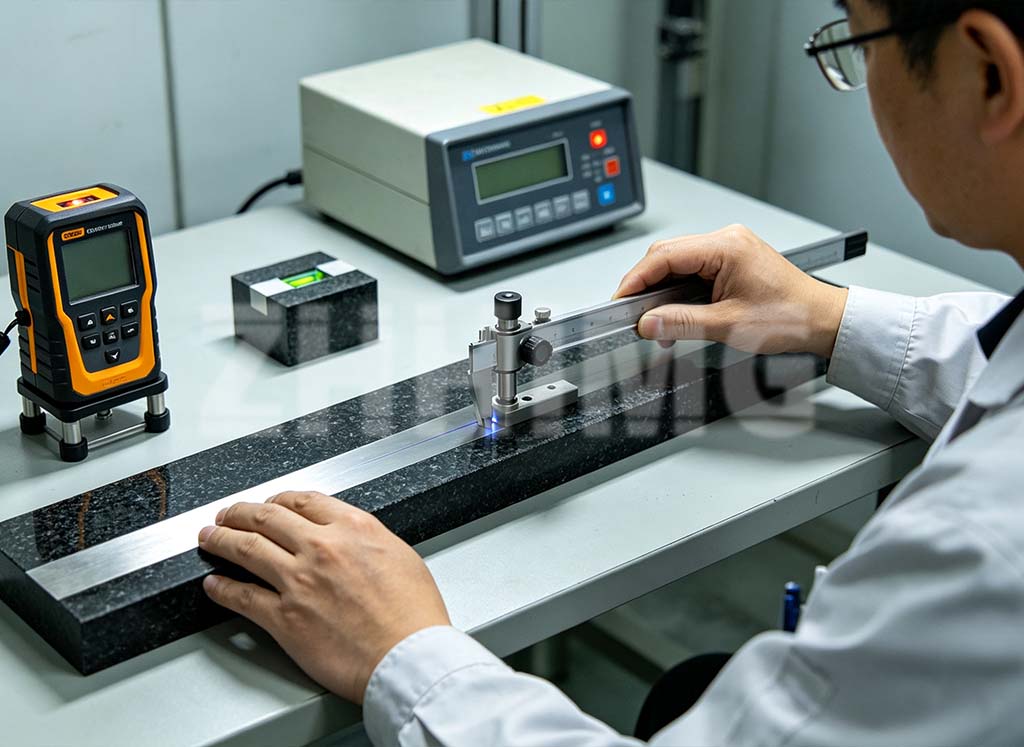
For precision applications, the supplier should also have strong measurement capability. Without reliable inspection, it is difficult to confirm whether a mineral casting base meets functional requirements.
ZHHIMG supports precision granite components, granite bases, granite surface plates and related metrology structures. For projects involving mineral casting, UHPC or hybrid designs, material selection should be confirmed based on drawing requirements, application environment and accuracy targets.
How to Choose Between Mineral Casting, Granite and Cast Iron
Use this simple checklist:
-
Does the part need a long-term reference plane?
Granite is often the first choice. -
Does the structure need high damping and complex shape?
Mineral casting or polymer concrete may be more suitable. -
Is the equipment exposed to heavy impact or cutting force?
Cast iron or reinforced steel structures may still be preferred. -
Is thermal stability critical?
Granite and mineral casting usually perform better than many metals. -
Is the base very large or custom-shaped?
Hybrid designs combining granite, mineral casting, UHPC or steel may offer the best balance. -
Is metrology traceability required?
Choose a supplier with calibrated inspection equipment and clear acceptance standards.
Common Misunderstandings About Mineral Casting
1. “Mineral casting is always better than granite.”
Not true. Mineral casting has excellent damping and design flexibility, but granite still offers superior long-term flatness stability for many metrology applications.
2. “Polymer concrete is just ordinary concrete.”
No. Precision mineral casting uses controlled aggregates, binders and manufacturing processes. It is not comparable to general construction concrete.
3. “All epoxy granite materials are the same.”
Performance depends on material formula, curing process, structural design and inspection capability. Supplier experience matters.
4. “Hybrid structures are too complex.”
When designed correctly, hybrid structures can reduce vibration, improve stability and lower total cost. The key is clear functional definition for each material zone.
Applications Where Mineral Casting and Granite Overlap
Both mineral casting and granite are commonly considered for:
- • Semiconductor equipment bases
- • Metrology frames
- • CMM support structures
- • Laser machine platforms
- • AOI and optical inspection bases
- • Precision assembly tables
- • Large inspection fixtures
- • UHPC precision structures
- • Non-metallic machine beds
- • Hybrid damping platforms
If your equipment requires both high damping and high reference accuracy, a combined solution may be more effective than a single-material design.
What to Ask Your Supplier
Before ordering mineral casting, polymer concrete or hybrid precision bases, confirm:
- • Material composition and curing process
- • Expected dimensional stability
- • Flatness and tolerance requirements
- • Post-machining capability
- • Inspection method and calibration support
- • Experience in precision industrial applications
- • Packaging, transportation and installation requirements
For granite-related components, also confirm material density, grain structure, flatness grade, workshop environment and inspection traceability.
ZHHIMG specializes in precision granite components, granite measuring tools, granite bases and granite air bearing platforms. Our manufacturing and inspection processes support high-stability requirements for metrology, semiconductor, laser and precision automation equipment.
You can learn more on our Precision Granite Components and Granite Air Bearing Platforms pages.
FAQ
Is mineral casting better than cast iron?
For vibration damping and thermal stability, mineral casting often performs better. For heavy cutting or high-impact applications, cast iron may still be more suitable.
For vibration damping and thermal stability, mineral casting often performs better. For heavy cutting or high-impact applications, cast iron may still be more suitable.
Can mineral casting replace granite surface plates?
Not usually. Granite remains the preferred material for long-term reference flatness. Mineral casting is better suited for base structures, frames and damping-critical components.
Not usually. Granite remains the preferred material for long-term reference flatness. Mineral casting is better suited for base structures, frames and damping-critical components.
What is the difference between polymer concrete and epoxy granite?
Both are resin-based composite materials. Performance depends on formula, aggregate, curing and manufacturing quality rather than name alone.
Both are resin-based composite materials. Performance depends on formula, aggregate, curing and manufacturing quality rather than name alone.
Is UHPC used in precision equipment?
Yes. UHPC can be used in large precision structures and hybrid designs, especially when combined with granite, steel or composite components.
Yes. UHPC can be used in large precision structures and hybrid designs, especially when combined with granite, steel or composite components.
Can ZHHIMG produce mineral casting or UHPC parts?
Our core strength is precision granite components, granite bases, granite surface plates and granite air bearing platforms. For mineral casting, UHPC or hybrid projects, please share your drawings and requirements so our team can evaluate feasibility and recommend the most suitable material solution.
Our core strength is precision granite components, granite bases, granite surface plates and granite air bearing platforms. For mineral casting, UHPC or hybrid projects, please share your drawings and requirements so our team can evaluate feasibility and recommend the most suitable material solution.
Post time: Nov-16-2026