
A machine base is not just a “frame.” It is the foundation of precision.
If the base deforms, vibrates, expands with temperature or releases internal stress over time, even the best sensors, motors and controllers cannot deliver stable accuracy.
That is why high-end metrology, semiconductor, PCB drilling, laser processing and precision inspection equipment manufacturers pay close attention to base material selection.
The three most common options are:
- Black granite
- Cast iron
- Steel / welded steel structure
Each has advantages. The right choice depends on application, environment, accuracy requirements and total cost of ownership.
Quick Comparison: Granite vs. Cast Iron vs. Steel
| Factor | Black Granite | Cast Iron | Steel |
|---|
| Factor | Black Granite | Cast Iron | Steel |
|---|---|---|---|
| Dimensional stability | Very high | Medium | Medium–low |
| Vibration damping | Excellent | Good | Lower |
| Thermal expansion | Low | Higher | Higher |
| Rust / corrosion risk | None | Yes | Yes |
| Internal stress release | Very low | Possible | Possible |
| Weight / density | High | High | Lower |
| Machining complexity | High | Medium | Medium |
| Long-term precision retention | Excellent | Good | Fair |
| Best for | Metrology, CMM, AOI, laser, semiconductor | General machine tools | Structural frames, welding bases |
Black Granite: Why Precision Equipment Keeps Moving to Granite
High-quality black granite — especially dense black granite with a density around 3,100 kg/m³ — is widely used in precision components, surface plates, machine bases, air bearing platforms, CMM frames and inspection fixtures.
Its main advantages are:
1. Excellent vibration damping
Granite naturally absorbs vibration better than most metals. This helps reduce measurement noise and improves surface finish in precision processes.
For equipment such as CMMs, AOI systems, optical inspection and laser machines, even small vibrations can affect repeatability.
2. Low thermal sensitivity
Black granite expands and contracts less with temperature changes compared with many metals. This makes it more stable in environments where temperature fluctuates slightly, such as inspection rooms, clean rooms and precision assembly areas.
3. No rust, no corrosion
Unlike cast iron and steel, granite does not rust. This is important for long-term maintenance, especially in humid environments or equipment that must remain stable for many years.
4. Minimal internal stress
Cast iron and welded steel can release internal stress after machining or over time, which may cause slight deformation. Granite does not have this problem when properly sourced and processed.
5. High density and structural stability
Dense black granite provides strong mass stability. This helps suppress micro-vibration and improves the rigidity of precision bases, gantries and measurement platforms.
Note: Not all black granite is the same. Material quality, grain structure, density, flatness processing and environmental control during manufacturing all affect final performance.
You can learn more about material selection and processing on our Precision Granite Components page.
Cast Iron: Still Useful, but Not Always Ideal for Ultra-Precision
Cast iron has been used in machine tools for more than a century. It is strong, relatively easy to cast into complex shapes and offers decent damping performance.
However, cast iron also has limitations:
- It can rust if not properly protected.
- It may release internal stress after casting or machining.
- It is more sensitive to temperature changes than granite.
- Surface accuracy may drift over long periods if the casting structure is not fully stabilized.
Cast iron is still a good choice for general machine tools, heavy cutting equipment and applications where extreme metrology-level stability is not required.
But for nanometer-level or micron-level precision, granite usually provides better long-term reliability.
Steel Structures: Strong and Flexible, but Less Stable for Metrology
Steel bases are common in industrial frames, welding platforms, automation structures and some CNC equipment. They are easy to weld, modify and reinforce.
But steel has two weaknesses in high-precision applications:
- Higher thermal expansion than granite.
- Lower natural damping than granite and cast iron.
Welded steel structures may also deform over time due to stress release, especially if they are not properly heat-treated or aged.
Steel is often suitable when structural strength, flexibility and cost are more important than ultra-high flatness or long-term metrology stability.
When Should You Choose Granite?
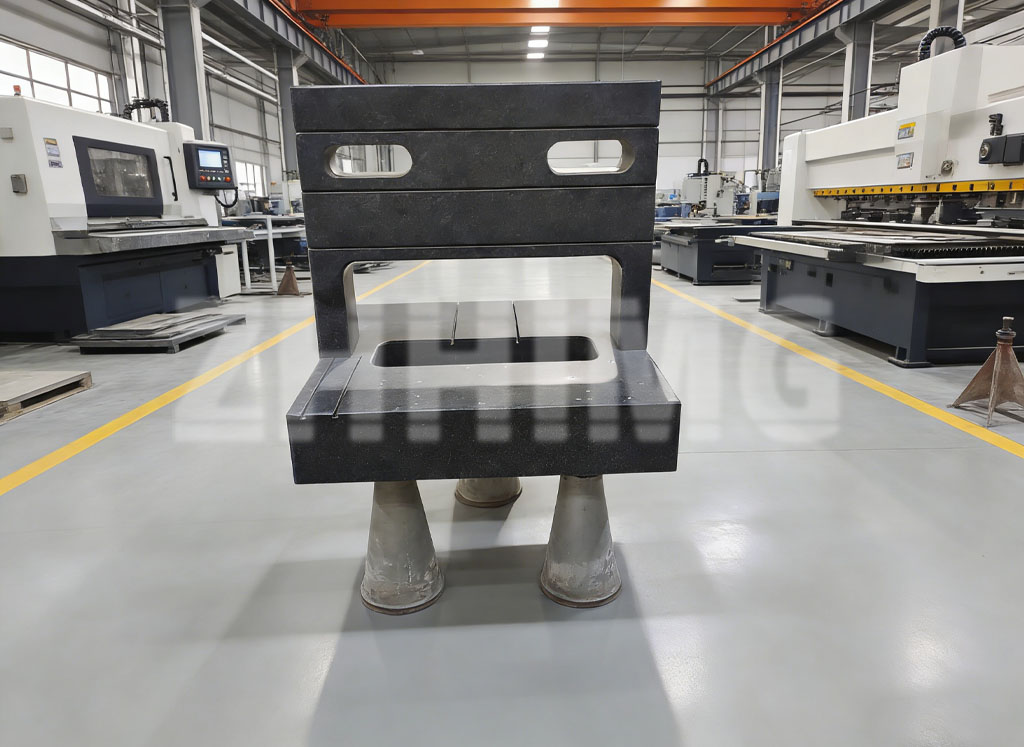
Granite machine bases and granite components are usually the better choice if your equipment requires:
- Long-term flatness stability
- High vibration resistance
- Low thermal deformation
- Corrosion-free surfaces
- Stable performance in inspection or clean-room environments
- High repeatability for measurement, alignment or positioning
Typical applications include:
- CMM frames and bases
- Semiconductor equipment bases
- AOI and optical inspection systems
- Laser cutting, laser drilling and ultrafast laser machines
- PCB drilling machines
- Metrology and calibration equipment
- XY tables and linear motor platforms
- Precision assembly fixtures
If your product belongs to these categories, granite deserves serious consideration.
When Cast Iron or Steel May Still Be Better
Granite is not always the automatic answer. Cast iron or steel may be more suitable when:
- The equipment faces strong mechanical impact.
- The structure requires complex internal cavities that are easier to cast.
- The budget is limited and metrology-level stability is not required.
- The base must be frequently modified or welded.
- The environment allows regular anti-rust maintenance.
A good supplier should help you choose the right material based on function, not just promote one solution for every case.
How to Judge Granite Quality
If you are evaluating granite components or granite machine bases, check these points:
- Material density and grain structure
- Flatness tolerance and stability
- Processing capability for large or complex parts
- Temperature-controlled manufacturing environment
- Measurement equipment and calibration traceability
- Experience in precision metrology applications
Not all granite suppliers use the same material grade, processing standards or measurement methods. For precision applications, material traceability and inspection capability matter as much as the final drawing dimensions.
ZHHIMG uses high-density black granite with stable physical properties and processes granite components, granite bases, granite surface plates and granite air bearing platforms in temperature-controlled workshops. Our inspection process supports traceable calibration for critical precision requirements.
See our Granite Surface Plates and Granite Air Bearing Platforms for more details.
Final Recommendation
| Application focus | Recommended base material |
|---|
| Application focus | Recommended base material |
|---|---|
| Metrology, CMM, calibration | Black granite |
| Semiconductor / AOI / optical inspection | Black granite |
| Laser / ultrafast laser equipment | Black granite |
| General machine tools | Cast iron |
| Heavy industrial frames | Steel or cast iron |
| Cost-sensitive structures | Steel or cast iron |
| Ultra-precision, long-term stability | Black granite |
If your equipment must stay accurate year after year — not just on the day it leaves the factory — granite is often the safer long-term investment.
FAQ
Is granite better than cast iron for precision machines?
For metrology, semiconductor, laser and inspection equipment, granite usually offers better long-term stability, lower thermal sensitivity and better vibration damping.
For metrology, semiconductor, laser and inspection equipment, granite usually offers better long-term stability, lower thermal sensitivity and better vibration damping.
Does granite rust?
No. Black granite does not rust, which makes it easier to maintain than cast iron or steel in many industrial environments.
No. Black granite does not rust, which makes it easier to maintain than cast iron or steel in many industrial environments.
Is granite heavier than steel?
High-density black granite can reach around 3,100 kg/m³, so it provides strong mass stability. Whether it is “heavier” than a steel structure depends on design, wall thickness and component geometry.
High-density black granite can reach around 3,100 kg/m³, so it provides strong mass stability. Whether it is “heavier” than a steel structure depends on design, wall thickness and component geometry.
Can granite be used for large machine bases?
Yes. With proper processing equipment and temperature-controlled manufacturing, granite can be used for large bases, gantries, inspection platforms and assembly fixtures.
Yes. With proper processing equipment and temperature-controlled manufacturing, granite can be used for large bases, gantries, inspection platforms and assembly fixtures.
How do I choose a granite supplier?
Look at material quality, processing capacity, flatness control, measurement equipment, calibration traceability and experience in precision industries.
Look at material quality, processing capacity, flatness control, measurement equipment, calibration traceability and experience in precision industries.
Post time: Nov-16-2026