
When designing high-precision equipment—such as semiconductor lithography machines, laser cutters, or medical CT scanners—the choice of structural material is critical. While traditional metals like cast iron and steel have been industry standards for decades, Mineral Casting (Polymer Concrete) and Precision Granite are rapidly becoming the preferred choice for next-generation machinery.
1. Vibration Dampening: The Key to Accuracy
The most significant advantage of mineral casting and granite is their ability to dampen vibrations.
The most significant advantage of mineral casting and granite is their ability to dampen vibrations.
- Cast Iron: Offers moderate damping but can resonate at certain frequencies.
- Mineral Casting/Granite: Provides 6 to 10 times better damping capacity than cast iron. This ensures that external vibrations do not affect the machining or measurement process, resulting in higher surface quality and accuracy.
2. Thermal Stability
In environments where temperature fluctuates, material expansion can ruin precision. Granite and mineral casting have lower thermal conductivity compared to metals, meaning they are less affected by rapid temperature changes. This thermal inertia is crucial for maintaining tight tolerances in metrology applications.
In environments where temperature fluctuates, material expansion can ruin precision. Granite and mineral casting have lower thermal conductivity compared to metals, meaning they are less affected by rapid temperature changes. This thermal inertia is crucial for maintaining tight tolerances in metrology applications.
3. Design Flexibility
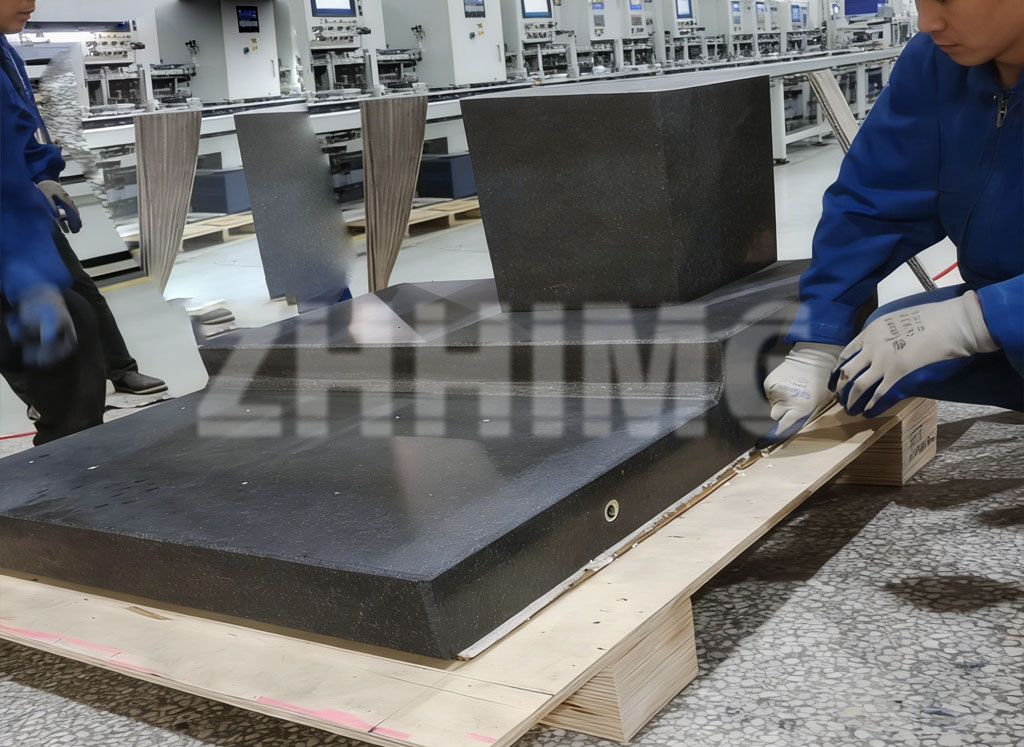
Mineral casting allows for complex geometries that would be difficult or expensive to achieve with metal casting. Integrated features like cable ducts, cooling channels, and mounting points can be cast directly into the base, reducing assembly time and costs.
Mineral casting allows for complex geometries that would be difficult or expensive to achieve with metal casting. Integrated features like cable ducts, cooling channels, and mounting points can be cast directly into the base, reducing assembly time and costs.
Conclusion
For applications demanding the highest levels of static and dynamic accuracy, switching from traditional metals to mineral casting or precision granite is a strategic investment. At ZHHIMG, we help engineers select the optimal material for their specific performance requirements.
Post time: May-27-2026