
I. Breaking Traditional Constraints: The Evolution from Single Flat Plates to Multi-Dimensional Functional Integration
Traditional standardized stone or metal plates often only provide simple flat support, appearing inadequate when facing intricate optical matrices.
-
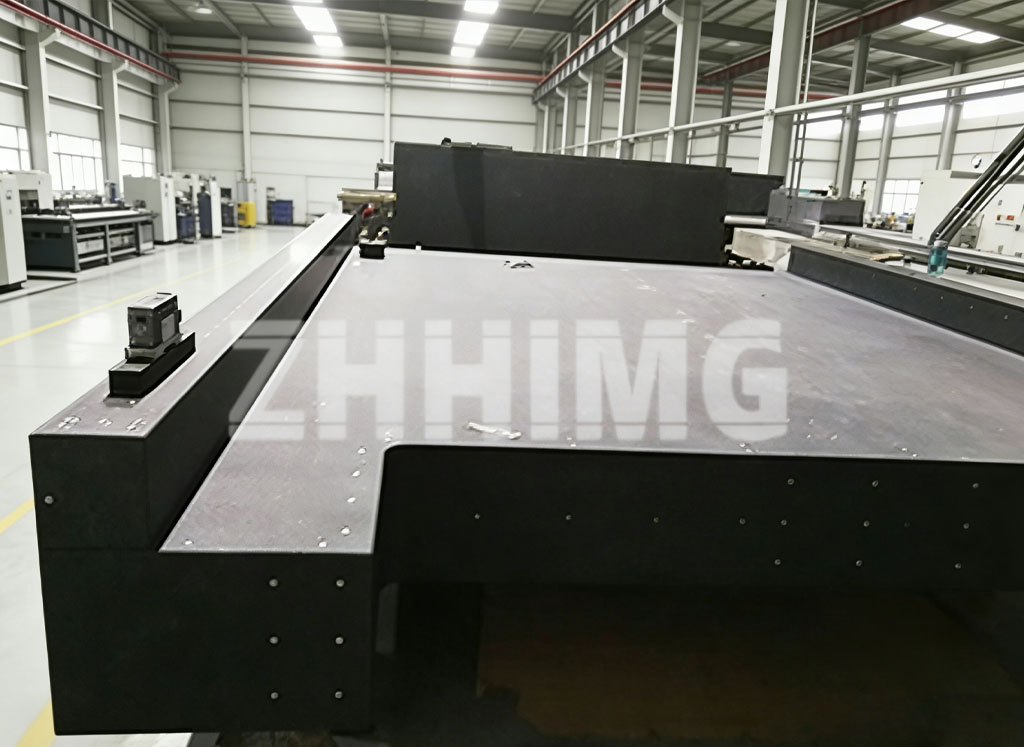
Liberation of Spatial Layout: Modern optical systems integrate a large number of high-precision optical components and sensors. Non-standard opening and slotting technologies allow engineers to precisely reserve light-passing holes, wiring slots, air-bearing mounting positions, and embedded threaded fixing holes at specific locations on the base.
-
Elimination of Secondary Stress Damage: Excellent high-precision machining capabilities ensure that all non-standard hole slots are formed in a single clamping or high-precision CNC milling process, avoiding internal stress release and flat warping caused by subsequent on-site secondary modifications.
II. Extreme Process Challenges: High-Precision Non-Standard Carving of Large-Format Materials
Achieving complex non-standard openings and slots on specialized high-density granite with extremely high hardness and dense crystal structures poses a near-rigorous test for processing equipment and technology.
-
Synergy of Ultra-Large CNC and Grinding: Taking ZHHIMG®’s cutting-edge manufacturing capabilities as an example, this requires relying on ultra-large CNC processing equipment with a single-piece processing length of up to 20 meters and a width of 4000mm, ensuring that on macroscopic substrates weighing tens or even hundreds of tons, the straightness and positional tolerance of non-standard slots reach the micron or even nanoscale.
-
Perfect Fusion of Experience and Tactile Sense: In the edge transition and micron-level finishing links of complex irregular hole slots, it relies on ZHHIMG®’s grinding masters with decades of manual experience to meticulously polish the details. Through the exquisite coordination of naked eye and touch sense, they push the boundary of mechanical processing and the fit with the optical system to the extreme.
III. Linking the Complete System: Spatial Alignment Meeting Rigorous International Standards
The non-standard opening and slotting of an optical bench base is by no means random geometric cutting, but must strictly serve the spatial coaxiality and dynamic balance of the complete optical system.
-
Seamless Compatibility with Multi-National Standards: Whether following German DIN standards, American ASME standards, or international ISO specifications, all non-standard interface dimensions, hole depths, and tolerances of ZHHIMG® must be precisely traceable.
-
Precision Assembly in Constant-Temperature Environments: The processed non-standard irregular bases typically need to enter ZHHIMG®’s constant-temperature, constant-humidity, and dust-free cleanrooms equipped with ultra-hard concrete anti-vibration trenches and silent cranes, where they undergo modular integrated assembly with the air-bearing systems, linear motors, and high-precision optical lens mounts of the complete optical system, ensuring that the system remains rock-solid under complex working conditions.
Conclusion
In summary, optical bench bases supporting non-standard openings and slots are not only a deep physical adaptation to complete optical systems, but also a comprehensive grand test of modern ultra-precision manufacturing strength. Upholding the quality policy that “the precision business can’t be too demanding,” ZHHIMG Group (ZHHIMG®) deeply chains high-density native materials, ultra-large CNC equipment, exquisite manual nanoscale finishing, and rigorous international metrology standards together, allowing customized opening and slotting bases to become the silent backbone supporting the complex matrices of various cutting-edge optical and semiconductor equipment.
Post time: Sep-24-2026