
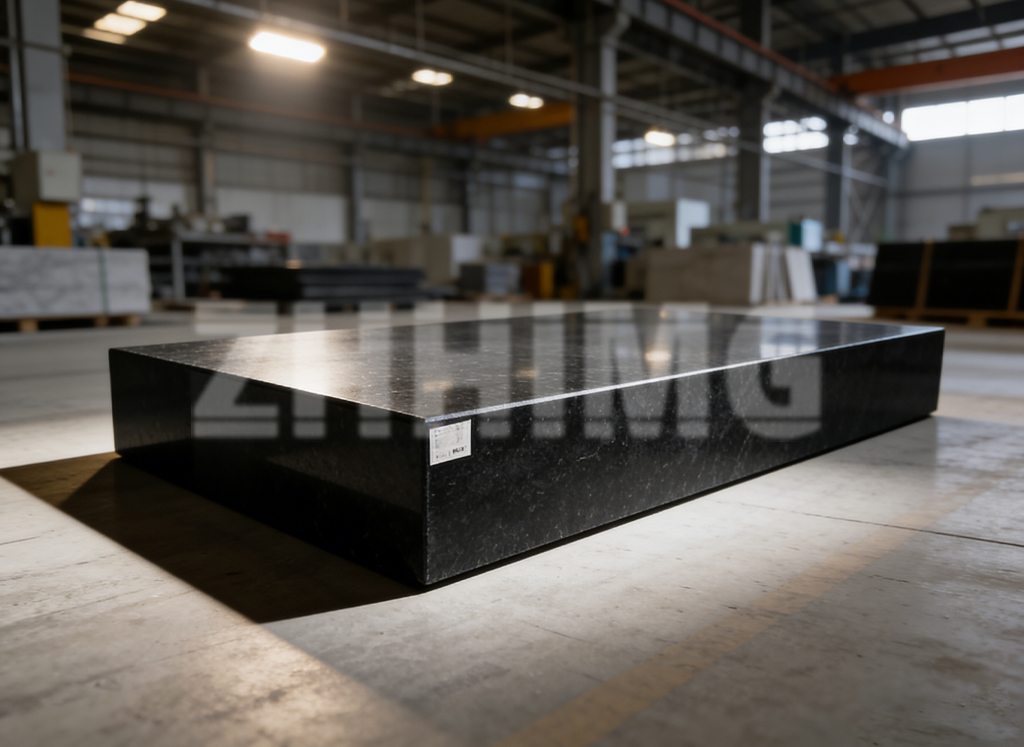
Walk into any precision machining facility, metrology lab, or quality control department, and you’ll spot it almost immediately—a massive slab of dark stone sitting on a workbench or mounted on a stand, its surface gleaming under the lights. That unassuming piece of granite is one of the most critical tools in manufacturing: the surface plate.
So what exactly is a granite surface plate? In simple terms, it’s a precision reference plane that serves as the primary horizontal datum for measurement, layout, and tool setup operations. One of its main surfaces is machined to an extremely flat condition, making it the baseline against which virtually every other measurement in a manufacturing environment gets verified. Surface plates often come equipped with mounting points, allowing them to function as structural components in coordinate measuring machines and other precision equipment.
The reason manufacturers choose granite over other materials comes down to some remarkable physical properties that have made this natural material irreplaceable in precision metrology for over a century.
Why Granite? The Core Advantages
The story of granite surface plates begins with the material itself. Unlike cast iron, the surface plate material that dominated early manufacturing, granite offers superior stability and longevity. Here’s what makes it special:
The thermal stability is perhaps the most important advantage. Granite’s linear thermal expansion coefficient measures just 4.61×10⁻⁶/°C—roughly 10 times more stable than steel. In environments where temperature fluctuations are unavoidable, this minimal expansion rate means the plate maintains its dimensional accuracy where other materials would expand and contract, introducing measurement errors.
The mechanical properties reinforce this stability. With a density between 2970-3070 kg/m³ and compressive strength of 245-254 N/mm², granite handles heavy workloads without deforming. The Shore hardness of HS70 or higher ensures the surface resists wear and maintains flatness even under substantial loads.
Granite also resists corrosion naturally. It won’t rust like steel, tolerates moisture without degradation, and stands up to most chemical exposure. Water absorption below 0.13% means the material doesn’t swell or warp with humidity changes—a common problem with wood and even some engineered materials.
One practical advantage that often surprises people: damage to a granite surface plate doesn’t necessarily compromise its accuracy. The material lacks internal stress points, so chips or edge damage don’t propagate. If one area becomes unusable, other portions of the surface can still deliver the flatness you need.
Material Composition and Technical Properties
The granite used in precision surface plates isn’t your average countertop material. It’s primarily composed of diabase and plagioclase feldspar, with smaller amounts of olivine, biotite, and magnetite woven throughout the crystalline structure.
These minerals combine to create a material with exceptional characteristics. The quartz content provides hardness and wear resistance. The interlocking crystal structure delivers strength without brittleness. Most importantly, the slow formation process over millions of years means the material is naturally stress-free—no hidden tensions that could cause warping or dimensional drift over time.
The manufacturing process takes advantage of these natural properties. After cutting and rough shaping, the granite undergoes precision grinding and lapping to achieve the final flat surface. This isn’t a quick operation; achieving Grade 000 tolerances on a large surface plate can take weeks of careful material removal and surface verification.
Understanding Precision Grades and Flatness Tolerances
This is where buyers often get confused, so let me break it down clearly.
Surface plate accuracy is classified into grades, with each level specifying allowable flatness deviation. The formula used in most standards—consistent with Chinese standard JB/T 7975-1999—calculates tolerance based on the plate’s diagonal length:
- Grade 000: 1×(1+d/1000) μm, where d equals the diagonal length in millimeters, measured at 20±2°C
- Grade 00: 2×(1+d/1000) μm
- Grade 0: 4×(1+d/1000) μm
- Grade 1: 8×(1+d/1000) μm
To put this in practical terms, a 1000mm diagonal Grade 0 plate would have a tolerance of 8μm—roughly one-tenth the thickness of a human hair. Grade 000 plates achieve tolerances under 2μm, placing them in the realm of ultra-precision metrology.
Grade selection depends entirely on your application. Grade 000 plates belong in metrology laboratories and calibration rooms where traceability to national standards matters. Grade 0 plates are the workhorses of manufacturing floors, delivering adequate precision for most inspection tasks without the cost and maintenance burden of higher grades. Grade 1 plates handle rough layout work and tool setup where ultimate precision isn’t critical.
Standard Sizes and Customization Options
Surface plates come in a wide range of dimensions to fit different applications. Standard sizes typically span from compact 200×200mm plates for small tool rooms up to large-format 3000×5000mm plates for production measurement lines. Thickness varies from 60mm for lighter inspection work to 400mm for heavy industrial applications where rigidity matters most.
Beyond basic dimensions, manufacturers offer various surface configurations:
Plain finished surfaces work for general measurement and layout work. Threaded mounting holes allow attachment of accessories like magnetic stands, clamps, or precision fixtures. T-slot patterns provide mounting points for custom setups. Leveling stands with adjustable feet help achieve proper installation on uneven floors.
Larger custom configurations are available for specialized applications. If your requirements fall outside standard ranges, most manufacturers can produce plates in non-standard sizes, thicknesses, or with custom hole patterns to match your specific equipment and workflows.
Applications Across Industries
The versatility of granite surface plates shows up in their widespread use across precision manufacturing.
In precision measurement, they serve as the reference plane for inspecting instruments, gauges, and machined components. Quality control departments rely on surface plates for dimensional verification of parts ranging from medical implants to precision gears.
For tool setup, surface plates provide the stable reference needed for setting height gauges, dial indicators, and other measuring instruments. Machinists use them to establish reference heights when setting up CNC machines or hand tools.
In equipment manufacturing, surface plates function as structural components in coordinate measuring machines, optical assembly equipment, and other precision instruments where dimensional stability directly affects measurement accuracy.
Industry applications span aerospace component manufacturing, semiconductor fabrication facilities, automotive precision parts production, and general precision engineering. Any operation where tolerances matter needs a reliable reference plane, and granite delivers that foundation.
Selection Criteria: Making the Right Choice
Choosing the right surface plate involves balancing several factors:
Accuracy requirements drive grade selection. Match the plate grade to your actual measurement needs. Paying for Grade 000 accuracy when your processes only require Grade 0 means unnecessary expense and higher maintenance requirements.
Size needs depend on your largest workpiece and working clearances. The plate should comfortably accommodate your workpieces with room to maneuver measurement tools without reaching over edges.
Environmental conditions affect long-term stability. If your facility lacks climate control, the inherent thermal stability of granite becomes even more valuable, but you may need to account for measurement temperature variations.
Accessories matter for practical usability. Consider whether you need leveling stands, protective covers, carrying handles for portable plates, or custom fixtures for your specific applications.
Certification requirements vary by industry. Some applications require traceable calibration certificates from accredited laboratories. Make sure your supplier can provide the documentation your quality system demands.
Maintenance and Calibration: Protecting Your Investment
A granite surface plate represents a significant investment, and proper maintenance ensures it delivers decades of reliable service.
Regular calibration is essential for maintaining confidence in your measurements. Grade 00 plates typically require recalibration every six months, while Grade 0 plates can go twelve months between calibrations. Your quality requirements and usage frequency may dictate shorter intervals.
Daily care involves keeping the working surface clean and protected. Use only clean, soft materials for wiping. Never place workpieces with burrs or sharp edges directly on the surface. Avoid contact with acidic or alkaline substances that could attack the stone over time.
Proper storage extends plate life significantly. Keep the surface covered when not in use to prevent dust accumulation and accidental damage. Maintain environmental conditions near 20±2°C with humidity between 40-60% when possible.
Handling precautions prevent damage during movement. Even though granite is hard, sharp impacts from dropped tools or rough handling can chip edges or create stress points. Use appropriate lifting techniques and equipment for heavy plates.
Industry Standards and Specifications
Several international standards govern surface plate manufacturing and testing:
The German standard DIN 876 provides specifications widely recognized in European manufacturing. American practice follows ASME B89.3.7-2013, which replaced the earlier Federal Specification GGG-P-463C. Chinese manufacturers reference GB/T 25994-2010 for domestic production and export. International practice often follows ISO 5459:2015 guidelines. Calibration laboratories in China use JJG 117-2013 as the verification procedure.
Understanding which standard applies to your industry helps ensure compliance and compatibility with international trade requirements.
Conclusion: The Reliable Foundation
Despite advances in laser interferometry, electronic measurement systems, and coordinate measuring technology, the simple granite surface plate remains essential to precision manufacturing. Its combination of thermal stability, mechanical strength, corrosion resistance, and long-term accuracy retention makes it irreplaceable for many applications.
The key to successful selection lies in matching the plate grade and configuration to your actual requirements. An over-specced plate adds cost without benefit, while an undersized plate compromises measurement capability. Take time to assess your needs honestly, and you’ll end up with a tool that serves reliably for decades.
Whether you’re setting up a new quality lab, equipping a machine shop, or replacing worn equipment, understanding what a granite surface plate offers—and what specifications actually matter for your applications—helps you make informed purchasing decisions that support your precision measurement needs.
The surface plate has earned its place as a foundational tool in manufacturing not through complexity, but through reliability. When you need a reference plane you can trust, granite delivers—tonight, next year, and decades from now.
Post time: Apr-15-2026