
In cleanrooms for semiconductor, optical inspection and precision component assembly, stringent controls are enforced over particulate contamination, vibration interference and temperature & humidity fluctuations. Granite inspection tables serve as core metrology reference platforms in these spaces. During project selection, many buyers only focus on the flatness of the tabletop itself while overlooking unique constraints brought by clean environments. A cleanroom is not merely a well-swept room. Dust particles, airflow turbulence, material outgassing and mounting structures interact with granite tabletops. Improper selection or installation will not only compromise cleanroom classification but also gradually degrade table accuracy and reduce product yield. To enable granite inspection tables to deliver stable nano-level reference performance in cleanrooms, special requirements covering material cleanliness, surface treatment, dust-proof structural design, environmental compatibility and operation & maintenance management must be satisfied.
First are material and surface treatment requirements compatible with cleanroom conditions. Ordinary granite slabs feature tiny internal pores that trap mineral dust and debris. These particles may be released continuously under airflow disturbance, contaminating sensitive workpieces such as wafers and optical elements. Granite inspection tables deployed in cleanrooms are made of dense black granite blanks with ultra-low porosity. They undergo special sealing treatment to close internal micro-pores and suppress persistent particle emission. The tabletop grinding process must leave no residual abrasive grains, and the finished surface shall be free of pits that accumulate dust. Clean, low-outgassing protective finishes are adopted instead of VOC-releasing paints or resins to avoid organic contamination of the clean space. Smooth chamfers are applied to all edges and corners to reduce dust accumulation and facilitate routine wiping.
Second are dust-proof and micro-vibration resistant designs for supports and bases. Cleanrooms usually have weak vibration generated by circulating air conditioning airflow, conveying equipment and automated platforms. Thread gaps on standard leveling feet tend to collect dust and shed fine particles. Support assemblies for cleanroom granite tables are made of low particle-shedding metal materials, with fully enclosed dust-proof structures and protective sleeves fitted over exposed threads. The whole support system serves two purposes: fine leveling to maintain the reference plane and effective vibration isolation to block micro-vibration from fans and robotic handlers. Cleanroom floors are generally epoxy anti-static floors, which cannot accommodate heavy vibration isolation trenches like those in conventional metrology rooms. Vibration pads are therefore used on support systems to dampen vibration transfer and prevent accuracy drift caused by vibration coupling. The area beneath the table frame shall remain accessible for cleaning without dead corners, to allow wiping with cleanroom mops and vacuum cleaners.
Third are controls over temperature & humidity stability and thermal deformation. Although cleanrooms are equipped with constant temperature systems, directional air supply from air conditioners may blow directly onto granite surfaces and create localized temperature differences. Granite conducts heat slowly, and uneven local heating will trigger minor thermal distortion that ruins the reference plane. Granite inspection tables must be positioned away from air outlets and direct laminar airflow. The material’s inherent excellent thermal stability is leveraged to limit dimensional variation within the cleanroom’s temperature and humidity range. Humidity must also stay within a proper window. Excess humidity causes corrosion of metal support components, and rust particles become a major contamination source. Low humidity leads to static electricity that attracts dust onto tabletops and workpieces. For granite air-bearing platforms, compressed air supplied to air channels requires thorough filtration to stop dust from blowing onto the tabletop.
Fourth are clean control requirements for assembly and auxiliary components. Granite inspection tables in cleanrooms are often used to assemble granite bases, air-bearing modules and optical inspection mechanisms, with linear motor stages and XY motion systems mounted on top. All hardware and fasteners must be cleaned, degreased and packed in dust-free packaging outside the cleanroom before entry. Cartons and ordinary plastic bags are prohibited inside clean areas. Assembly work on the tabletop must use cleanroom tools. Operators wear cleanroom suits and gloves to prevent contamination from skin flakes and grease. Holes for locating pins and threaded inserts machined into granite must be fully cleared of processing debris and sealed to trap embedded contaminants. Air channels on air-bearing granite platforms are flushed repeatedly after machining to remove all residual particles before on-site installation. 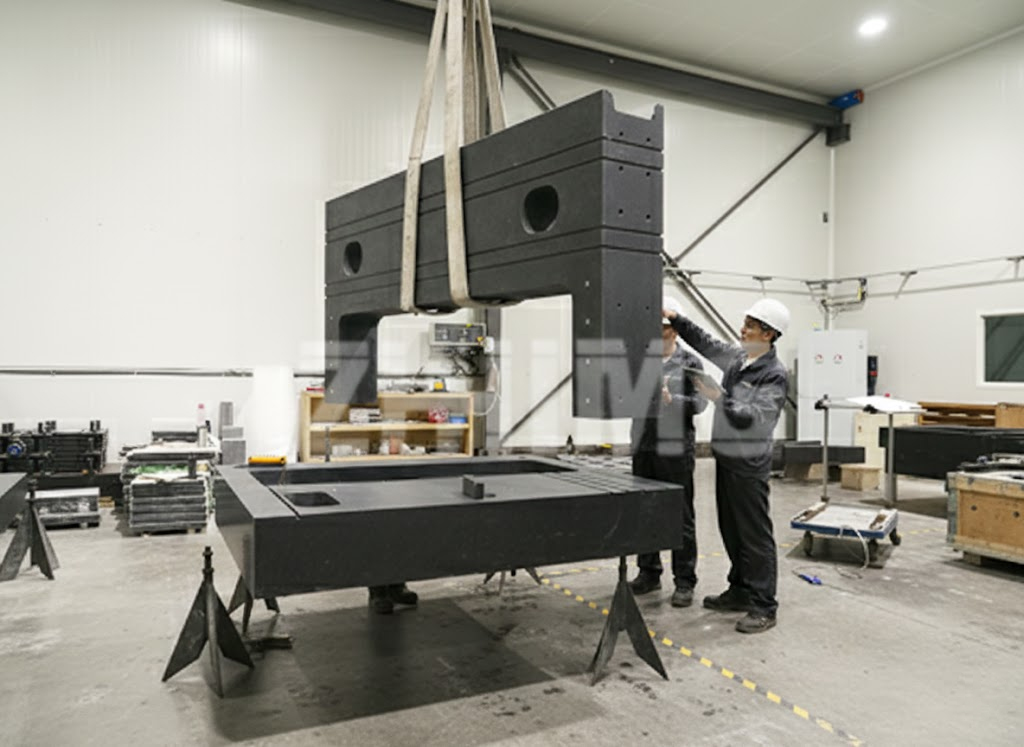
Fifth are clean operation and maintenance protocols. Ordinary metrology labs may use common cotton wipes and standard cleaners, but only designated dust-free wipes and neutral particle-free detergents can be used in cleanrooms. Hard scraping tools are forbidden, as scratches on precision ground surfaces will permanently trap contaminants. Gauges and probes used for accuracy checks must be de-dusted before contact with the tabletop. Periodic accuracy calibration is scheduled during low-production periods to minimize particle disturbance from personnel movement. Granite tabletops should not be moved casually inside cleanrooms, as friction during relocation generates large quantities of particles and downgrades cleanroom classification. Recurring accuracy verification is carried out with laser interferometers and electronic levels to maintain stable reference performance. Maintenance staff regularly inspect support structures for particle shedding and seal integrity. Damaged sealing layers are repaired promptly to stop continuous particle release from stone pores.
In summary, for granite inspection tables used in cleanrooms, precision is merely the entry requirement. Clean compatibility, particulate control, resistance to airflow disturbance and low outgassing are the core special requirements. Tabletop material, support structures, installation schemes and maintenance workflows must all adapt to cleanroom environments. Only in this way can both cleanroom classification and nano / micron measurement reference stability be maintained, supporting stable operation of precision inspection processes for semiconductors, optics and new energy industries.
Post time: Sep-23-2026