
When a high-precision machine’s linear motor achieves nanometer-level positioning, when its grating encoder resolution breaks below 0.1 micrometers, and when a laser interferometer compensates for every axis error in real time—a counterintuitive truth remains: what ultimately determines how precise that machine can be is often not these expensive motion components, but the silent base beneath them.
In recent years, from semiconductor wafer inspection to femtosecond laser machining, from coordinate measuring to AOI optical sorting, virtually all high-precision equipment has converged on granite as the standard base material. This is not industry bandwagoning; it is a rational choice forged around the “precision bottleneck.”
1. The Final Short Board in the Precision Race
Over the past two decades, the core components of high-precision machines have undergone iteration after iteration: linear motors have replaced ball screws, air-bearing guideways have replaced contact guideways, and grating encoders have evolved from micrometer to nanometer resolution. Yet all of these components mount on the base—and if the base itself deforms by micrometers under temperature fluctuations, or creeps slowly under long-term loading, the precision of every upstream component is “eaten away.”
Engineers have come to realize that the base is not a passive support part, but the “reference zero component” of the entire machine’s precision system. In the search for a reference-zero material, cast iron, marble, mineral casting, and granite have all had their turn. The one that has ultimately prevailed in the high-precision arena is granite.
2. Thermal Stability: The “Anchor” Against Temperature Fluctuations
In a precision workshop, every 1°C change in temperature causes a one-meter cast-iron part to expand by approximately 11 micrometers, while granite’s coefficient of thermal expansion is only half that, or even lower. For a machine with a two-meter travel, this means that under the same thermal drift conditions, the dimensional change of a granite base is an order of magnitude smaller than that of cast iron.
This is one of the core reasons ZHHIMG insists on using black granite with a density of approximately 3100 kg/m³. This stone is not only dense but also uniformly grained, with highly isotropic thermal expansion that avoids localized stress deformation. Combined with the processing environment of ZHHIMG’s 10,000 m² constant-temperature, constant-humidity workshop—where temperature fluctuations are tightly controlled—every base leaves the factory already in a thermally stable state matching the customer’s precision workshop, ready for use on-site without a lengthy temperature-equilibration period.
3. Long-Term Precision Retention: The Secret of Staying Accurate for a Decade
Buyers often focus only on as-built precision, overlooking “precision after ten years.” Cast-iron bases rust and release internal stress; marble bases, being softer, develop indentations and creep under long-term loading; welded structural parts carry risks of weld fatigue and stress deformation.
Granite has virtually none of these problems. Its mineral crystal structure has already undergone millions of years of stress relief during geological formation, leaving extremely low residual internal stress; its high Mohs hardness means it does not indent under normal use; and it does not rust, age, or suffer attack from oils and coolants. Many ZHHIMG customers report that granite bases in service for over a decade still measure flatness within their original factory tolerances—a “gets-more-stable-with-time” characteristic that other materials struggle to match. 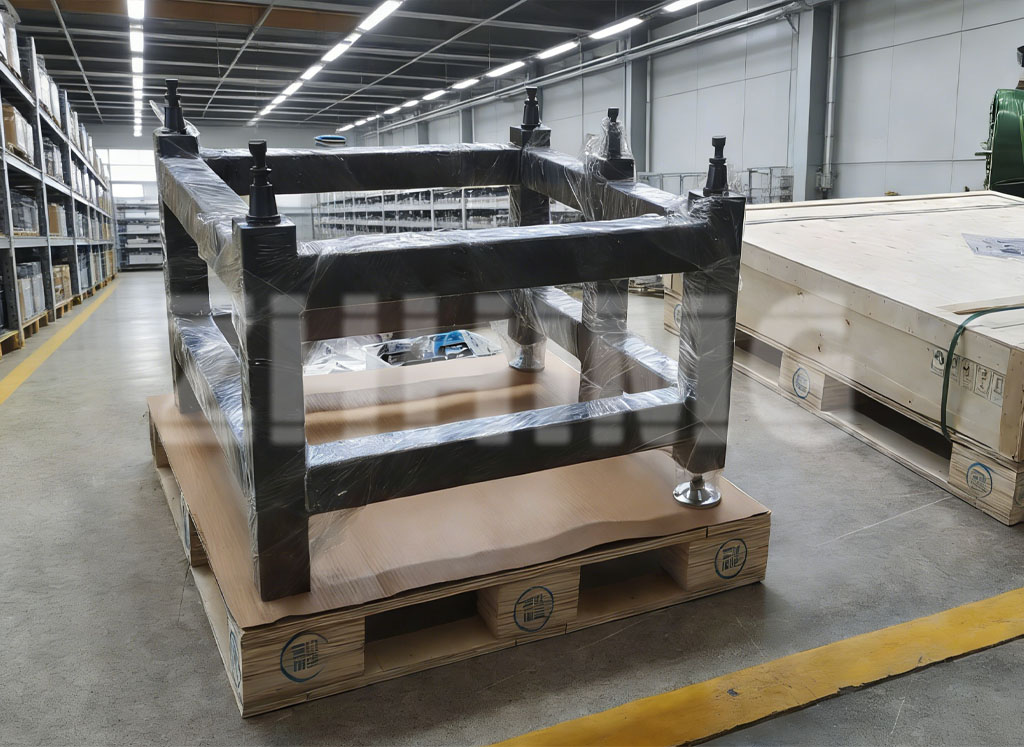
4. Non-Magnetism and Corrosion Resistance: Must-Haves for Semiconductor and Optical Applications
In semiconductor inspection, electron-beam machining, and magnetically sensitive measurement, the non-magnetic nature of the base material is a hard requirement. Even after demagnetization, cast-iron bases can retain weak magnetic fields that interfere with electron-beam paths or magnetic-scale readings. Granite, as a non-metallic mineral, is inherently non-magnetic, eliminating this risk at the source.
At the same time, granite resists acids and alkalis, is unaffected by chemicals commonly found in semiconductor fabs, and does not produce rust particles that contaminate cleanrooms in humid environments—unlike metals. This makes it the material of choice for precision component assembly in simulated semiconductor-fab environments, for which ZHHIMG has built a dedicated constant-temperature, constant-humidity cleanroom.
5. The Upper Limit of Machining Precision: Hand Lapping to the Nanometer Level
Even the best material requires machining capability to deliver. Granite’s high hardness means ordinary machine tools struggle to achieve ultra-high flatness. ZHHIMG’s solution is a combined process of “large grinding machine roughing + artisan hand finishing.” Four Taiwan Nante ultra-large grinding machines—each valued at over USD 500,000—handle efficient rough grinding of platforms up to 6,000 mm, while the final nanometer-level flatness is achieved by hand-lapping specialists with over 30 years of experience, whose tactile control can regulate material removal per stroke to the micrometer level—earning them the nickname “walking electronic levels” from customers.
Before shipment, every base undergoes full inspection with equipment including a German Mahr dial indicator (0.5 μm), a Swiss WYLER electronic level, and a British Renishaw laser interferometer. All data is traceable to the national metrology institute, and reports can be issued in accordance with DIN, ASME, JIS, BS, and other international standards.
6. From “Optional” to “Standard”: The Formation of an Industry Consensus
Today, the granite base has become standard equipment on high-precision machines—not through the choice of any single vendor, but through a consensus formed across the industry after repeated trial and error. Global precision manufacturers including GE, Samsung, Bosch, Flex (Israel), 5th Axis (U.S.), Akribis (Singapore), Schunk (Germany), THK, HIWIN, and MISUMI (Japan) build their high-precision platforms on granite bases, as do national metrology institutes in Germany, the UK, France, and Russia, and research institutions such as the National University of Singapore and Nanyang Technological University.
As the only company in the industry simultaneously holding ISO 9001, ISO 45001, ISO 14001, and CE certifications, and with more than 20 international trademarks and patents registered in the EU, the U.S., Southeast Asia, and other regions, ZHHIMG is both a beneficiary and a driver of this consensus—using 200,000 m² of production capacity, 20-meter monolithic machining capability, and a monthly output of 20,000 precision bed sets to transform the granite base from a high-end luxury into a standard configuration for high-precision equipment.
Why are granite bases standard on high-precision machines? The answer lies not in a single parameter, but in the combined advantages of thermal stability, long-term retention, non-magnetism, vibration damping, and machinability to the nanometer level. When all these advantages converge in one material, “standard” becomes the only rational choice.
Post time: Aug-19-2026