
The semiconductor industry demands unprecedented levels of precision, where tolerances are measured in nanometers and environmental stability determines yield rates. In this environment, granite machine bases have become the foundation of choice for wafer inspection systems, lithography equipment, and precision motion platforms. This article explores why high-density black granite, with its exceptional thermal stability and vibration damping characteristics, has become indispensable for semiconductor fabrication facilities seeking to achieve breakthrough precision in wafer inspection and manufacturing processes.
High-density black granite with 3100kg/m³ density provides the thermal stability (<0.001mm/°C) and vibration damping essential for semiconductor equipment operating at nanometer-level tolerances. The material’s inherent chemical inertness and particle-free surface make it ideal for cleanroom environments where contamination control is paramount. Semiconductor fabs increasingly specify granite components for wafer inspection platforms, stage systems, and metrology equipment where material outgassing and thermal drift cannot be tolerated.
Understanding Thermal Stability Requirements in Semiconductor Fabrication
The Impact of Thermal Expansion on Measurement Accuracy
Semiconductor fabrication occurs within In a strictly controlled temperature environment, where temperature variations directly impact overlay accuracy and feature placement. Modern process nodes require alignment accuracy below 1 nanometer, making thermal expansion a critical consideration for any structural material.
High-density black granite exhibits thermal expansion coefficients below 0.001mm/°C, approximately 12 times lower than steel and dramatically superior to most engineering materials. This characteristic means that even significant ambient temperature fluctuations produce negligible dimensional changes in granite-supported equipment.
Managing Heat Generation from Equipment and Environment
Semiconductor fabs generate substantial heat from process equipment, HVAC systems, and human occupancy. Without proper material selection, this heat creates thermal gradients that induce bow, warp, and alignment drift in precision equipment.
The thermal mass of granite components, combined with their low expansion coefficients, provides natural thermal buffering that smooths temperature-induced effects. Equipment mounted on granite bases experiences reduced peak-to-peak thermal excursion and slower thermal equilibration rates, enabling more predictable compensation by control systems.
Vibration Damping Performance for Nanoscale Precision
Vibration Sources in Semiconductor Fabrication Facilities
Semiconductor fabs contain numerous vibration sources including vacuum pumps, cryogenic systems, cleanroom air handlers, and adjacent manufacturing equipment. Floor vibrations at amplitudes below human perception can induce pattern placement errors in lithography processes and measurement noise in inspection systems.
The high density of approximately 3100kg/m³ in black granite provides superior vibration damping through a combination of material internal friction and mass loading effects. When equipment masses are supported by granite structures, vibration amplitudes attenuate rapidly across the granite mass.
Comparing Damping Performance Across Materials
|
Material |
Density (kg/m³) |
Damping Ratio |
Natural Frequency |
| Black Granite | 3100 | High | Low |
| Cast Iron | ~7200 | Moderate | Very Low |
| Steel | ~7850 | Low | Medium |
| Aluminum | ~2700 | Very Low | High |
| Polymer Concrete | ~3000 | Very High | Low |
The combination of high density and excellent damping characteristics makes black granite uniquely suited for semiconductor equipment foundations where vibration isolation and dynamic stiffness must be simultaneously optimized.
Cleanroom Compatibility and Contamination Control
Why Cleanrooms Demand Special Material Properties
Semiconductor cleanrooms maintain particle counts far below atmospheric levels, with some areas requiring zero particles above 0.1μm in size. Any material shedding particles, outgassing volatile compounds, or corroding in the controlled humidity environment introduces contamination risks that compromise yield.
Black granite’s crystalline structure does not corrode, rust, or shed measurable particles under normal cleanroom conditions. Unlike metals that can oxidize or develop surface films, granite maintains stable surface chemistry indefinitely.
Chemical Inertness for Process Environment Compatibility
Semiconductor processes involve aggressive chemicals including acids, bases, and reactive gases. Materials selected for equipment in these environments must resist corrosion and avoid contributing metallic contamination to process chambers.
The mineral composition of black granite provides excellent chemical inertness across the pH range encountered in semiconductor processing. This characteristic eliminates concerns about material degradation or particle generation from equipment foundations and support structures.
Applications of Precision Granite in Semiconductor Manufacturing
Wafer Inspection and Metrology Systems
Coordinate measuring machines and optical inspection systems for wafer metrology require granite surfaces that maintain sub-micron flatness over years of continuous operation. The inspection systems themselves demand vibration isolation and thermal stability that only granite foundations can provide reliably.
Equipment manufacturers serving the semiconductor industry specify granite components for probe stations, automatic optical inspection (AOI) equipment, and critical dimension scanning electron microscopes (CD-SEM) where environmental vibrations would introduce measurement noise.
Lithography Support Structures
Modern lithography scanners operate at frequencies that demand exceptional dynamic stiffness from their support structures. While the scanner isolation tables provide primary vibration control, the building foundations and floor structures must contribute minimal vibration at the scanner’s resonant frequencies.
Granite-filled sumps and foundation elements provide mass loading that attenuates building vibrations before they reach sensitive equipment. The thermal mass of these granite elements also buffers thermal effects from HVAC systems and process equipment.
Precision Motion Stages and Positioning Systems
Linear motors and air bearing stages used in wafer handling and alignment require reference surfaces with exceptional flatness and stability. Granite way surfaces and reference plates provide the geometric accuracy these systems demand.
The long-term stability of granite’s flatness specifications eliminates concerns about reference surface degradation that would require costly maintenance and recalibration procedures.
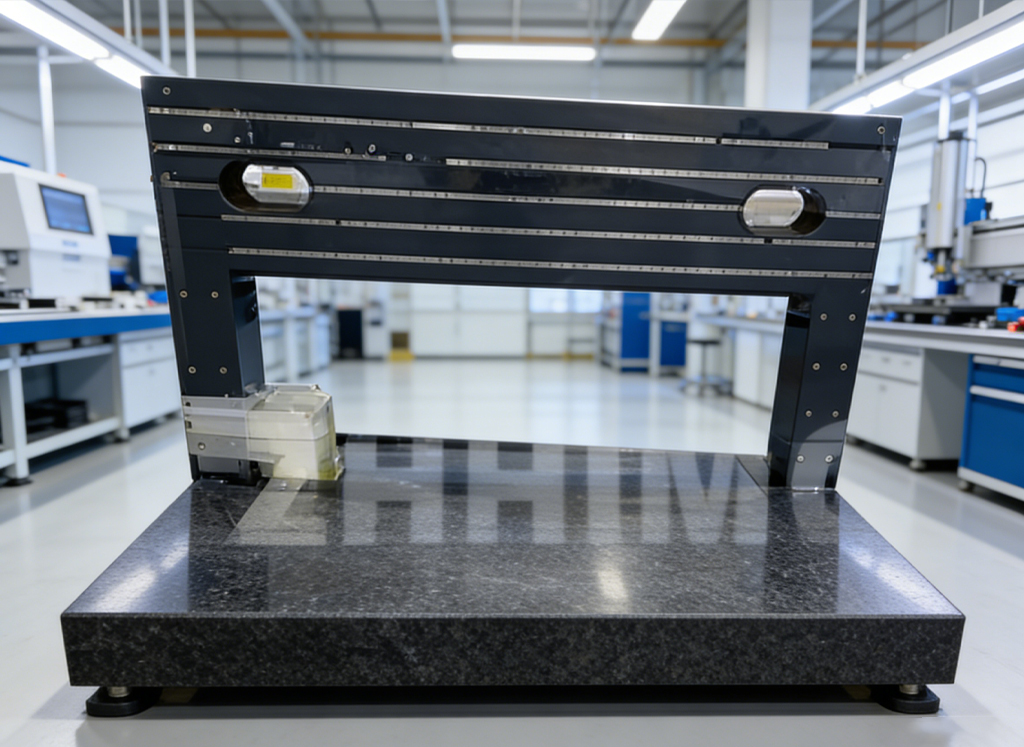
Manufacturing Capabilities for Semiconductor-Grade Components
Ultra-Precision Machining of Large Granite Structures
Semiconductor equipment requires granite components ranging from small mounting blocks to large machine bases exceeding several meters in length. Meeting these requirements demands advanced manufacturing capabilities including:
- Maximum machining dimensions up to 20,000×4,000×1,000mm
- Ultra-large grinding equipment for surfaces up to 6000mm in length
- Temperature-controlled manufacturing environments
- Vibration-isolated production facilities with Seismic Joint design
Surface Finish Requirements for Semiconductor Applications
Semiconductor-grade granite components require surface finishes optimized for their specific applications. Optical reference surfaces demand mirror-quality polishing, while bearing ways require precision-ground surfaces with controlled surface texture.
Modern CNC grinding techniques achieve surface finishes below Ra 0.1μm on critical surfaces, meeting the requirements of the most demanding semiconductor equipment specifications.
H2: Certification Requirements for Semiconductor Industry Suppliers
Essential Quality System Certifications
Semiconductor manufacturers and equipment suppliers require their component vendors to maintain rigorous quality management systems. ISO9001:2015 certification provides the baseline quality management framework, while ISO14001 addresses environmental compliance and ISO45001 ensures workplace safety standards.
Process Control Documentation
Beyond basic certifications, semiconductor industry customers require detailed process control documentation including:
- Incoming material inspection records
- In-process dimension verification data
- Final inspection certificates with measured values
- Calibration records for measurement equipment
- Traceability documentation linking components to material lots
These requirements ensure that any quality issue can be traced to its root cause and that component specifications are maintained throughout the production process.
FAQ: Semiconductor Equipment Granite Applications
Q1: Why is granite preferred over cast iron for semiconductor equipment foundations?
A: Granite offers superior thermal stability (<0.001mm/°C vs ~0.012mm/°C for cast iron), eliminating dimensional drift from temperature changes. Granite’s crystalline structure provides inherent flatness stability without periodic resurfacing. Additionally, granite does not corrode or shed particles, maintaining cleanroom integrity where contamination directly impacts yield.
Q2: What density is required for semiconductor-grade granite components?
A: High-quality black granite for semiconductor applications should have density approximately 3100kg/m³. This density level correlates with fine grain structure, minimal porosity, and superior vibration damping characteristics essential for nanometer-precision equipment.
Q3: How does granite contribute to cleanroom air quality?
A: Unlike metals that can corrode, pit, or shed particles, granite’s crystalline mineral structure remains physically and chemically stable. Granite does not outgas volatile compounds, does not corrode in controlled humidity environments, and generates negligible particles during normal operation. These characteristics make it ideal for semiconductor cleanrooms where particle control is paramount.
Q4: What size granite components can be manufactured for semiconductor equipment?
A: ZHHIMG® manufactures precision granite components up to 20,000×4,000×1,000mm, utilizing Taiwan’s most advanced grinding equipment capable of finishing surfaces up to 6000mm in length. This enables production of large machine bases and foundation elements for semiconductor manufacturing equipment.
Q5: How does thermal stability affect wafer inspection accuracy?
A: Thermal expansion causes dimensional changes that directly impact measurement accuracy. A granite component with thermal coefficient <0.001mm/°C experiences only 10μm of dimensional change across a 10-meter length for a 1°C temperature change. This stability ensures inspection measurements remain accurate despite environmental temperature variations.
Q6: What certifications should semiconductor equipment granite suppliers maintain?
A: Essential certifications include ISO9001:2015 for quality management, ISO14001 for environmental management, ISO45001 for occupational health and safety, and CE marking for European market compliance. Many semiconductor customers also require supplier quality audits and PPAP documentation for custom components.
Conclusion
High-density black granite has earned its position as the material of choice for semiconductor equipment foundations through decades of proven performance in the industry’s most demanding applications. The combination of exceptional thermal stability, superior vibration damping, cleanroom compatibility, and lifetime flatness retention addresses the fundamental requirements of nanometer-precision manufacturing.
When specifying granite components for semiconductor equipment, work with certified manufacturers capable of producing large-scale precision components in controlled environments. Verify manufacturing capabilities including maximum dimensions, surface finish capabilities, and quality documentation systems. The right granite supplier becomes a strategic partner in your equipment development program, providing material expertise and manufacturing capability that enables your precision goals.
The semiconductor industry’s continued advancement toward smaller process nodes will only increase the demand for precision granite components. Selecting suppliers with proven track records, advanced manufacturing capabilities, and comprehensive quality systems ensures your equipment programs have the foundation—literally and figuratively—for success.
Post time: Jun-04-2026