
Structural stability is non-negotiable in ultra-precision manufacturing, especially within sub-micron semiconductor lithography, automated optical inspection (AOI), and coordinate measuring machines (CMM). The foundational base of these machines dictates their ultimate accuracy. While some budget-tier manufacturers substitute industrial granite with commercial-grade marble to reduce costs, this compromise introduces severe metrological risks.
Understanding the mineralogical and physical divergence between true high-density black granite and commercial marble is essential for procurement engineering.
Physical Property Divergence: High-Density Granite vs. Marble
The structural behavior of a machine base depends heavily on density, water absorption, and thermal expansion. The table below outlines the performance delta between proprietary ZHHIMG® Black Granite and standard commercial marble.
| Physical Property | ZHHIMG® Black Granite | Commercial Marble | Impact on Precision Equipment |
| Density | ≈ 3100 kg/m³ | 2600 – 2700 kg/m³ | Higher density ensures superior vibration damping and structural rigidity. |
| Material Class | Igneous (Magmatic) | Metamorphic (Carbonate) | Granite resists wear; marble is prone to scratching and acid etching. |
| Deflection Under Load | Minimal (High Modulus) | High (Prone to sagging) | Marble warps over time under heavy CNC or gantry loads. |
| Internal Stress | Natural aging over millions of years | Prone to micro-cracking | Granite maintains geometric flatness over decades. |
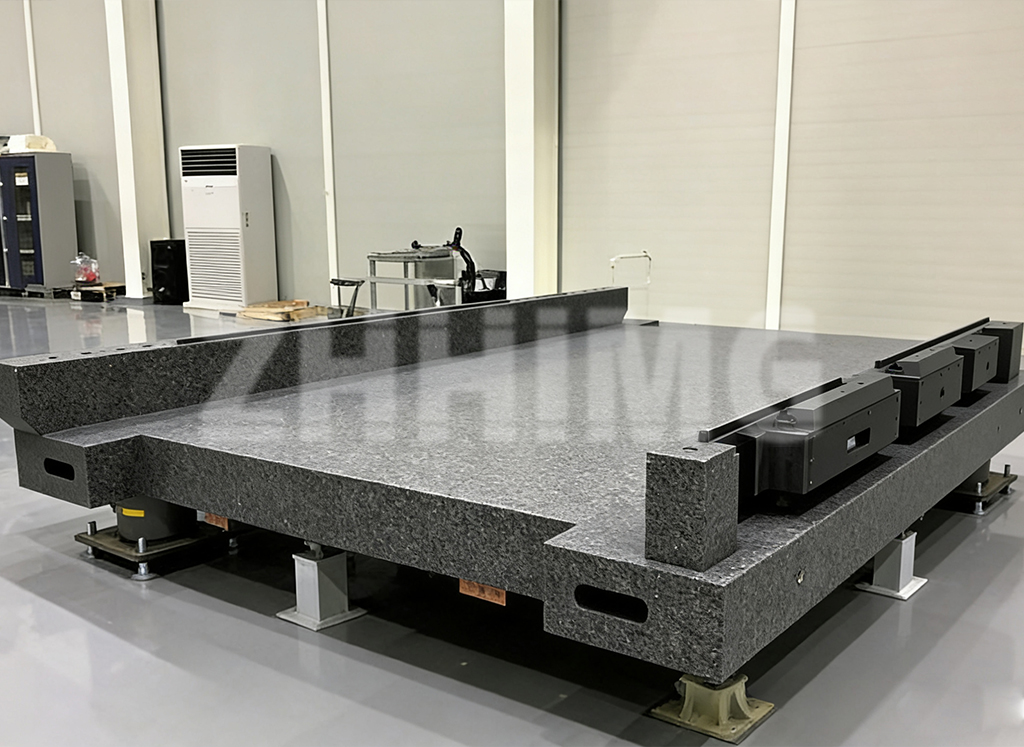
Mineralogical Integrity and Thermal Stability
Commercial marble consists primarily of calcium carbonate (CaCO3). This composition makes it inherently softer, porous, and highly susceptible to ambient environmental changes. When temperature fluctuates within a facility, marble exhibits anisotropic thermal expansion, causing uneven geometric distortion across the machine base.
In contrast, ZHHIMG® Black Granite is an igneous rock formed under extreme pressure deep within the earth’s crust. Its high density of approximately 3100 kg/m³ indicates a tightly interlocked crystalline matrix with near-zero internal stress.
-
Vibration Absorption: High-density granite absorbs high-frequency micro-vibrations generated by linear motors and high-speed XY tables far more effectively than marble.
-
Zero Corrosion: Unlike cast iron or marble, high-density black granite is completely rust-proof and resistant to chemical agents common in cleanrooms.
Eliminating Metrological Deception in the Supply Chain
The industrial precision market has seen a rise in low-cost alternatives where marble is chemically treated or dyed to mimic black granite. For high-speed PCB drilling machines, laser cutting systems, and lithography stages, utilizing these sub-par bases leads to catastrophic structural failures, alignment drift, and lost calibration.
ZHHIMG® maintains a strict policy against material substitution or misleading specifications. Every granite component is extracted from certified geological reserves, ensuring a consistent density of ≈ 3100 kg/m³. This mineralogical purity guarantees that the material can be lapped to nanometer-level flatness without pitting or structural degradation.
Conclusion for Procurement Engineers
Selecting a machine base solely on initial cost is a critical error for ultra-precision applications. Commercial marble lacks the structural rigidity, density, and thermal stability required to support modern semiconductor and optical metrology equipment. High-density black granite remains the global standard for engineering foundations that require lifelong geometric permanence.
Post time: Jun-15-2026