
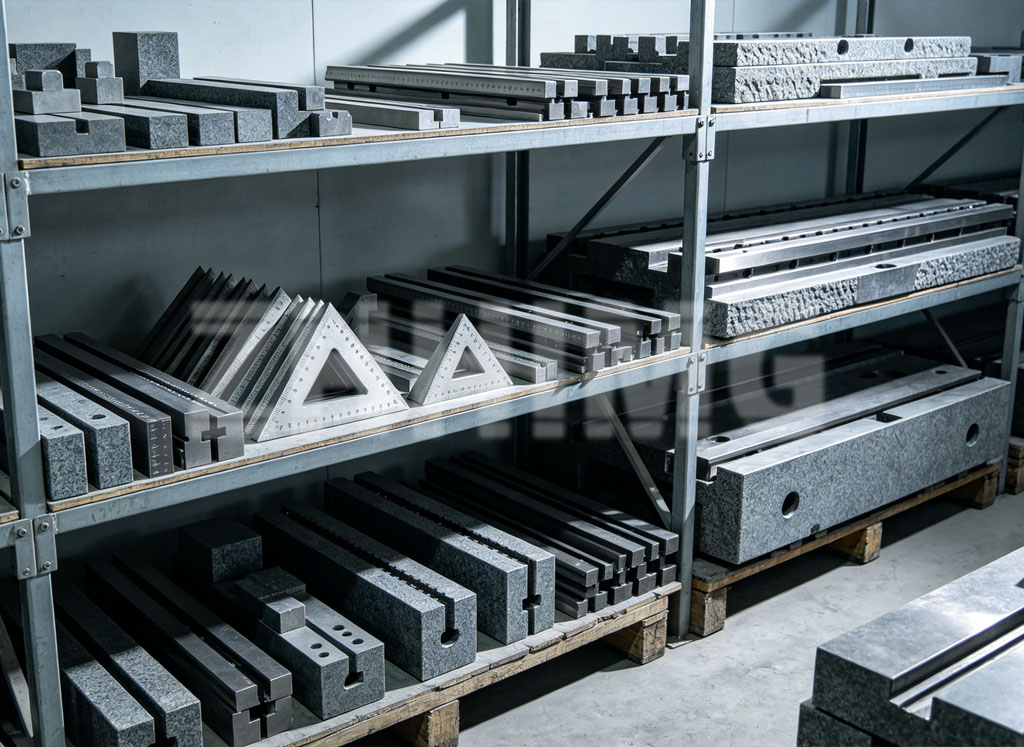
Black granite, specifically Jinan Black Granite, offers unmatched stability for precision measuring equipment. With a density of 3100kg/m³ and near-zero thermal expansion, it ensures higher accuracy than steel or cast iron in industrial metrology.
What are the physical properties of Jinan Black Granite?
Jinan Black Granite is renowned for its extreme hardness and durability. It features a specific density of 3100kg/m³, making it heavier and more stable than standard materials. This density ensures that granite surface plates remain flat under heavy loads without deformation.
Jinan Black Granite is renowned for its extreme hardness and durability. It features a specific density of 3100kg/m³, making it heavier and more stable than standard materials. This density ensures that granite surface plates remain flat under heavy loads without deformation.
How does thermal stability affect measurement accuracy?
Temperature fluctuations are the enemy of precision. Granite has a very low coefficient of thermal expansion. This means precision measuring tools made from granite do not expand or contract significantly with temperature changes, maintaining accuracy in varying factory environments.
Temperature fluctuations are the enemy of precision. Granite has a very low coefficient of thermal expansion. This means precision measuring tools made from granite do not expand or contract significantly with temperature changes, maintaining accuracy in varying factory environments.
Why is granite non-magnetic and rust-proof?
Unlike steel, black granite is completely non-magnetic and impervious to rust. This makes it the ideal material for granite mechanical components used in sensitive electronic manufacturing or humid environments where metal parts would corrode or interfere with magnetic fields.
Unlike steel, black granite is completely non-magnetic and impervious to rust. This makes it the ideal material for granite mechanical components used in sensitive electronic manufacturing or humid environments where metal parts would corrode or interfere with magnetic fields.
Comparison: Granite vs. Cast Iron vs. Steel
| Feature | Black Granite | Cast Iron | Steel |
|---|---|---|---|
| Density | 3100kg/m³ (High Stability) | ~7200kg/m³ | ~7850kg/m³ |
| Thermal Expansion | Extremely Low | Moderate | High |
| Corrosion Resistance | Excellent (Rust-proof) | Poor (Requires coating) | Moderate |
| Magnetism | Non-magnetic | Magnetic | Magnetic |
Frequently Asked Questions (FAQ)
Q1: What is the density of the granite used in your products?
A: Our Jinan Black Granite has a density of 3100kg/m³, ensuring superior stability for precision applications.
A: Our Jinan Black Granite has a density of 3100kg/m³, ensuring superior stability for precision applications.
Q2: Can granite surface plates rust?
A: No. Unlike cast iron, our granite products are naturally rust-proof and resistant to chemical corrosion.
A: No. Unlike cast iron, our granite products are naturally rust-proof and resistant to chemical corrosion.
Q3: Is the material suitable for magnetic environments?
A: Yes, black granite is 100% non-magnetic, making it safe for use with sensitive electronic equipment.
A: Yes, black granite is 100% non-magnetic, making it safe for use with sensitive electronic equipment.
Q4: Where is your granite quarried?
A: We source our raw material from Jinan, Shandong, known for producing high-quality fine-grain black granite.
A: We source our raw material from Jinan, Shandong, known for producing high-quality fine-grain black granite.
Q5: How does temperature affect the accuracy of these components?
A: Granite has a low thermal expansion coefficient, meaning it maintains accuracy even with temperature fluctuations.
A: Granite has a low thermal expansion coefficient, meaning it maintains accuracy even with temperature fluctuations.
Q6: Do you provide certification for the granite flatness?
A: Yes, all our precision measuring equipment
A: Yes, all our precision measuring equipment
Post time: May-28-2026