
In the world of ultra-precision manufacturing—spanning semiconductor lithography, Coordinate Measuring Machines (CMM), optical inspection tools, and high-speed linear motor stages—micro-level stability is the line between a high-yield production run and catastrophic component failure.
When designing or procuring these high-end machines, mechanical engineers and procurement heads face a critical decision regarding the foundation material. While alternative materials frequently enter the market, natural black granite remains the gold standard.
However, a concerning trend has emerged: a growing number of low-cost workshops are quietly substituting industrial-grade black granite with cheaper, commercially available marble to artificially lower their quotes.
Understanding the profound physical, chemical, and structural disparities between these two geological materials is paramount to protecting your machinery—and your business reputation—from costly geometric deformations.
The Structural Reality: Granite vs. Marble
To understand why marble fails in high-precision applications, one must look at its geological formation. Marble is a metamorphic rock formed from the recrystallization of carbonate minerals (like calcite or dolomite) under heat and pressure. It is inherently soft, chemically reactive, and structurally porous.
Granite, conversely, is an igneous rock born from the slow crystallization of molten magma deep beneath the Earth’s crust. It consists primarily of quartz, feldspar, and dark plagioclase minerals. This creates an interlocking crystalline matrix that yields entirely different physical characteristics:
| Physical Property | Industrial Black Granite (ZHHIMG®) | Standard Commercial Marble | Impact on Precision Applications |
| Density | ≈ 3100 kg/m³ | 2500 – 2700 kg/m³ | Higher density directly translates to superior vibration dampening and mass stability. |
| Hardness (Mohs Scale) | 6 – 7 | 3 – 4 | Granite resists scratches, structural wear, and accidental indentation during assembly. |
| Internal Stress | Virtually Zero (Naturally Aged) | High Residual Stress | Marble undergoes micro-deformation over time; granite maintains geometric form for decades. |
| Chemical Resistance | Excellent (Acid & Alkali Resistant) | Highly Vulnerable to Acids | Shop floor coolants or cleaning agents degrade marble rapidly, compromising surface flatness. |
The Hidden Risks of Cheap Marble Substitutes
When low-cost manufacturers cut corners by using marble, the consequences are rarely visible on day one. They manifest weeks or months later on the end-user’s factory floor.
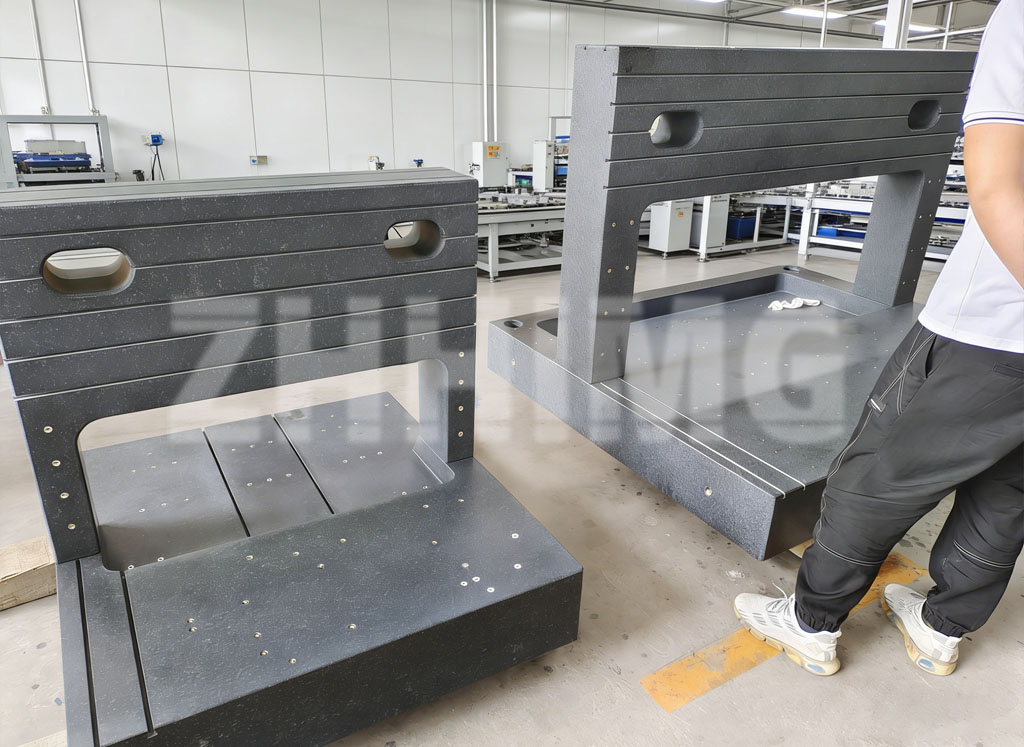
1. Micro-Deformation and Loss of Flatness
Because marble possesses high residual internal stresses and lower structural rigidity, it changes shape over time. A surface plate or machine bed that left the factory with a flatness deviation of 1μm can warp by tens of micrometers after being subjected to the dynamic loads of moving gantries. For a semiconductor AOI (Automated Optical Inspection) system or a femtosecond laser cutting machine, this minor deformation ruins sensor calibration and destroys yield rates.
2. Thermal Expansion Volatility
Precision engineering requires predictable thermal behavior. Marble reacts unpredictably to minor temperature fluctuations, flexing unevenly across its surface area. Industrial-grade black granite has an incredibly low and uniform coefficient of thermal expansion. When paired with high-end metrology components, it guarantees that temperature changes do not translate into measurement or positioning errors.
3. Moisture Absorption and Corrosion
Marble is porous. It absorbs ambient moisture and reacts negatively to industrial solvents, oils, and cutting fluids common in precision CNC machining environments. This absorption causes localized swelling, leading to micro-blistering of the surface. Granite is chemically inert and virtually non-porous, making it immune to environmental degradation.
ZHHIMG® Black Granite: Engineering Beyond the Standard
At ZHONGHUI Group (ZHHIMG®), we believe that the precision business cannot be too demanding. We have established a firm stance against the deceptive practice of mislabeling marble as precision stone.
To deliver on our commitment of No cheating, No concealment, and No misleading, we strictly source proprietary ZHHIMG® Black Granite.
Backed by Comprehensive International Certifications
We do not ask our partners to rely on blind trust. ZHHIMG® is the only manufacturer in the ultra-precision industry to simultaneously hold ISO 9001 (Quality Management), ISO 14001 (Environmental Management), ISO 45001 (Occupational Health & Safety), and CE certifications. Every structural component we ship features complete material traceability, backed by international patents registered across the United States, the European Union, and Southeast Asia.
Whether you require a custom 20-meter single-piece machine bed for a linear motor setup or high-precision granite air bearings, our components are built to resist environmental shifts, damp dynamic vibrations, and preserve sub-micron geometry under structural loads.
Protect Your Machine’s Foundation
Selecting a machine base based solely on the lowest initial bid introduces severe structural vulnerabilities down the line. A precision machine tool or CMM is only as reliable as the stone it rests upon. Insisting on authentic, high-density black granite protects your technology, secures your machine’s lifecycle, and protects your end-users from unpredictable calibration failures.
Need verified material data sheets or custom engineering advice for your next machine base layout?
Post time: Jul-20-2026