
How much does a custom granite machine base cost?
There is no single price that applies to every design. A reliable quotation depends on the complete specification—not just the length, width, and thickness of the granite.
Two bases with similar external dimensions may require different manufacturing routes. One might need a single precision reference surface and a simple mounting pattern. The other might require multiple accurately related mounting faces, stepped features, numerous threaded inserts, and a detailed inspection report.
For equipment builders, the most useful question is therefore not simply, “What is the price per piece?” It is, “What is included in the price, and does it match the requirements of our machine?”
This guide explains eight factors to review when requesting a custom granite machine base quotation and shows you how to prepare an RFQ that suppliers can evaluate accurately.
Quick Overview: What Determines the Price?
| Cost factor | Information to define in your RFQ |
|---|---|
| 1. Material and blank selection | Material specification, required properties, and documentation |
| 2. Size, weight, and geometry | Overall dimensions, openings, pockets, steps, and handling requirements |
| 3. Number of precision surfaces | Functional faces and the relationship between them |
| 4. Tolerances and surface finish | Flatness, straightness, parallelism, perpendicularity, and surface requirements |
| 5. Threaded inserts and mounting features | Thread sizes, quantities, positions, loads, and installation requirements |
| 6. Inspection and documentation | Acceptance criteria, measurement conditions, and required reports |
| 7. Assembly and supplied accessories | Bare component, subassembly, or inspected assembly |
| 8. Packaging and delivery scope | Packaging requirements, destination, and agreed delivery terms |
1. Granite Material and Blank Selection
Material selection is the starting point of a custom granite machine base quotation.
For a precision structural component, the purchasing specification should identify more than the stone’s color. It should clarify the material requirements relevant to the application and any supporting documentation needed for approval.
Questions to resolve include:
- Is a specific granite material required?
- Are material property data or test reports needed?
- Are there restrictions on material defects or repairs?
- Does the design require a particularly large one-piece blank?
- Are cosmetic surfaces subject to separate acceptance criteria?
Density may be one item in a material specification, but it should not be treated as a substitute for a complete performance requirement.
For a straightforward quotation comparison, ask each supplier to identify the proposed material and explain what documentation is included. Otherwise, two quotations may appear comparable while being based on different material assumptions.
2. Overall Dimensions, Weight, and Structural Complexity
Size matters, but the finished component’s volume does not tell the whole story.
The supplier must also consider the starting blank, material removal, machine access, handling, and inspection setup. A simple rectangular base and a heavily featured base of similar external dimensions may require substantially different work.
Features to highlight in the drawing include:
- Large through-openings.
- Deep pockets or recessed areas.
- Raised mounting sections.
- Stepped profiles.
- Cable passages and access slots.
- Narrow sections between openings.
- Features machined from several directions.
Large or heavy components also require an agreed handling approach. Transport dimensions, lifting arrangements, installation access, and support locations should be reviewed before the design is finalized.
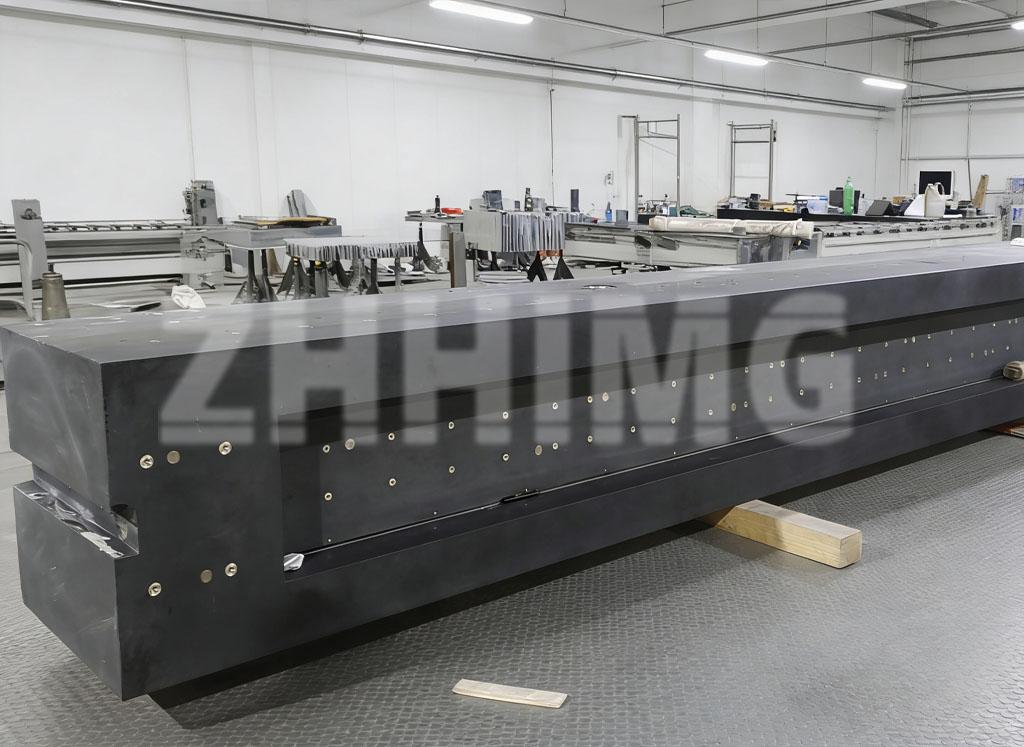
ZHHIMG offers custom granite bases with openings, stepped geometries, mounting faces, and integrated interfaces, with the final configuration defined through drawing review.
How to Keep the Design Cost-Effective
Before requesting a quotation, identify which features are essential to machine function and which are optional.
If a pocket exists only to provide clearance, for example, its dimensions may not require the same control as a guideway mounting surface. Clearly distinguishing those requirements allows the supplier to evaluate the design without assuming that every feature needs precision finishing.
Any proposed change should still be approved by the equipment designer.
3. Number and Arrangement of Precision Surfaces
A granite base with one precision top surface is a different manufacturing task from a component with several precision faces that must maintain defined geometric relationships.
Examples of functional surfaces include:
- Linear guide mounting faces.
- Optical mounting references.
- Column seating faces.
- Stage installation surfaces.
- Vertical alignment faces.
- Stepped reference surfaces at different heights.
The cost depends not only on the area of these surfaces, but also on how they relate to one another and how they can be accessed for finishing and measurement.
A drawing should clearly separate precision functional faces from general surfaces.
For each critical face, identify:
- Its function.
- Its datum relationship.
- Its individual tolerance.
- Any required relationship to another face.
This helps prevent unnecessary precision work on nonfunctional areas while protecting the interfaces that matter to the machine.
4. Geometric Tolerances and Surface Finish
“High precision” is not a complete manufacturing specification.
A supplier needs measurable requirements to determine whether the design is achievable, how it should be manufactured, and how it will be accepted.
Depending on the component, those requirements may include:
- Flatness.
- Straightness.
- Parallelism.
- Perpendicularity.
- Hole location.
- Height differences between mounting surfaces.
- Surface roughness or other surface-condition requirements.
These specifications describe different characteristics. A surface roughness requirement does not replace a flatness requirement, and a general dimensional tolerance does not fully define the alignment of two mounting faces.
Why Tighter Requirements Can Affect the Quote
A more demanding requirement may change the finishing process, measurement method, number of inspection steps, or time needed to demonstrate conformity.
Feasibility also needs to be evaluated against the actual component—not a general claim that every product can achieve the same accuracy.
For example, ZHHIMG’s product information states that achievable flatness depends on the plate’s size, thickness, and support conditions, with the target reviewed before quotation.
A useful specification therefore states both what must be achieved and the conditions under which it will be checked.
5. Threaded Inserts and Mounting Features
Threaded inserts and mounting interfaces are functional parts of the design, not minor details to add after the granite body has been priced.
ZHHIMG’s custom base offerings include bonded threaded inserts and other mounting interfaces, with requirements such as thread size, location, load, torque, and installation condition reviewed during the design stage.
Information to provide includes:
| Item | Details to specify |
|---|---|
| Thread | Metric or imperial designation |
| Quantity | Total number and distribution |
| Location | Dimensions and positional requirements |
| Material | Required insert material, if specified |
| Installation condition | Flush, recessed, or another agreed arrangement |
| Fastening requirement | Engagement length and applicable tightening requirements |
| Loading | Load direction and any required validation |
| Related features | Locating bushings, dowel interfaces, plates, or brackets |
A dense mounting pattern, several insert types, or demanding positional requirements can change the manufacturing and inspection scope.
Do not assume that a larger thread automatically provides an acceptable connection. The insert design, installation, surrounding geometry, and intended load must be reviewed together. ZHHIMG’s product guidance similarly identifies thread size, insert type, embedment depth, and surrounding stone as relevant to connection capacity.
6. Inspection, Acceptance Criteria, and Documentation
An inspection requirement is part of the product specification and should be included in the original RFQ.
If the inspection scope is left until after ordering, the buyer and supplier may have different expectations about how conformity will be demonstrated.
Agree on the following before production:
- Which features will be measured.
- Which drawing revision applies.
- What datum and support arrangement will be used.
- Whether measurement is required before or after assembly.
- What environmental conditions must be recorded or controlled.
- What results must appear in the report.
- Whether the customer has a required report template.
- What instrument calibration documentation is needed.
A basic dimensional report is not necessarily equivalent to a report covering multiple geometric relationships and assembly interfaces. Quotations should state the included scope clearly.
ZHHIMG lists inspection reports, quality documentation, and calibration information for measuring equipment among its available delivery documentation. The exact package should be confirmed for the project.
Match the Inspection to the Supply Scope
If the order covers only the granite component, define acceptance at component level.
If the order includes installed rails, columns, or other hardware, identify which additional relationships must be checked after assembly. Component inspection should not be presented as proof of the complete machine’s positioning performance.
7. Assembly and Additional Supply Scope
A bare granite base and an assembled precision substructure should not be compared as though they are the same product.
Depending on the project, the supply scope may include:
- The granite component only.
- Installed inserts and locating features.
- Support or leveling hardware.
- Columns, beams, or brackets.
- Customer-specified mounting hardware.
- Linear guide installation.
- Assembly alignment and inspection.
ZHHIMG’s published product information includes assembly and calibration with customer hardware, subject to the project requirements.
When requesting this service, clarify:
- Who supplies each component?
- Which part numbers and drawing revisions apply?
- What alignment or assembly criteria must be met?
- Who approves the final inspection results?
- Which adjustments remain the customer’s responsibility after delivery?
An assembly quotation may be higher than a bare-component quotation because it includes additional work and responsibility. Evaluate it against the same scope, rather than comparing the unit prices alone.
8. Export Packaging, Freight, and Delivery Terms
The quoted component price is not always the final cost of receiving the base at your facility.
Depending on the agreed terms, additional items may include:
- Export packaging.
- Inland transport.
- International freight.
- Insurance.
- Customs-related charges.
- Import duties and taxes.
- Destination handling.
- Unloading and movement to the installation location.
Some of these charges may be included in the supplier’s quotation; others may remain with the buyer or logistics provider.
For large precision components, provide the delivery location and relevant receiving constraints early. These may include unloading equipment, access dimensions, and any packaging restrictions.
Ask the supplier to state the delivery term, named location, and included services explicitly. This makes quotations easier to compare and helps avoid treating an ex-factory component price as a delivered project cost.
Why Two Similar Granite Bases Can Receive Different Quotes
Consider this hypothetical comparison. It illustrates scope differences, not actual ZHHIMG pricing.
| Requirement | Base A | Base B |
|---|---|---|
| External dimensions | Similar overall size | Similar overall size |
| Geometry | Simple rectangular structure | Steps, pockets, and a large opening |
| Precision faces | One primary functional face | Several related functional faces |
| Mounting features | Limited insert pattern | Multiple insert patterns and locating interfaces |
| Inspection | Agreed component checks | Expanded geometric and interface inspection |
| Supply scope | Granite component | Component plus assembly work |
Even with similar external dimensions, Base B represents a different manufacturing and verification task.
The purpose of a detailed RFQ is to make those differences visible before the order—not after delivery.
How to Reduce Unnecessary Cost Without Compromising Function
The goal is not to remove requirements that the machine genuinely needs. It is to avoid paying for requirements that do not serve its function.
Define Critical and Noncritical Features
Identify which surfaces control alignment, measurement, or motion performance. Apply appropriate requirements to other areas rather than extending the tightest tolerance across the entire component.
Submit a Consistent Drawing Package
Provide a dimensioned 2D drawing and, where available, a matching 3D model. Confirm that the revision numbers, units, materials, and notes agree.
Finalize Mounting Interfaces Early
Confirm insert patterns, rail interfaces, locating features, and access requirements before releasing the order.
Agree on Inspection Before Production
Define acceptance criteria, support conditions, and reporting requirements at quotation stage.
Include Delivery Requirements in the RFQ
A technically complete drawing does not replace information about packaging, destination, unloading, and installation constraints.
Request a Manufacturability Review
Ask whether any features could be simplified without changing the required function. Any modification should be documented and approved before manufacture.
RFQ Checklist for a Custom Granite Machine Base
Use the following checklist when preparing your inquiry.
| Category | Information to provide |
|---|---|
| Application | Machine type and the base’s function |
| Drawing package | Dimensioned PDF and available CAD files |
| Revision | Current drawing and model revision |
| Dimensions | Overall size and major structural features |
| Material | Required specification and documentation |
| Precision faces | Clearly identified functional surfaces |
| Tolerances | Dimensional and geometric requirements |
| Surface requirements | Finish and edge requirements where applicable |
| Inserts | Thread, material, quantity, location, and loading information |
| Support conditions | Intended support and inspection arrangement |
| Assembly | Hardware and alignment work included in the request |
| Inspection | Acceptance criteria and report requirements |
| Quantity | Prototype quantity and expected repeat demand |
| Schedule | Requested delivery date |
| Logistics | Destination and preferred delivery terms |
If the design is still preliminary, state which requirements are confirmed and which remain open. This helps the supplier distinguish an initial budget estimate from a production-ready quotation.
Frequently Asked Questions
Can you quote from overall dimensions alone?
Overall dimensions can support an initial discussion, but they do not define the full manufacturing scope. A project-specific quotation also needs information about geometry, tolerances, mounting features, inspection, quantity, and delivery.
Why is there no standard price per kilogram?
Weight does not capture precision finishing, feature complexity, insert installation, inspection, or assembly. It can be relevant to material handling and logistics, but it is not a complete basis for pricing a custom precision component.
Does every surface need the same precision?
No. The drawing should define requirements according to function. A guideway mounting face, a reference face, and an external clearance surface may have different requirements.
Can ZHHIMG manufacture a base from customer drawings?
Yes. ZHHIMG’s published service scope includes custom granite components manufactured from customer drawings and CAD files, with review of material, datums, mounting interfaces, tolerances, and inspection requirements before production.
Can the order include assembly with linear guides?
ZHHIMG offers assembly, calibration, and inspection services with customer hardware. The supplied parts, alignment criteria, and final acceptance scope should be confirmed during quotation.
Request a Project-Specific Granite Machine Base Quote
A useful quotation should explain what will be supplied, how the specified requirements will be verified, and what is included in the delivery scope.
ZHHIMG® provides custom precision granite bases with machined mounting faces, openings, threaded inserts, and other interfaces defined around the application.
For a project review, send:
- Your 2D drawing and available 3D model.
- Overall dimensions and quantity.
- Critical tolerances and surface requirements.
- Threaded insert and mounting details.
- Assembly and inspection requirements.
- Delivery destination and requested schedule.
Start with the requirements that matter to your machine. A clear specification is the foundation of a quotation you can evaluate with confidence.
Post time: Nov-06-2026