
Why Precision Equipment Manufacturers Are Quietly Switching Away From Cast Iron
If you’ve spent any time sourcing base structures for coordinate measuring machines, semiconductor handling systems, or laser alignment platforms, you’ve probably run into the same question from your engineering team: granite, cast iron, or marble — and does it actually matter which one you pick?
It matters more than most procurement checklists suggest. The base of a precision system isn’t a passive support structure. It’s part of the measurement chain. Choose wrong, and you’ll spend months chasing “phantom” accuracy drift that has nothing to do with your sensors or software — and everything to do with what the machine is sitting on.
The problem with cast iron: it never really stops moving
Cast iron has been the default choice in machine tool bases for over a century, mostly because of tradition and machinability. But cast iron carries residual internal stresses from the casting process, and those stresses release slowly over years — sometimes decades — causing gradual, unpredictable deformation. A cast iron base that measured flat on the day it shipped can be measurably out of tolerance five years later, with no external damage at all.
Cast iron also has a coefficient of thermal expansion around 10-12 µm/m·°C, which means a 1°C temperature swing across a 1-meter base can shift dimensions by 10-12 microns. In a climate-controlled metrology lab that’s manageable. On a factory floor with HVAC cycling, door traffic, and equipment heat load, it’s often the single biggest source of measurement uncertainty.
Why marble shows up in cheap quotes — and why that should worry you
Marble occasionally gets substituted into granite specifications because it’s cheaper and superficially similar in appearance — dark, hard-looking, stone. The problem is structural. Marble is a metamorphosed sedimentary rock, typically with a crystalline density in the 2,600-2,700 kg/m³ range and a more porous, less uniform grain structure than igneous granite. It absorbs moisture more readily, has lower compressive strength, and is more prone to micro-fracturing under repeated thermal or mechanical cycling.
For a decorative countertop, none of this matters. For a base plate expected to hold nanometer-level flatness over ten or fifteen years of production use, it does. If a supplier’s quote for a “granite” precision base comes in dramatically below market and won’t share density or hardness test data, that’s usually the first thing to check.
What high-density granite actually does differently
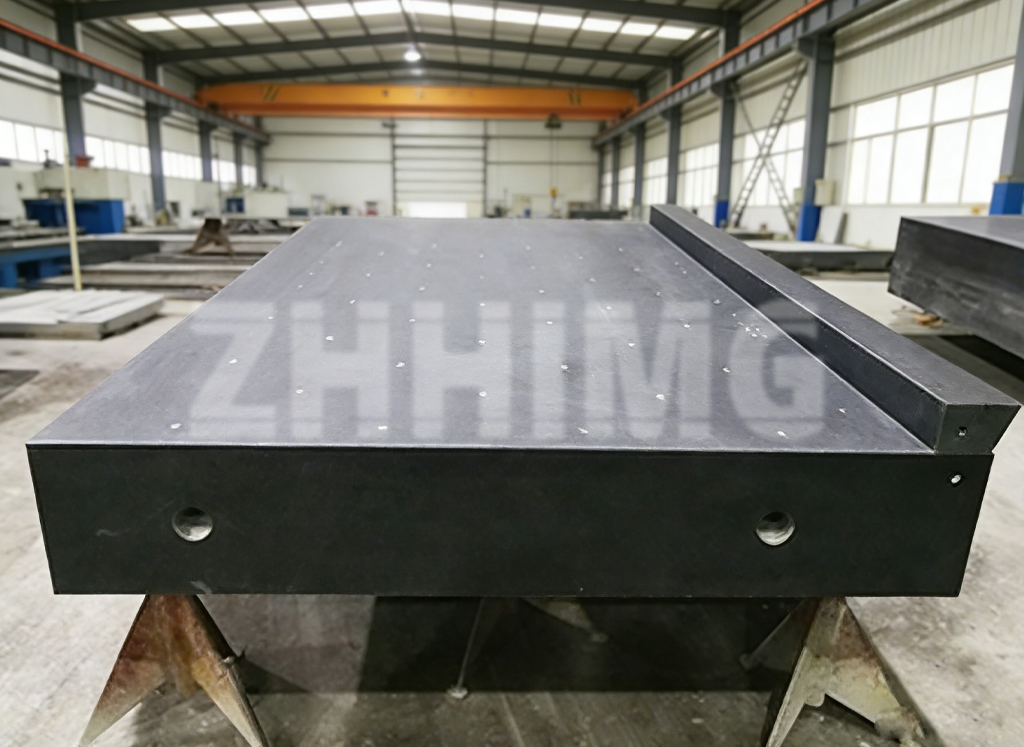
Precision-grade black granite typically runs a density around 3,100 kg/m³ — noticeably denser than both marble and many commercial granite grades used in construction. Density correlates directly with two things engineers care about: vibration damping and long-term dimensional stability. A denser, more homogeneous crystalline structure resists both micro-deformation under load and the kind of resonance that shows up as noise in high-resolution measurement systems.
Granite also has a thermal expansion coefficient roughly 4-8 µm/m·°C depending on composition — often less than half that of cast iron. That difference alone can meaningfully reduce thermal drift error in systems like CMMs, AOI inspection platforms, and semiconductor wafer-handling stages, where the entire point of the equipment is measuring things that are smaller than the error budget.
Because granite doesn’t carry casting stress, it also doesn’t creep the way cast iron does. A properly aged and stress-relieved granite base that’s flat today will, barring physical damage, still be flat in fifteen years.
Where the choice actually matters — and where it doesn’t
Not every application needs precision granite. If you’re building a general-purpose fixture or a low-tolerance jig, cast iron’s machinability and lower upfront cost can be the right call. But for applications where sub-micron stability is the actual product requirement — CMMs, laser interferometry setups, semiconductor lithography and inspection tools, air bearing stages, optical comparators — the base material isn’t a line item you optimize for cost. It’s the foundation your accuracy spec is built on.
A quick checklist before you sign off on a base material
- Ask for actual density test data, not just “granite” on the spec sheet — commercial and precision grades vary significantly
- Check whether the supplier can provide flatness certification traceable to a national or accredited metrology institute
- For cast iron, ask how long the casting was aged/stress-relieved before final machining — this affects long-term stability
- Match the thermal expansion coefficient to your operating environment, not just your lab environment
- If cost seems unusually low for “granite,” ask directly whether it’s been tested against marble substitution — reputable suppliers will have this data ready
The base plate is easy to overlook in a procurement process focused on sensors, software, and moving parts. But in precision measurement, the thing that doesn’t move is just as important as the thing that does.
Post time: Jul-22-2026