
The Synergy of Air Bearings and Precision Granite
Frictionless Motion for Ultra-Precision Systems
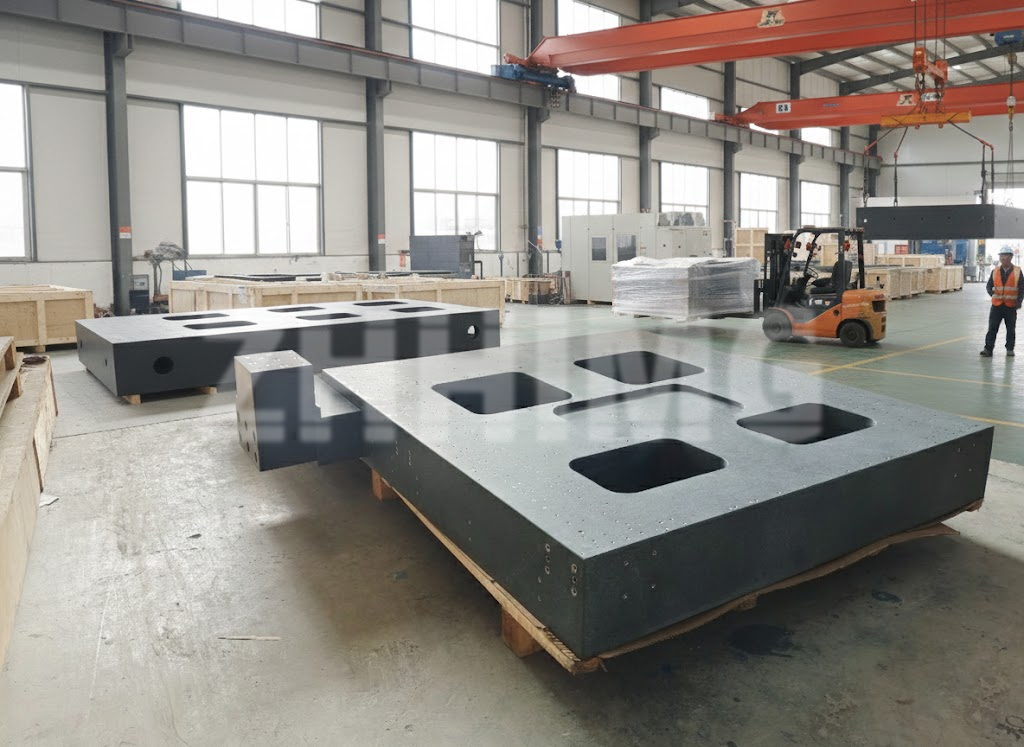
Traditional mechanical guide rails suffer from wear, friction, and heat generation during high-speed travel. ZHHIMG® precision granite beams with engineered air bearing holes allow components to float on a thin film of compressed air. This frictionless movement removes mechanical backlash, allowing smooth, uninterrupted sub-micron positioning.
Unrivaled Flatness Over Extended Travel Lengths
An air bearing requires an incredibly flat counter-surface to function correctly. Our master craftsmen process granite beams to achieve a flatness straightness within 1 to 2 microns per meter. This absolute precision prevents air film collapse, ensuring consistent floating heights across the entire linear stage axis.
Elimination of Wear and Maintenance Downtime
Because there is no direct physical contact between the moving gantry and the granite guide surface, zero mechanical wear occurs during operation. This extends the lifetime of semiconductor and coordinate measuring machines indefinitely. It eliminates the need for hazardous lubrication oils, keeping cleanrooms perfectly sterile.
Exceptional Stability Under Dynamic Dynamic Loads
Accelerating linear motors place heavy moment loads on support beams. The massive structural rigidity of our high-density black granite resists structural deflection under dynamic forces. This ensures that the air gap remains uniform, preventing geometric errors during high-speed scanning and laser cutting.
Guide Rail Systems Performance Comparison
| Performance Metric | ZHHIMG® Granite Air Bearing | Standard Steel Linear Guide | Cast Iron Slideway |
| Friction Coefficient | ~ 0 | 0.002 – 0.005 | 0.05 – 0.10 |
| Wear & Degradation | None (Zero Contact) | Moderate Wear | High Wear Over Time |
| Lubrication Required | None (Clean Air Only) | Continuous Greasing | Regular Oil Lubrication |
| Positioning Resolution | Nanometer-Level | Sub-Micron | Micrometer-Level |
| Straightness Over 1m | < 0.002 mm | 0.010 mm | 0.020 mm |
FAQ
Q1: How does a granite air bearing system work?
A1: Clean compressed air is supplied through precisely machined air bearing holes in the granite component. This creates a highly pressurized, uniform air film that lifts the moving stage micro-inches above the granite surface.
Q2: Why is granite preferred over metal for manufacturing air bearing beams?
A2: Metal surfaces warp due to internal stress and thermal changes, which can distort the thin air gap. ZHHIMG® black granite provides perfect dimensional stability, keeping the air gap completely uniform.
Q3: What happens if dust enters a frictionless air bearing system?
A3: The continuous outbound flow of compressed air acts as a natural seal, constantly blowing away microscopic dust particles from the precision guiding surfaces to prevent clogging.
Q4: What are the flatness requirements for an effective granite air bearing beam?
A4: To maintain a stable air film, the granite surface must have a flatness and straightness variance of less than 2 microns. This requires expert hand-lapping by experienced technicians.
Q5: Can ZHHIMG® integrate custom inserts into air bearing structures?
A5: Yes. We install high-precision stainless steel or brass threaded inserts directly into the granite. This allows you to bolt down linear motors and encoder scales securely.
Q6: Are ZHHIMG® air bearing components compatible with Renishaw encoder systems?
A6: Absolutely. Our granite beams are engineered to provide the stable, ultra-flat foundation required for Renishaw laser interferometers and linear encoders to read data with absolute precision.
Post time: Jun-03-2026