
A granite machine base delivers superior thermal stability and vibration damping compared to cast iron, making it the preferred choice for coordinate measuring machines requiring sub-micron accuracy. While cast iron offers lower initial cost, granite’s near-zero thermal expansion coefficient (<0.001mm/°C) and natural vibration damping properties ensure long-term flatness retention in precision metrology environments. For CMM applications demanding nanometer-level repeatability, granite is the engineering choice backed by ISO 9001:2015 certified manufacturers.
1. Understanding the Material Physics: Why Granite Outperforms Cast Iron
The fundamental difference between granite and cast iron lies in their molecular structure and thermal behavior. Cast iron, an iron-carbon alloy, experiences significant dimensional changes with temperature fluctuations—a critical flaw in precision measurement applications. In contrast, granite, a natural igneous rock composed primarily of quartz, feldspar, and hornblende, demonstrates exceptional dimensional stability across temperature ranges.
Granite’s thermal expansion coefficient of <0.001mm/°C means that even a 10°C environmental shift causes virtually imperceptible movement in a granite machine base. This characteristic is paramount for CMM operations in facilities without climate control or those experiencing seasonal temperature variations. Cast iron, by comparison, exhibits thermal expansion rates approximately 3-4 times higher, which translates to measurable errors in high-precision measurements.
The natural crystalline structure of granite also provides inherent vibration damping properties. When vibrations from floor traffic, HVAC systems, or nearby machinery reach a granite base, the energy dissipates through the interlocking mineral crystals. Cast iron, being metallic, tends to transmit vibrations rather than absorb them—a phenomenon known as “ringing” that can introduce measurement noise and reduce CMM repeatability.
2. Long-Term Stability and Total Cost of Ownership
While cast iron machine bases typically carry a lower upfront price tag, the total cost of ownership analysis strongly favors granite. Cast iron surfaces are susceptible to corrosion, particularly in facilities with humidity fluctuations or proximity to coastal environments. This corrosion not only affects measurement accuracy but also requires ongoing maintenance and surface re-grinding.
Granite machine bases, when properly maintained, retain their nanometer-level flatness indefinitely. The non-ferrous nature of granite means it will not rust or corrode, even in challenging environmental conditions. This zero-maintenance characteristic, combined with granite’s documented lifespan exceeding 50 years without significant degradation, makes it a one-time investment that pays dividends through decades of reliable service.
Precision metrology facilities including those serving aerospace, automotive, and semiconductor sectors have increasingly standardized on granite as their primary base material. The cost savings from eliminated maintenance, reduced calibration frequency, and extended equipment service life collectively justify the higher initial investment in quality granite components.
3. Grade Classifications and Performance Specifications
Understanding granite grade classifications is essential for selecting the appropriate machine base for your CMM application. The ISO 9001:2015 certified manufacturers offer three primary grades that correspond to different precision requirements:
|
Grade |
Flatness Tolerance |
Application Range |
| Grade 00 | ≤0.5μm/m | Reference standards, calibration laboratories, research institutions |
| Grade 0 | ≤1μm/m | Production CMMs, high-precision inspection, semiconductor wafer measurement |
| Grade 1 | ≤2μm/m | General-purpose measurement, large-scale inspection, quality control |
The flatness tolerance is expressed as micrometers per meter (μm/m), meaning that a Grade 00 granite surface plate maintains its specified flatness regardless of size. For a 2000mm long surface plate, Grade 00 guarantees flatness within 1μm across the entire surface—a specification that cast iron cannot reliably achieve or maintain.
Material density also plays a crucial role in vibration damping performance. Premium Jinan Black Granite features density approaching 3,100 kg/m³, providing substantial mass for absorbing mechanical vibrations without transmitting them to sensitive measurement equipment. This high-density characteristic makes granite machine bases particularly effective in production environments with heavy machinery operating nearby.
4. Environmental Factors and Facility Considerations
Modern manufacturing facilities present unique challenges for precision measurement equipment. Floor vibrations from CNC machines, injection molding equipment, or material handling systems can compromise CMM accuracy if the machine base cannot effectively isolate the measurement system from these disturbances.
Granite’s natural microstructure creates a damped system that attenuates vibrations across a wide frequency range. This vibration damping capability is particularly valuable in multi-story facilities where foot traffic and building structure vibrations are unavoidable. Cast iron bases, lacking this natural damping, require additional isolation systems that add cost and complexity to the CMM installation.
Thermal gradients within facilities present another significant challenge. Direct sunlight, proximity to loading docks, HVAC vent positioning, and equipment heat generation can create temperature variations that affect measurement accuracy. A granite machine base’s near-zero thermal expansion coefficient minimizes these environmental impacts, allowing CMMs to maintain specified accuracy across varying operating conditions without constant recalibration.
5. Industry Applications and Case References
The precision metrology sector has extensively documented the advantages of granite over cast iron for CMM applications. Major coordinate measuring machine manufacturers, including global suppliers to the aerospace and automotive industries, have standardized on granite machine bases as original equipment specifications.
Semiconductor wafer inspection systems represent one of the most demanding applications for precision positioning and measurement. These systems require vibration damping and thermal stability characteristics that only premium granite components can reliably provide. The air bearing platforms used in wafer inspection equipment typically mount directly to granite bases that must maintain sub-micron flatness over areas exceeding several square meters.
Medical device manufacturing, particularly for orthopedic implants and precision surgical instruments, similarly demands granite-based measurement solutions. The combination of strict dimensional tolerances, cleanroom requirements, and regulatory compliance documentation has driven adoption of granite machine bases as the foundation for metrology systems in this highly regulated industry.
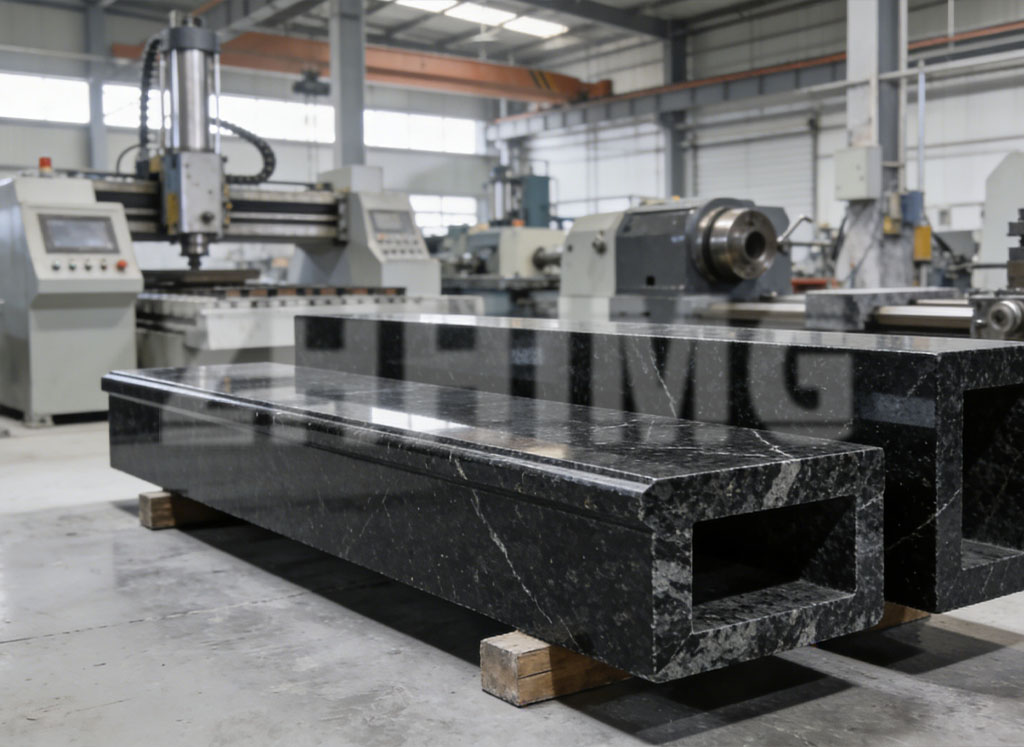
Case Study: Aerospace Component Inspection
A leading aerospace manufacturer transitioning from cast iron to granite CMM bases documented measurable improvements in inspection throughput and repeatability. The facility, operating 24/7 in an unconditioned building, experienced cast iron base expansion/contraction cycles that required multiple daily recalibrations. Following granite base installation, recalibration frequency dropped to monthly intervals, freeing operator time and reducing measurement uncertainty contributions from equipment drift. First-pass yield on inspected components improved by 12% as measurement variability decreased.
6. Installation Best Practices for Maximum Performance
Proper installation ensures granite machine bases deliver their full potential. Even the finest granite component will underperform if mounted incorrectly or on inadequate foundations.
Surface preparation begins with verifying the supporting structure’s flatness and rigidity. The mounting surface must be level to within 0.1mm/m and capable of supporting the granite base without deflection. Concrete foundations should cure for minimum 28 days before granite installation to prevent settling-related stresses.
Three-point support systems provide optimal load distribution and vibration isolation. The three contact points should be positioned at locations calculated to minimize deflection under expected loading—typically at positions dividing the base into equal thirds. Leveling pads at each support point allow fine adjustment to achieve precise horizontal alignment.
Thermal isolation from heat sources prevents localized heating that could create thermal gradients within the granite base. Position granite-mounted equipment away from direct sunlight, HVAC vents, and heat-generating machinery. If thermal isolation is impractical, consider installing thermal barriers between heat sources and granite components.
Grounding and electrical bonding may be required for CMMs with electrical components or static-sensitive measurement systems. Consult your equipment manufacturer for specific grounding requirements and ensure grounding connections do not create vibration transmission paths through mounting hardware.
Frequently Asked Questions
How long does a granite machine base maintain its flatness specification?
A properly maintained granite machine base will retain its specified flatness tolerance for decades, often exceeding 50 years of service life. Unlike cast iron, granite does not require periodic re-grinding to maintain accuracy, provided it is protected from impact damage and contamination.
What size granite machine bases can manufacturers produce?
ISO certified manufacturers with advanced capabilities can produce granite machine bases up to 20,000 × 4,000 × 1,000mm. For exceptionally large CMM installations, these bases can be manufactured in modular sections that are precisely matched for seamless integration.
Can granite machine bases be customized for specific CMM models?
Yes, reputable granite manufacturers offer custom machining services including precision-machined mounting holes, T-slots, threaded inserts, and datum reference features. Custom configurations are standard practice for OEM applications serving major CMM manufacturers.
What certifications should a granite machine base supplier hold?
Essential certifications include ISO 9001:2015 for quality management, ISO 45001 for occupational health and safety, and ISO 14001 for environmental management. Additional compliance with ISO/IEC 17025 indicates calibration laboratory capability for metrology-grade components.
How does granite’s vibration damping compare to engineered composites?
Natural granite provides vibration damping characteristics that compare favorably with mineral casting and composite materials. The crystalline microstructure efficiently converts mechanical vibration energy into heat through internal friction, without the potential delamination or material aging concerns associated with some composite alternatives.
What maintenance is required for granite machine bases?
Granite requires minimal maintenance compared to cast iron. Regular cleaning with non-abrasive materials, periodic verification of mounting hardware tightness, and protection from heavy impact loads are the primary maintenance requirements. No corrosion prevention or surface re-grinding is necessary under normal operating conditions.
Ready to Upgrade Your CMM Foundation?
Selecting the right machine base material is a foundational decision that impacts measurement accuracy, equipment longevity, and total cost of ownership for decades. ZHHIMG® is the only manufacturer in this industry sector holding simultaneous ISO 9001:2015, ISO 45001, ISO 14001, and CE certifications.
Our precision granite machine bases are manufactured using 30+ years of hand-lapping expertise, achieving flatness tolerances down to 0.5μm/m (Grade 00) with maximum dimensions reaching 20,000mm. Monthly production capacity of 20,000 units (at 5000mm specification) ensures reliable supply for OEM and replacement applications.
Contact our engineering team today to discuss your CMM base requirements. We provide factory-direct pricing, custom manufacturing capabilities, and technical support for precision metrology applications worldwide.
Post time: Jun-02-2026